
TweakTown reported the Radeon addition on August 3, while Club386 described the broader AMD-and-NVIDIA expansion. The official HWiNFO version history now confirms both sets of changes, but it also corrects an important point in the early coverage: NVIDIA support is specified for GPUs using GDDR6X or GDDR7, not all GDDR6-based GeForce cards.
For Windows users troubleshooting a card after a repaste, thermal-pad replacement, cooler swap, or long high-load session, that limitation and the beta status matter. The new readings can make a physical cooling problem visible; they do not, by themselves, establish that a card is overheating or justify immediately opening hardware that remains under warranty.
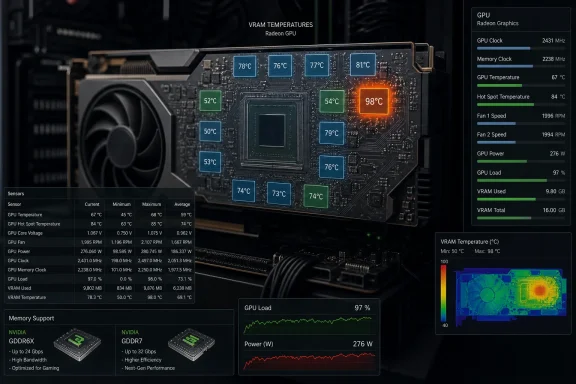 HWiNFO’s current beta has moved past the build cited in early reports
The original NVIDIA additions arrived in HWiNFO v8.51 build 6040, released July 28, 2026. That build introduced GPU hot-spot reporting for NVIDIA Blackwell and per-chip VRAM temperature monitoring for NVIDIA cards with GDDR6X and GDDR7 memory. HWiNFO credited Paulo Gomes and Igor Wallossek of Igor’sLAB for discovery and assistance with the NVIDIA telemetry work.
AMD Navi per-chip monitoring appeared in a later v8.51 beta revision. As of August 4, HWiNFO’s own download page offers v8.51-6045 as the portable beta, while the normal installer and portable stable downloads remain on v8.50, released July 8.
That sequencing is more than a version-number nitpick. A reader who installs the stable release today will not receive the new Radeon memory-chip sensors, and a reader who grabs an older 8.51 beta may receive the RTX 50 hot-spot work but not the Navi addition. The practical instruction is simple: verify the build number is 6045 or later, launch HWiNFO’s Sensors window, and check whether the card exposes the added fields.
HWiNFO has not said when these beta functions will move into a stable release. It also has not published a compatibility table tying each sensor layout to specific Radeon board designs, laptop implementations, or AIB models. “AMD Navi GPUs” is the official scope; it is not the same thing as a guarantee that every board in every Radeon product family will present every new sensor in identical form.
The meaningful Radeon change is visibility into the outlier
A conventional GPU memory temperature reports one value. That can be useful for routine monitoring, but it is a poor diagnostic tool when a cooler contacts eight, 10, or more individual memory packages. A single reported maximum can tell an owner that memory is warm, but it cannot identify whether the temperature is spread uniformly across the card or concentrated at one chip near a weak pad, imperfect mounting pressure, or a localized airflow problem.
Per-chip telemetry changes that. If every package runs within a narrow range under a sustained workload, the memory cooling system is behaving consistently. If one package stands significantly above the others, the problem becomes specific enough to investigate: a shifted thermal pad, uneven thermal putty application, a warped cold plate, a missing pad, a cooler remounted incorrectly, or—in a laptop—an assembly limitation that software cannot solve.
The new data is particularly useful after maintenance. Replacing pads and repasting a GPU has always involved an uncomfortable blind spot: the core might look fine, the card might avoid throttling, and the only memory value might still look broadly acceptable while one IC is hotter than its neighbors. HWiNFO now offers a way to compare the chips under the same load rather than treating the highest reading as a black box.
There is a useful correction to make here. Club386 wrote that previous memory readings did not reveal whether they were an average, hot spot, or arbitrary sensor. HWiNFO’s developer, Martin Malík, had already addressed the Radeon RX 9000-series memory-temperature field in the company forum in March 2025, saying it should be the highest temperature among the VRAM modules. In other words, the prior Radeon value was not useless or random: it was effectively a worst-case indicator. Per-chip reporting gives users the distribution behind that maximum.
That is why the addition is genuinely practical, rather than simply another crowded row in a monitoring panel. The maximum tells an owner whether there may be a problem. The individual readings tell them where to look.
AMD’s implementation details remain undisclosed
HWiNFO’s release notes say only that per-chip VRAM temperature monitoring has been added for “AMD Navi GPUs.” They do not explain whether the tool is reading existing temperature registers supplied by AMD’s management firmware, using a mechanism newly exposed in drivers, or handling different Navi generations through separate methods.
TweakTown noted the same omission and suggested that the close timing of NVIDIA and AMD support invited questions about the discovery process. The record supports a narrower conclusion: HWiNFO has documented the feature’s availability, but not the technical path that made it possible. There is no evidence in the public notes that AMD newly enabled these readings in a Radeon Software driver, nor that the values require a third-party mod.
That absence of detail should temper some of the grander interpretations of the update. A new HWiNFO field does not necessarily mean each Radeon board has gained new sensors. It means the current beta can retrieve and label additional data on supported hardware. The difference is important for IT staff and repair shops trying to build repeatable procedures: software availability, firmware capability, board design, and sensor accuracy are separate questions.
Club386 also reported that the RX 9070 XT may show two temperature readings for each of its eight memory channels or chips. That specific behavior has not been described in HWiNFO’s public release notes, and no second independent outlet has confirmed its exact meaning. Treat it as an interesting implementation detail on that model, not a standard readers should expect across every Radeon card.
NVIDIA support is narrower than “all RTX 30 and later”
The NVIDIA portion of the story has been muddled by fast-moving coverage. HWiNFO’s official July 28 announcement specifically says per-chip VRAM temperature support covers NVIDIA GPUs with GDDR6X and GDDR7. Its current version-history page uses the same GDDR6X/GDDR7 wording.
Club386’s broader claim that all GDDR6 and GDDR7-equipped NVIDIA cards are included goes beyond that official scope. The distinction excludes ordinary GDDR6 GeForce models from a blanket support claim, even where they belong to RTX 30-, 40-, or 50-series product lines. Architecture labels alone are not enough; the memory type is the relevant divider in HWiNFO’s stated support.
That reflects the unusual circumstances around NVIDIA telemetry this summer. Reporting by Tom’s Hardware and VideoCardz documented how developers and researchers found ways to obtain Blackwell hot-spot and granular memory data despite NVIDIA not exposing those readings through its standard public monitoring interfaces. The work has spread into tools including HWiNFO, HWMonitor, AIDA64, and community modifications for MSI Afterburner.
The hot-spot field deserves separate caution. HWiNFO’s build 6040 release notes call it “GPU Hot Spot Temperature” for Blackwell, but early analysis reported multiple plausible internal temperature channels and uncertainty over how some tools should interpret them. The availability of a reading is valuable; it does not erase the need to compare behavior across sustained loads, fan speed, ambient temperature, power limit, and clock behavior before declaring a hardware fault.
How to use the new readings without creating a false alarm
Per-chip VRAM data is best treated as diagnostic context, not as a leaderboard. The useful test is a repeatable, sustained workload—such as a long game benchmark loop, rendering job, or compute task—after the card has reached thermal equilibrium. Capture the GPU core temperature, hot-spot temperature where applicable, fan speed, board power, ambient room temperature, and each VRAM channel’s current and maximum values.
A quick checklist is enough:
- Use HWiNFO v8.51-6045 or a newer beta, because v8.50 stable does not yet include the listed Radeon per-chip addition.
- Compare memory chips under the same load rather than comparing idle readings or values collected from different games.
- Look for a persistent outlier, especially one that rises well beyond adjacent packages as load continues.
- Preserve a sensor log before changing pads, paste, fan curves, or power limits, so there is a baseline for comparison.
- Do not disassemble an in-warranty GPU solely because one new telemetry field looks surprising.
The immediate consequence is that Radeon owners have a more defensible way to distinguish a genuinely uneven memory-cooling result from a card whose single “Memory Temperature” value merely represents the hottest otherwise normal package. For NVIDIA owners, HWiNFO’s beta expands access to similarly granular data only on the GDDR6X and GDDR7 cards HWiNFO has named. The remaining milestone is a stable HWiNFO release—and, more importantly, vendor documentation that explains what these newly visible sensors actually measure and how users should interpret them.
Update: RX 9070 XT owner reports a 7.4°C per-chip VRAM spread (August 4, 2026)
VideoCardz reports that an ASUS Prime Radeon RX 9070 XT OC owner has tested HWiNFO v8.51-6045’s new per-chip sensors under load and observed a 7.4°C gap between the coolest and hottest memory packages at roughly 29°C ambient temperature.
The card had modified memory cooling using thermal putty rather than its stock pads, so the result is not a baseline for retail RX 9070 XT boards. The owner reported lower overall VRAM temperatures after the modification, but the individual readings still varied noticeably. A separate owner reportedly saw one package reach 90°C while neighboring packages remained in the 86°C-to-88°C range.
These are user reports, not controlled testing, but they provide an early practical example of what the new sensor layout can reveal: an uneven temperature distribution that a single memory-junction maximum would obscure. A several-degree spread alone is not proof of a defect; component placement, airflow, cooler pressure, and thermal-interface contact can all contribute.
