
For Windows PC enthusiasts, builders, and gamers, Core 2 Duo was more than a new CPU badge. It was the architecture that made an affordable dual-core system feel transformative, helped normalize quieter and cooler desktop hardware, and established the design principles—strong instructions-per-clock performance, careful power management, scalable multicore designs, and cache efficiency—that would echo through Intel’s later Core generations.
 The launch that ended Intel’s GHz obsession
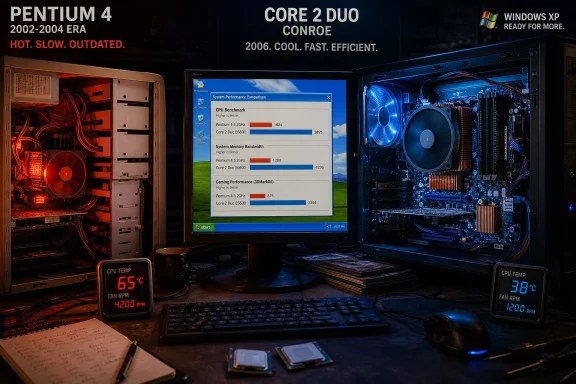
The Core 2 Duo launch happened at the end of a difficult era for Intel. Through much of the early 2000s, the company had pursued the NetBurst design philosophy behind Pentium 4 and Pentium D: long pipelines, escalating clock rates, and aggressive marketing around megahertz and gigahertz. The basic message to consumers had been simple—more GHz meant more speed.
That message became increasingly untenable.
Higher clock speeds came with substantial costs. NetBurst processors, particularly the later Pentium 4 and Pentium D parts, were associated with high thermal output, heavy cooling requirements, and an efficiency profile that compared poorly with AMD’s Athlon 64 and Athlon 64 X2 families. AMD had turned that weakness into a competitive advantage, winning substantial enthusiast goodwill through better per-clock performance, compelling 64-bit support, and strong gaming results.
Intel’s answer was not a faster Pentium D. It was a strategic reversal.
The Core microarchitecture, which powered Core 2 Duo, placed performance per clock and performance per watt above raw frequency. Intel had previewed the direction earlier in 2006, describing a processor strategy built on the energy-conscious ideas of Pentium M while extending them across desktop, mobile, and server products. The company explicitly positioned the design around “energy-efficient performance,” rather than around ever-higher clock speeds. Intel’s March 2006 architectural preview stated that Conroe was expected to provide roughly a 40% performance improvement and a 40% reduction in power compared with the Pentium D 950, though that was an Intel estimate based on its selected testing methodology.
That distinction matters. Core 2 Duo did not win because it had the highest frequency. It won because it accomplished more work at each clock cycle.
The launch transformed a common purchasing habit. A buyer comparing a 3.6 GHz Pentium D with a 2.4 GHz Core 2 Duo could no longer assume the higher-frequency part was quicker. In many workloads, the opposite was true—and often by a wide margin.
The July 27, 2006 Core 2 Duo lineup
Intel formally unveiled 10 Core 2 Duo and Core 2 Extreme processors on July 27, 2006. The release covered five desktop products and five mobile chips, allowing Intel to push the same architectural story through enthusiast desktops, business systems, notebooks, and workstations. Intel’s launch release also said that more than 550 customer system designs were already in development, an indication of how broadly OEMs had committed to the platform.
For desktop builders, the initial Conroe lineup was especially memorable:
| Processor | Clock speed | L2 cache | Front-side bus | Launch price |
|---|---|---|---|---|
| Core 2 Extreme X6800 | 2.93 GHz | 4 MB | 1066 MT/s | $999 |
| Core 2 Duo E6700 | 2.66 GHz | 4 MB | 1066 MT/s | $530 |
| Core 2 Duo E6600 | 2.40 GHz | 4 MB | 1066 MT/s | $316 |
| Core 2 Duo E6400 | 2.13 GHz | 2 MB | 1066 MT/s | $224 |
| Core 2 Duo E6300 | 1.86 GHz | 2 MB | 1066 MT/s | $183 |
Those original model specifications and 1,000-unit prices came directly from Intel’s launch material. Intel’s product table shows just how aggressively Intel covered the market, from the $183 E6300 to the flagship $999 X6800.
Why the E6600 became the enthusiast favorite
While the Core 2 Extreme X6800 carried the prestige halo, the Core 2 Duo E6600 became the chip many enthusiasts remember most fondly. At $316, it combined a 2.4 GHz clock speed with 4 MB of L2 cache—half the price of the E6700, yet based on the same essential design.
That pricing was central to Core 2 Duo’s legend. Intel did not restrict the architectural breakthrough to a narrow ultra-premium niche. The company placed the E6300 and E6400 within reach of mainstream builders, while the E6600 offered a compelling high-performance option without the extreme-edition tax.
The result was a rare alignment of factors:
- A large architectural leap
- Competitive mainstream pricing
- Strong gaming performance
- Substantially improved power behavior
- A receptive enthusiast ecosystem
- Motherboards and memory platforms ready for overclocking
In practical terms, Core 2 Duo made the Windows desktop feel faster in the workloads people actually used: game frame rates, media encoding, multitasking, productivity software, file compression, and general system responsiveness. It was a much more persuasive upgrade than a small percentage gain on a benchmark chart.
Conroe’s real breakthrough: IPC, cache, and efficiency
The most important Core 2 Duo specification was not its clock speed, cache capacity, or process node in isolation. It was the combination of architectural changes that improved instructions per clock, commonly abbreviated as IPC.
Intel’s Core microarchitecture included several elements that were designed to improve how efficiently the CPU found, scheduled, executed, and fed instructions.
Wide Dynamic Execution
Intel’s Wide Dynamic Execution allowed each core to complete up to four full instructions simultaneously through a 14-stage pipeline. Intel’s Core architecture description framed this as a direct route to higher performance and better energy efficiency.
The shorter pipeline was a major philosophical break from the Pentium 4 approach. NetBurst’s deep pipelines were intended to support extremely high frequencies, but they made branch mispredictions expensive. When a processor guessed the wrong direction of a branch, a long pipeline could waste a significant amount of work before recovery.
Core 2 Duo’s more balanced pipeline design made it possible to sustain strong performance without chasing frequencies that were increasingly impractical from a thermal and electrical perspective.
Smart Memory Access
A powerful execution engine is not enough if it spends too much time waiting for memory. Intel’s Smart Memory Access technology was designed to better hide memory latency and improve use of available data bandwidth. Intel described the feature as a way to get data to the processor “when and where it is needed.”
That language was marketing-friendly, but the underlying issue was real. Modern processors are often limited not by their ability to execute instructions, but by their ability to keep execution resources supplied with useful data. Conroe’s refinements in memory ordering, prefetch behavior, and cache management helped it convert its theoretical execution advantages into visible application performance.
Advanced Smart Cache
Core 2 Duo’s shared L2 cache was also important. Rather than giving each core a completely separate L2 cache, Intel designed Advanced Smart Cache so either core could draw on the shared pool as needed. Intel argued that this reduced unnecessary memory traffic and let one active core access more cache capacity when the other core was idle. Intel’s technical overview identified shared L2 cache as a feature intended to improve both performance and power use.
In the original desktop range, the cache divide was meaningful:
- The E6300 and E6400 included 2 MB of L2 cache.
- The E6600, E6700, and X6800 included 4 MB of L2 cache.
At the time, cache size could make a material difference in certain games, encoding workloads, and demanding desktop applications. The E6600’s 4 MB cache was one reason it became such a common recommendation in 2006 and 2007.
Advanced Digital Media Boost
The architecture also accelerated many 128-bit SSE, SSE2, and SSE3 operations by allowing them to execute in one cycle. Intel called this Advanced Digital Media Boost, positioning it as particularly useful for multimedia and graphics-oriented workloads. Intel’s launch documentation stated that the feature effectively doubled execution speed for relevant instructions.
This was a fitting capability for the era. Digital photo editing, DVD encoding, video playback, music management, early HD media workflows, and PC gaming were all becoming more important parts of the Windows experience. Core 2 Duo arrived precisely when consumer PCs were becoming genuine media machines rather than primarily document and web terminals.
How Core 2 Duo dethroned AMD’s Athlon 64
It is easy to forget just how strong AMD’s position was before Conroe.
The Athlon 64 had succeeded where prior AMD generations often struggled: it was not merely a lower-cost alternative to Intel. It was frequently the enthusiast performance choice. AMD’s Athlon 64 FX chips held a powerful reputation in gaming, while Athlon 64 X2 established AMD as a credible—and in many situations superior—dual-core option.
Intel itself acknowledged the competitive reality in its 2006 annual report, identifying AMD as its primary microprocessor competitor and stressing that its ability to compete depended on bringing products with improved performance and energy efficiency to market at competitive prices. Intel’s 2006 annual report makes clear that the company saw performance, price, and power efficiency as inseparable competitive requirements.
Core 2 Duo changed the balance quickly because it attacked AMD’s strengths directly.
AMD had been particularly formidable in:
- Gaming performance
- Desktop responsiveness
- 64-bit consumer computing
- Dual-core value
- Performance at relatively moderate clock speeds
Conroe answered with higher IPC, strong dual-core execution, excellent gaming results, lower power consumption relative to Intel’s outgoing products, and a product ladder that made the architecture accessible at multiple price points.
Tom’s Hardware’s retrospective notes that early testing characterized the Core 2 Duo as a processor family capable of outperforming the Athlon 64 X2 and FX range across the board, including gaming—an area where AMD had traditionally been especially strong. Tom’s Hardware’s 20th-anniversary account captures why the launch was treated as a genuine reversal rather than a routine generational refresh.
The price war was part of the victory
Core 2 Duo’s impact was amplified by pricing pressure.
AMD responded to the looming launch with sharp reductions across its desktop CPU lineup. That did not erase the strength of Athlon 64 hardware, but it demonstrated how rapidly Conroe had changed the competitive calculus. When a rival is cutting prices before a product reaches broad retail availability, the market has already absorbed the message delivered by reviews, system builders, and OEM roadmaps.
For consumers, this was excellent news. Competition produced better value on both sides, while Intel’s architectural reset forced a new performance baseline for mainstream PCs.
For AMD, however, the challenge was more difficult. It had to compete against a processor family that was not simply quicker in selected tasks but more efficient in the broad, balanced workload mix that defined desktop computing.
The Windows PC impact: faster, quieter, and more capable systems
The Core 2 Duo era aligned neatly with a changing Windows landscape.
Windows Vista was approaching, 64-bit computing was gaining relevance, HD media was becoming more common, and software increasingly expected PCs to juggle multiple applications at once. Intel promoted Core 2 Duo systems for everything from business management features to content creation and notebook battery life. Intel’s launch announcement highlighted 64-bit support, virtualization technology, and compatibility with Windows Vista Premium Ready chipset platforms.
Some of that platform marketing has aged poorly. Intel Viiv, for example, never became a consumer brand with the lasting cultural impact of Centrino or Core. Yet the broader platform story was correct: a CPU upgrade was no longer only about opening one application faster. It was about making a Windows PC more fluid while multiple workloads competed for processor time.
A Core 2 Duo system could more comfortably handle combinations that had previously felt punishing:
- Browsing while downloading files
- Running antivirus scans during everyday work
- Encoding video while managing other applications
- Playing games while voice chat and background utilities ran
- Editing photos or video while maintaining a responsive desktop
- Using early 64-bit editions of Windows with more practical headroom for future software
The architecture’s improved efficiency also influenced desktop design. The Pentium D era had made CPU cooling a prominent concern, especially for performance systems. Core 2 Duo did not eliminate heat, but it made it easier to build capable PCs without treating the processor as a small space heater.
That mattered for manufacturers as well as enthusiasts. Lower cooling demands could support quieter systems, smaller form factors, less aggressive fan profiles, and potentially more attractive notebook designs. Intel’s pre-launch messaging explicitly connected the architecture to faster, smaller, quieter systems with longer battery life and lower electrical demand. Intel’s 2006 Core microarchitecture announcement made performance-per-watt the central promise.
Core 2 Duo and the road to quad-core computing
Core 2 Duo’s legacy was not limited to two-core PCs. It was also the foundation for Intel’s next major mainstream push: Core 2 Quad.
Intel formally introduced the first mainstream-branded Core 2 Quad processor, the Q6600, on January 8, 2007. Intel’s CES 2007 announcement described the move as an expansion of quad-core PCs toward mainstream buyers, with the Q6600 running at 2.4 GHz and carrying 8 MB of L2 cache.
The Q6600’s eventual reputation was enormous, particularly after later price reductions. But the important point is that Core 2 Quad existed because Conroe was scalable. Intel could extend the same successful architectural formula into four-core configurations, giving users a tangible reason to think about thread-heavy applications, content creation, encoding, and future game engines.
This was not the beginning of multicore computing—dual-core products already existed—but it was a major moment in making multicore performance feel both desirable and attainable for ordinary PC builders.
Intel’s own 2007 material emphasized that the company was working with software developers to improve threading in applications and next-generation games. The Core 2 Quad launch release pointed to media-intensive software such as Adobe After Effects, Premiere Pro, Windows Media Encoder, and other parallel-friendly programs as obvious beneficiaries.
The transition was gradual. Many Windows applications and games remained highly dependent on one fast core, a fact that remains relevant even in modern PC performance analysis. But Core 2 Duo’s strong single-threaded output ensured that the multicore transition did not force users into a compromise. It delivered excellent responsiveness immediately while offering a path toward more threaded computing.
The limits of the legend
Calling Core 2 Duo legendary does not require treating it as flawless.
The original Conroe platform still used a front-side bus, a design that would later become a constraint as processor cores, memory demands, and graphics workloads evolved. Intel’s subsequent Nehalem generation would move toward an integrated memory controller and more modern interconnect architecture, addressing limitations that Core 2-era systems could not fully escape.
Core 2 Duo also arrived in an ecosystem where performance depended heavily on motherboard quality, chipset selection, memory configuration, BIOS maturity, and cooling. Enthusiasts remember the era partly because overclocking was so rewarding, but that same characteristic meant results could vary sharply between systems.
There was also a broader industry risk in Intel’s return to dominance. Core 2 Duo was so successful that it helped establish a long period in which Intel often held the consumer CPU performance narrative. Strong competition is healthier for buyers than a market with one unquestioned leader. AMD’s eventual Ryzen resurgence would later reintroduce pressure around core counts, platform features, pricing, and architectural innovation.
Still, those caveats reinforce rather than diminish the historical importance of Conroe. A processor launch can be technically impressive without reshaping the market. Core 2 Duo did both.
Why Core 2 Duo still matters 20 years later
The Core 2 Duo anniversary is a useful reminder that the best CPU launches do not necessarily produce the largest number on a specification sheet. The defining quality of Conroe was balance.
Intel combined:
- High IPC
- Competitive clock speeds
- Improved power efficiency
- A scalable multicore architecture
- A practical price ladder
- Strong support from PC makers
- Clear benefits for Windows users
The most lasting lesson was architectural. A processor cannot rely indefinitely on frequency growth to create compelling performance gains. Eventually, efficiency, cache behavior, execution width, memory access, branch prediction, and software scaling matter more. Core 2 Duo made that reality unmistakable for mainstream PC buyers.
Intel’s own launch claim of up to 40% more performance and more than 40% better energy efficiency should be read as vendor-provided comparative positioning rather than a universal result for every workload. The company’s launch release tied those figures to its previous best processor and selected comparison conditions. Yet independent enthusiasm, rapid market response, and AMD’s immediate competitive pressure demonstrated that the underlying story was real: Core 2 Duo represented a major generational leap.
Two decades later, the processors themselves belong in retro builds, vintage Windows gaming rigs, and hardware collections rather than modern daily-driver PCs. But the importance of Intel Core 2 Duo has not faded. It marked the moment Intel stopped trying to win the GHz race and started winning the architectural one—and in doing so, it reset expectations for every mainstream desktop CPU that followed.
