
Intel has documented five Core Ultra Series 3 “Panther Lake” processors aimed at embedded and industrial deployments, extending its 25W mobile platform into systems that may need to run continuously in harsh environments. As first reported by VideoCardz, the newly listed parts carry unusual HR, HRE and RE suffixes rather than appearing in Intel’s standard consumer laptop lineup.
The processors are the Core Ultra X7 358HR, Core Ultra 7 366HRE, Core Ultra 7 365RE, Core Ultra 5 336HRE, and Core Ultra 5 335RE. Each is listed with 25W base power and Intel vPro support, positioning them for managed edge PCs, factory systems, transportation hardware, medical devices, and similar long-lifecycle installations rather than mainstream notebooks.
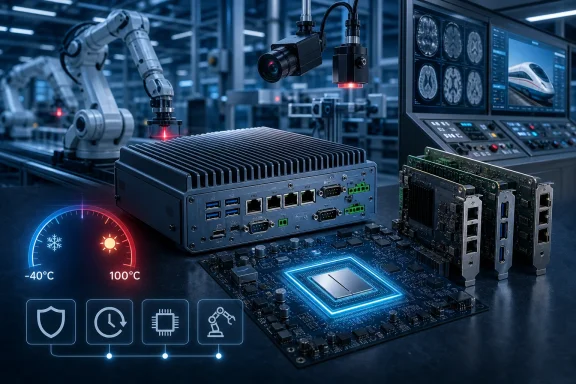
Intel’s current naming material identifies H as a high-performance mobile class and E as embedded, but does not fully define R for the Core Ultra Series 3 family. However, older HRE naming has been used for Industrial Extended Temperature products, and Intel’s edge documentation says qualifying Series 3 processors can operate across a -40°C to 100°C range.
That makes the new suffixes a practical procurement distinction. A conventional Core Ultra H processor may offer comparable compute resources, but an industrial-qualified derivative is built around validation, availability and environmental requirements that ordinary laptop platforms do not have to meet.
Intel also promotes up to 10 years of product availability and continuous-operation support for selected industrial edge products. For OEMs building a robotics controller or a fixed-function Windows device, that can matter more than a modest peak-clock advantage.
The remaining four processors use four Xe graphics cores. The 366HRE carries 16 CPU cores, while the 365RE and 335RE have eight cores; the 336HRE has 12 cores. Intel’s guide also lists 20 PCIe lanes for the four HRE/RE parts, compared with 12 lanes for the 358HR, a split that could be significant for industrial boards needing storage, networking, machine-vision cameras, data-acquisition hardware, or expansion modules.
Intel has not yet published final clocks for the five models. Their quick-reference entries still use placeholder “x.x GHz” values, so system builders should not infer final performance or turbo behavior from the core counts alone.
Intel has already placed the Core Ultra X7 358HR in Open Edge Platform requirements, while industrial module vendors have begun referencing Panther Lake derivatives in product documentation. That suggests the rollout is moving from platform planning toward real embedded designs, even if Intel has not yet issued individual ARK pages or full specifications.
The important next milestone is Intel’s release of final frequencies, memory support, graphics details and lifecycle terms for each SKU. Until then, the HR and RE models are best understood as industrial-qualified Panther Lake variants, not a separate consumer processor family.
The processors are the Core Ultra X7 358HR, Core Ultra 7 366HRE, Core Ultra 7 365RE, Core Ultra 5 336HRE, and Core Ultra 5 335RE. Each is listed with 25W base power and Intel vPro support, positioning them for managed edge PCs, factory systems, transportation hardware, medical devices, and similar long-lifecycle installations rather than mainstream notebooks.
The suffixes matter more than a new SKU count
Intel’s current naming material identifies H as a high-performance mobile class and E as embedded, but does not fully define R for the Core Ultra Series 3 family. However, older HRE naming has been used for Industrial Extended Temperature products, and Intel’s edge documentation says qualifying Series 3 processors can operate across a -40°C to 100°C range.That makes the new suffixes a practical procurement distinction. A conventional Core Ultra H processor may offer comparable compute resources, but an industrial-qualified derivative is built around validation, availability and environmental requirements that ordinary laptop platforms do not have to meet.
Intel also promotes up to 10 years of product availability and continuous-operation support for selected industrial edge products. For OEMs building a robotics controller or a fixed-function Windows device, that can matter more than a modest peak-clock advantage.
One model keeps the full Arc B390-class graphics configuration
The Core Ultra X7 358HR is the standout part in the group. VideoCardz reports that it combines 16 CPU cores with 12 Xe graphics cores, aligning it closely with the consumer Core Ultra X7 358H and its Intel Arc B390-class integrated graphics configuration.The remaining four processors use four Xe graphics cores. The 366HRE carries 16 CPU cores, while the 365RE and 335RE have eight cores; the 336HRE has 12 cores. Intel’s guide also lists 20 PCIe lanes for the four HRE/RE parts, compared with 12 lanes for the 358HR, a split that could be significant for industrial boards needing storage, networking, machine-vision cameras, data-acquisition hardware, or expansion modules.
Intel has not yet published final clocks for the five models. Their quick-reference entries still use placeholder “x.x GHz” values, so system builders should not infer final performance or turbo behavior from the core counts alone.
Windows edge systems gain another path to Panther Lake
For Windows administrators, the immediate news is not a new retail CPU to seek out. These processors will likely arrive inside purpose-built systems and modules, where hardware vendors control firmware, operating-system images, drivers and support lifecycles.Intel has already placed the Core Ultra X7 358HR in Open Edge Platform requirements, while industrial module vendors have begun referencing Panther Lake derivatives in product documentation. That suggests the rollout is moving from platform planning toward real embedded designs, even if Intel has not yet issued individual ARK pages or full specifications.
The important next milestone is Intel’s release of final frequencies, memory support, graphics details and lifecycle terms for each SKU. Until then, the HR and RE models are best understood as industrial-qualified Panther Lake variants, not a separate consumer processor family.
References
- Primary source: videocardz.com
Published: 2026-07-30T10:30:12+00:00
- Related coverage: newsroom.intel.com
Intel Unveils Panther Lake Architecture: First AI PC Platform Built on 18A - Intel Newsroom
Panther Lake will enter high-volume production at Intel’s newest fab in Arizona later this year as the company invests in strengthening U.S. technology and manufacturing leadership.newsroom.intel.com - Related coverage: tomshardware.com
Intel Nova Lake leak points to Core Ultra Series 400 branding, staggered release next year — hotly anticipated flagship 52-core desktop CPU might not arrive until late 2027 | Tom's Hardware
A huge leap for desktop processors incoming?www.tomshardware.com - Related coverage: intc.com
- Related coverage: download.intel.com
- Related coverage: intel.com