
The commitment came from Robert Hallock, Intel’s vice president and general manager for the enthusiast channel business, in an interview reported by Tom’s Hardware. Hallock described Raptor Lake as a core part of Intel’s portfolio for years to come, said LGA 1700 remains a viable socket, and promised that pricing should “smooth out” as supply catches up. iXBT.games reported the comments as Intel returning the Core i5-14600K and other popular models to stores, but Intel has not announced a new product launch, a relaunch date, a formal SKU list, or a price cut.
For builders, that difference matters. This is an availability pledge, not a new Raptor Lake generation. Anyone delaying a DDR4 build should not treat it as confirmation that a particular chip will be in stock next week, or that its price will return to the lows seen before the shortage.
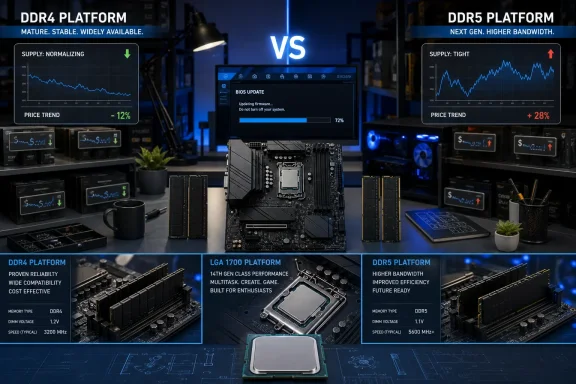 The shortage has made LGA 1700 relevant again
Raptor Lake’s renewed appeal has little to do with novelty. Intel’s current desktop platform moved on to DDR5-only systems, but Raptor Lake covers both DDR4 and DDR5 through LGA 1700 motherboards. In a market where memory pricing and availability have pressured entry-level and mainstream PC budgets, that compatibility gives system integrators and upgraders a way to reuse existing DDR4 kits rather than buy a new CPU, motherboard, and expensive DDR5 memory at once.
Intel officially identifies the Core i5-14600K as a 14th-generation Raptor Lake processor launched in the fourth quarter of 2023; 13th-generation desktop Raptor Lake chips arrived a year earlier. These are mature products with mature board firmware, broad cooler support, and a large used-parts market. For an office PC, a midrange gaming machine, or a workstation whose applications favor CPU cores more than memory bandwidth, those characteristics are practical advantages.
But “supports DDR4 and DDR5” needs careful reading. One motherboard uses one memory standard. An LGA 1700 board is built either for DDR4 DIMMs or DDR5 DIMMs; it does not let a builder install both types of desktop memory in the same system. Some board vendors have sold DDR4 and DDR5 versions of the same motherboard family, and Intel has pointed to more such platform options as a bridge for price-sensitive buyers. That is flexibility at the product-line level, not interchangeable memory slots on one board.
Tom’s Hardware reported that the Core i5-14600K, which had sold for around $200 or less for much of the previous year, had climbed to roughly $250 when stock could be found. It also found the Core i7-14700K selling above its earlier street price or unavailable at major retailers. Hallock attributed the mismatch to a sudden, unanticipated rush into older Intel platforms as buyers sought the lowest total platform cost.
That explanation is plausible, but it does not erase the commercial consequence: a supposed budget fallback stops being one if CPU scarcity eats the savings from DDR4. A $250 14600K paired with an overpriced legacy motherboard is a less compelling proposition than the same chip at its earlier discount pricing.
Intel has promised supply normalization, not a product roadmap
Hallock’s language was deliberately broad. Intel plans to keep offering Raptor Lake and expects price and inventory conditions to return toward normal, according to the interview. What it did not say is how much additional silicon it will allocate, which models will be prioritized, which regions will receive them first, or when retail availability will improve.
That omission is material for PC buyers. Desktop processors travel through Intel’s distributors, system builders, board partners, and retailers before a DIY customer sees a listing marked in stock. A public commitment to more supply does not guarantee that every Core i5-14600K, Core i7-14700K, or Core i9 model returns in equal quantities. It also does not guarantee a return to prior sale prices if upstream component costs remain elevated.
There is a related, still-unconfirmed story that should not be confused with Hallock’s comments. Tom’s Hardware reported in June that Intel could introduce a “Raptor Lake Next” desktop refresh in early 2027, reportedly under Core 200 branding and retaining LGA 1700 and DDR4 support. Hallock did not confirm that product family in the newer interview. Until Intel publishes product names, specifications, launch timing, and board compatibility details, it remains reporting about a potential refresh rather than an announced solution to the current shortage.
That distinction also means the iXBT report’s reference to Intel “following AMD’s example” is more commentary than a confirmed parallel strategy. AMD has used older AM4 products to maintain lower-cost desktop options, but Intel has not announced an equivalent, named long-term legacy-platform program. It has said that Raptor Lake will remain available.
The Core i5-14600K is useful, but it is not a risk-free default
The Core i5-14600K remains attractive because it combines six Performance cores with eight Efficient cores, for 14 physical cores and 20 threads, while retaining DDR4 support. It has enough CPU throughput for modern games, streaming, code compilation, and broadly capable desktop productivity work. It is also compatible with a huge number of existing LGA 1700 boards after the appropriate BIOS update.
Yet this is also a 13th/14th-generation desktop family that carries an unavoidable support history. Intel’s current support guidance says some 13th- and 14th-generation desktop processors were affected by the Vmin Shift instability issue. Intel recommends current BIOS firmware with Microcode 0x12F or later and relevant Intel Default Settings, and it has extended warranty coverage for eligible affected processors by two years, up to five years from the original purchase date.
A buyer should therefore avoid treating “new sealed stock” as an excuse to skip setup work. The sensible process for any 13th- or 14th-generation desktop build is straightforward:
- Update the motherboard BIOS before serious use, using the manufacturer’s latest stable release that includes Intel’s current microcode guidance.
- Load Intel Default Settings rather than relying on an old vendor performance preset with unrestricted power behavior.
- Confirm that the particular board is a DDR4 model before ordering memory, because similarly named board families often have separate DDR4 and DDR5 versions.
- Compare the completed platform cost, including board, RAM, cooler, and warranty terms, rather than judging value from the CPU price alone.
For existing LGA 1700 owners, Intel’s decision is more useful than it is for people assembling a completely new machine. An owner of a compatible DDR4 board can often move from a Core i3 or older Core i5 to a 14600K-class processor without replacing memory or the motherboard. That is where sustained availability would create real value: it keeps a viable upgrade route open while newer platform costs remain high.
Nova Lake is still on the schedule, but it serves another buyer
Intel is not positioning renewed Raptor Lake availability as a delay to Nova Lake. Hallock told Tom’s Hardware that the newer architecture remains on course, while also arguing that the PC market is splitting between premium systems and mainstream systems constrained by component costs.
That creates a clearer product division than Intel has usually acknowledged. Nova Lake is expected to carry the newer-platform message, while LGA 1700 and Raptor Lake could become the price-controlled option for builders who need the performance of a modern desktop CPU but cannot justify moving every component to a new memory standard.
The problem is that Intel has not yet attached dependable retail details to that division. There is no announced Raptor Lake replenishment calendar, no public list of returning models, and no guarantee that retailers will receive enough stock to restrain prices. The useful development is Intel’s explicit commitment to keep Raptor Lake in the market. The decision to buy still rests on whether a complete DDR4 LGA 1700 system is actually cheaper on the day the parts are available.
