
For systems builders, that is a narrow but meaningful first step: Linux will be able to recognize the Starfire memory controller and expose its error-correction handling through an established kernel driver. It is not evidence that the full SoC has completed Linux enablement, nor that Intel’s radiation-hardening claims have completed qualification. The patch’s small size is the news here. It suggests Starfire inherits more from Panther Lake than Intel’s space-focused branding might imply.
Intel announced Starfire in July as a U.S.-manufactured, Panther Lake-derived SoC aimed at government and space applications. Intel’s product material describes two variants: a 10 W low-power model rated for up to 45 TOPS, and a 35 W performance model rated for up to 75 TOPS. Both combine an eight-core CPU and NPU built on Intel 18A with an Intel 3-based Xe graphics tile in a Foveros package.
The immediate practical result is that Linux is gaining groundwork for a processor whose intended deployments cannot afford silent memory corruption. But the public kernel record and Intel’s own product information also put needed limits on the announcement.
 The patch adds recognition, not a new reliability system
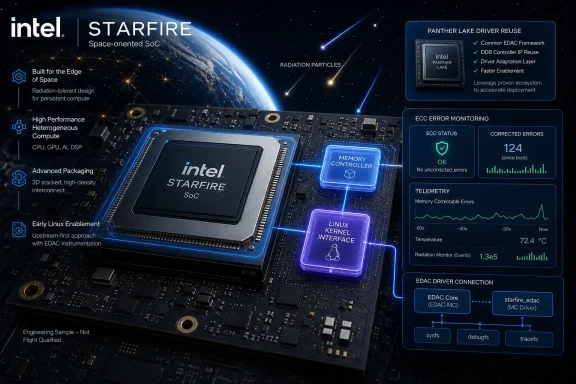
The submitted change lands in Linux’s Error Detection and Correction subsystem, known as EDAC. That subsystem provides the kernel plumbing for memory-controller drivers to identify, count, and report correctable and uncorrectable hardware memory errors. In ordinary servers, that translates to operating-system visibility into ECC events that may otherwise only surface in firmware logs or management tooling.
For Starfire, the patch reportedly adds a new PCI device ID to drivers/edac/igen6_edac.c, allowing the IGEN6 driver to attach to the SoC’s memory controller. The significance is less about the number of changed lines than what Intel did not have to add: no separate driver architecture, no Starfire-specific error-decoding scheme, and no new EDAC interface.
That supports Phoronix’s reading that Starfire’s relevant memory-controller behavior is close to Panther Lake. It also provides the clearest public technical evidence yet that Starfire is a ruggedized derivative rather than a clean-sheet space processor. The exact extent of that reuse remains unconfirmed: Intel’s public sell sheet identifies the product as Starfire, while the Linux patch points only to a shared driver path.
For Linux administrators, the operational distinction is important. A device ID means a stock, appropriately new kernel can recognize and monitor the relevant controller. It does not mean the operating system itself is correcting every radiation-induced upset, validating the memory modules used in a spacecraft, or making an unqualified device flight-ready. Hardware ECC, board design, firmware policy, memory selection, and mission-level fault recovery remain separate layers.
Linux 7.3 is a target, not a shipped platform
The timing in the original report needs a little restraint. As of August 3, 2026, the Linux Kernel Archives list Linux 7.2-rc6 as the current mainline release candidate, dated August 2. Linux 7.3 is therefore still a future development cycle, not a released kernel that integrators can deploy today.
The Starfire patch has been queued in the EDAC maintainer’s for-next branch. That is a strong indication that it is intended for the next merge window, but it is not the same thing as a merge into Linus Torvalds’ mainline tree. Patches can still be revised, reordered, or dropped before a release candidate appears.
That difference matters most for aerospace and defense integrators, whose software baselines are commonly frozen well before production hardware is qualified. Even if the change enters Linux 7.3 without revision, downstream users running long-term-support kernels will not receive it automatically. They will need either a newer kernel baseline or a backport of the device-ID addition into their vendor kernel.
The patch itself appears unusually backport-friendly because it is an identification update against an existing driver rather than a new dependency chain. But any organization considering that route should test on actual Starfire silicon: the reported code reuse establishes expected compatibility, not hardware validation across a mission board’s BIOS, memory population, telemetry stack, and watchdog configuration.
Intel’s radiation story remains incomplete
Starfire is being marketed around survivability in extreme environments, including space. Intel’s materials list operation from minus 55 degrees Celsius to 125 degrees Celsius and cite total-ionizing-dose, single-event latch-up, and single-event-effects work. Those are the right categories for a processor intended to face radiation and severe thermal conditions.
But Intel’s Starfire documentation, as reviewed by Tom’s Hardware, also labels radiation characterization as in process and says specifications remain subject to change. That is the material caveat missing from the shorthand description of Starfire as a finished “space-grade” processor: the publicly disclosed part is not yet presented as fully radiation-qualified.
The difference is consequential. Radiation characterization measures and documents device behavior under relevant exposure and event conditions. Qualification is the broader program decision that the part, process, package, configuration, and supporting components meet the applicable mission requirements. A Linux EDAC driver can make errors visible to software; it cannot close that qualification gap.
Some reporting on the announcement blurred that line by describing radiation-hardening certifications as if they were already complete. Intel’s own wording does not support treating the current public specifications as final flight qualification. Engineering samples are planned for the third quarter of 2026, which aligns with the early state of Linux support and with a product still moving through characterization.
The Panther Lake inheritance is an advantage — with boundaries
The Linux angle is favorable for Intel because the company is not starting from zero. Panther Lake support has already driven work across Intel’s Linux enablement stack, and the EDAC change indicates Starfire can reuse at least one mature code path. In a market where onboard systems may run Linux for years, that kind of inheritance reduces the software risk that comes with a specialized processor.
It also says something about Starfire’s intended role. Intel is pairing current-generation x86 cores, an NPU, integrated Xe graphics, DDR5 or LPDDR5 support, and 12 PCIe 4.0 lanes with a far harsher deployment target than a laptop. The pitch is on-orbit or edge inference where local processing can reduce the amount of sensor data that must be transmitted to the ground.
The public information does not yet show Linux support for every functional block. There are no publicly identified Starfire-specific submissions for graphics, NPU enablement, power management, firmware interfaces, or platform telemetry. That absence does not prove such work does not exist; Intel may be able to reuse Panther Lake support across those areas as well. It does mean the EDAC patch should not be misread as a complete software readiness declaration.
Windows users should also avoid drawing the opposite conclusion. Intel has not publicly announced Windows support details for Starfire, and a Linux kernel patch does not establish that Windows is unsupported. It establishes only that Linux has a visible, upstream path beginning with memory-error reporting. For this class of government and aerospace hardware, public upstream Linux work is often more informative than consumer-OS compatibility statements because the deployment software may be customized and long-lived.
Memory-error reporting will be a deployment requirement, not a checkbox
The Starfire EDAC patch is small because it plugs into an existing Intel driver, but it addresses a fundamental requirement for the product’s proposed use. If radiation, thermal stress, or aging produces correctable errors, operators need evidence that they occurred and a way to measure whether the rate is rising. If the platform reports uncorrectable errors, the system needs higher-level recovery behavior—reset, isolation, failover, or workload restart—designed around that event.
That is why the change is better understood as observability groundwork than as a reliability feature on its own. A Linux system that can identify Starfire’s memory controller can participate in mission logging and health monitoring. The real test will come later, when Intel’s qualification data, board-level ECC configuration, and the rest of the SoC’s Linux support become public enough to assess a complete deployment.
For now, Linux 7.3 is positioned to know that a Starfire memory controller exists. Intel still has to demonstrate that the silicon—and the software and systems built around it—can endure the environment its name promises.
