
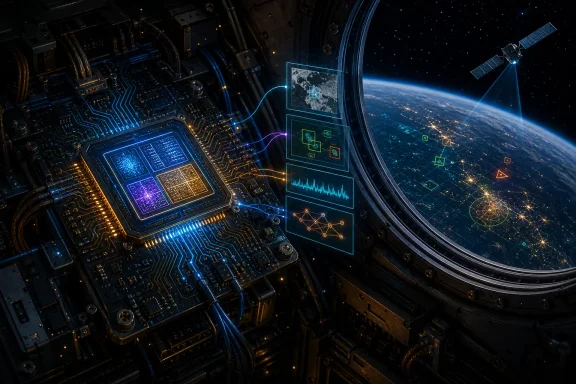
 Overview: Intel Takes Its PC and Data-Center DNA to Orbit
For Intel, Starfire is not simply another specialized embedded processor. It is a strategic expansion into space-grade computing, a field where the constraints are brutally different from those of laptops, servers, industrial PCs, and even terrestrial edge-AI systems.
A processor aboard a satellite must perform reliably through years of radiation exposure, launch vibration, vacuum, thermal cycling, limited electrical power, and scarce opportunities for hands-on maintenance. The occasional software patch is one thing; replacing a failed computer chip hundreds or thousands of miles above Earth is another entirely. NASA notes that energetic particles can scramble data, crash systems, and, in destructive single-event incidents, cause outright hardware failure. NASA
That reality has long favored conservative spacecraft architectures. Satellite operators often select processors with extensive flight heritage, years of radiation characterization, well-understood failure modes, and mature software stacks. The tradeoff has been computational capability: space computers have frequently lagged far behind the processor performance available in commercial markets.
Intel believes that tradeoff is becoming less acceptable. As government missions, commercial Earth-observation fleets, communications constellations, and defense networks demand more autonomous behavior, more capable onboard AI processing is becoming a mission requirement rather than an experimental luxury. Starfire is Intel’s answer to that shift. SpaceNews
What Intel Starfire Is Designed to Do
Starfire is described as a space-focused system-on-chip, or SoC. Rather than relying on a separate CPU, graphics processor, neural-processing engine, image-processing hardware, and peripheral controller, an SoC integrates multiple computing functions within a single package.
That approach matters in spacecraft design because every extra board, cable, memory interface, connector, and power-conversion stage carries a penalty. It consumes mass, volume, electrical power, and thermal headroom—four resources that satellite engineers ration constantly.
Intel says Starfire combines central processing, graphics, neural-processing, and image-processing capabilities to support both traditional flight-computer duties and advanced onboard analytics. The intended workloads reportedly include:
- Telemetry processing and spacecraft health monitoring
- Command sequencing and autonomous scheduling
- Data compression and prioritization before downlink
- Image analytics for Earth observation
- Object and anomaly detection
- Sensor fusion across payloads
- Predictive maintenance functions
- Autonomous operations that require local decision-making
These are not hypothetical mission categories. NASA’s High Performance Spaceflight Computing program similarly frames advanced onboard processors as essential to handling navigation, communications, power management, scientific instruments, and autonomous decisions when real-time human control is impractical. NASA
Two power tiers, one basic proposition
Intel plans to offer Starfire in two variants. One is intended for constrained spacecraft and operates below 10 watts, while the second sacrifices some power efficiency for more computing capability. SpaceNews
That two-tier approach is sensible because the space market is not uniform. A compact low-Earth-orbit imaging satellite, a geostationary communications platform, a military tracking spacecraft, and a deep-space science probe face fundamentally different power and thermal budgets.
The company’s proposition is not that every satellite should become a miniature data center. It is that spacecraft should be able to choose a more capable computing platform without accepting the form-factor and power penalties of assembling a similarly broad set of accelerators from several discrete chips.
Why Space Computing Needs a Modern SoC
The strongest part of Intel’s Starfire story is the timing. The satellite industry is moving steadily toward architectures that perform more analysis before data leaves the spacecraft.
Historically, many satellites captured raw data, stored it temporarily, and transmitted it to ground stations for processing. That model remains important, but it strains under the volume of modern high-resolution instruments and the finite capacity of satellite links.
The European Space Agency notes that instrument data can exceed what can realistically be transmitted to the ground, making onboard compression, reduction, and signal processing necessary. ESA also identifies the need for fast digital signal processors, high-speed links, and substantial onboard storage as data rates increase. ESA
The value of deciding before downlink
Onboard computing can change a satellite’s operating model in several meaningful ways:
- Transmit the useful data first.
A satellite may identify clouds, empty ocean, sensor errors, or unimportant scenes locally, reducing the need to downlink data with limited mission value. - Shorten response times.
Disaster monitoring, maritime tracking, weather observation, defense surveillance, and object detection often become more useful when analysis happens immediately instead of after a downlink and ground-processing delay. - Support distributed satellite systems.
Constellations can benefit from local routing, sensor fusion, prioritization, and coordination when each spacecraft has enough processing capacity to make decisions independently. - Enable more autonomy.
Deep-space missions cannot depend on real-time command loops because of communication delays. Faster local computing can support fault detection, planning, navigation, and equipment-health decisions.
ESA has emphasized that AI aboard satellites is not meant to replace ground infrastructure, but to complement it by delivering faster insight where latency matters. ESA
The implication for Intel is clear: the market is no longer defined purely by the reliability of a radiation-hardened CPU. It increasingly depends on the capability to combine CPU control workloads with accelerators suitable for image processing, AI inference, signal processing, and data management.
The Central Challenge: Radiation Qualification Is Not a Footnote
The most important caveat surrounding Starfire is also the most obvious one: the processor has not yet finished radiation characterization and qualification.
Intel told SpaceNews that radiation testing and characterization were expected to conclude before the end of the third quarter of 2026. The company described early results as encouraging, but has not publicly characterized Starfire’s final radiation survivability while that process remains underway. SpaceNews
Independent reporting on Starfire also noted that Intel lists total-ionizing-dose, single-event latch-up, and single-event-effects information as characterization in progress, with specifications subject to change. Tom’s Hardware
Why the testing process matters
Radiation is not one problem with one solution. Spacecraft electronics must contend with several categories of risk:
- Total ionizing dose (TID): gradual cumulative degradation caused by long-term radiation exposure.
- Single-event effects: immediate disruptions caused when a particle strikes sensitive circuitry.
- Single-event latch-up (SEL): an event that can induce excessive current and potentially damage a device if not controlled.
- Displacement damage: structural semiconductor damage caused by energetic particles over time.
NASA explains that single-event effects can flip binary values, disrupt programs, degrade communications or navigation, and sometimes create catastrophic failures. Long-term radiation also slowly degrades circuits and other spacecraft components. NASA
This is why raw performance claims should be treated differently in space than in consumer computing. A desktop benchmark can be reproduced in minutes. A radiation qualification campaign must prove behavior under defined conditions, and spacecraft builders must then map that information to specific orbits, shielding assumptions, temperatures, mission durations, fault-tolerance schemes, and safety margins.
Intel’s stated goal of supporting missions lasting more than a decade is therefore ambitious. The company’s eventual qualification data—not merely the architecture description—will determine where Starfire is genuinely competitive.
Hardware resilience is only half the answer
A radiation-tolerant chip is valuable, but mission resilience depends on the total system. Satellite builders still need to consider watchdog timers, redundancy, fault detection, correction mechanisms, safe-mode behavior, shielding, thermal design, memory protection, software recovery, and system-level validation.
NASA describes shielding and redundancy as common tools for handling radiation risks, while also making clear that shielding cannot eliminate every high-energy particle threat. NASA
For Starfire customers, the practical question will not simply be, “Can this chip survive space?” It will be, “Can this processor, board, memory subsystem, software stack, and mission architecture survive this orbit for this long with acceptable risk?”
x86 and Ubuntu Linux: Intel’s Potential Software Advantage
Intel’s decision to lean into x86 architecture and Ubuntu Linux could be one of Starfire’s most commercially important features. SpaceNews
The space electronics market has historically been filled with bespoke environments, specialized real-time operating systems, legacy instruction sets, proprietary board-support packages, and software tools with steep learning curves. Those are often appropriate for long-duration, highly assured missions, but they can slow development and complicate the transfer of commercial software expertise into space projects.
A familiar platform for developers
A Linux-capable x86 SoC may offer several advantages to satellite manufacturers and mission integrators:
- A broad base of developers already understands x86 development and Linux tooling.
- Existing AI, machine-vision, edge-processing, and data-management software can potentially be adapted more easily.
- Hardware abstraction and container-oriented workflows may simplify early integration and test environments.
- Engineers can prototype closer to the software platforms used in terrestrial edge and cloud systems.
- Intel can leverage established compiler, debugging, performance-analysis, and software-support ecosystems.
That does not mean a Linux application can simply be copied from a server or PC and flown without redesign. Flight software must still be profiled for performance, tested under power and thermal constraints, secured, hardened against failures, and validated against mission-specific requirements.
In other words, x86 may lower the barrier to software development, but it does not remove the aerospace assurance burden. The winning strategy will be to make high-performance Linux-based development possible while providing the deterministic behavior, documentation, lifecycle controls, and qualification evidence aerospace customers expect.
Intel Enters an Active, Not Empty, Market
Starfire arrives in a market that already contains serious competitors. Intel is not creating demand from scratch, but it will need to establish why its blend of integration, commercial software familiarity, domestic processing, and expected availability is worth switching architectures for.
BAE Systems has a long-established presence in radiation-hardened computing, including its RAD5545 single-board computer. BAE says that platform was designed to combine performance and resilience for missions involving communications, surveillance, tracking, weather, planetary exploration, encryption, high-resolution imagery, multiple operating systems, and autonomous operation. BAE Systems
AMD’s adaptive SoC strategy
AMD is also pushing further into the market with its Versal XQR adaptive SoCs, which combine heterogeneous processing resources, programmable logic, high-bandwidth interfaces, and machine-learning acceleration targeted at satellite and space applications. AMD
The distinction is important. Intel’s Starfire is pitched as a highly integrated x86-oriented computing platform. AMD’s space-grade Versal strategy places substantial emphasis on reconfigurability and adaptable acceleration, which can be attractive in missions where signal-processing pipelines, sensor interfaces, or AI algorithms may evolve.
AMD has also been pursuing enhanced space-grade packaging intended for demanding, long-duration missions, including a qualification target for missions of up to 15 years for one AI Core XQR configuration. AMD
NASA and Microchip’s HPSC program
Then there is High Performance Spaceflight Computing, NASA’s long-running program with Microchip Technology. NASA originally selected Microchip to develop an HPSC processor intended to provide at least 100 times the computational capacity of then-current spaceflight computers, while improving efficiency, scalability, reliability, and fault tolerance. NASA
As of March 2026, NASA said the processor had reached tape-out, early processors had been manufactured, and the project was continuing tests covering power, performance, reliability, and radiation tolerance. NASA expects HPSC to become commercially available through Microchip with broader ecosystem support. NASA
Microchip now presents its PIC64-HPSC family as 64-bit RISC-V high-performance MPUs for computationally intensive uses including spaceflight computing, AI, autonomous systems, and real-time data processing. Microchip
This competitive context is healthy for spacecraft builders. It means the industry is no longer asking whether satellites need more compute. It is debating which combination of CPU architecture, AI acceleration, programmable logic, power consumption, qualification status, software ecosystem, and supply-chain strategy offers the best mission value.
Domestic Assembly and Supply Chain: A Strategic Selling Point
Intel is also presenting Starfire as part of a domestic supply-chain strategy. According to Intel Government Technologies, some components may originate overseas, but final assembly, screening, and qualification are planned in the United States. SpaceNews
That distinction is worth reading carefully. “Domestic” in advanced semiconductors rarely means that every material, wafer, package element, passive component, and manufacturing step occurs within one country. Instead, Intel’s message is focused on controlling high-value integration, screening, qualification, and supply-chain assurance activities in the United States.
For national-security customers, that can be a meaningful advantage. Trusted sourcing, traceability, long-term availability, counterfeit avoidance, export controls, and predictable support matter as much as peak compute figures. BAE similarly highlights trusted U.S. production for its radiation-hardened space electronics. BAE Systems
Intel’s commercial manufacturing scale could also help with lead times, assuming the company can translate that scale into reliable availability for a specialized, comparatively low-volume space product. Space-grade electronics traditionally carry long procurement cycles because the market values controlled processes and consistent lots, not just fast semiconductor fabrication.
That creates a tension Intel must manage carefully. Commercial chip culture favors rapid product generations. Space customers want configuration stability, long lifecycle commitments, detailed documentation, and minimal surprises. Starfire will be judged by whether Intel can deliver both.
The Real Test Is Flight Heritage
Intel reportedly is discussing an experimental flight opportunity with multiple U.S. government agencies, though no confirmed demonstration had been announced at the time of the report. SpaceNews
That matters because the road to adoption in aerospace is rarely paved by a datasheet alone. Radiation tests, vibration profiles, thermal cycling, and lab characterization establish technical credibility. Flight heritage establishes operational confidence.
A successful technology demonstration could validate more than Starfire’s silicon. It could prove:
- Software behavior under real mission conditions
- Thermal performance within a flight enclosure
- Power use during actual workload bursts
- Recovery from radiation-induced anomalies
- Compatibility with spacecraft buses and payload interfaces
- The value of Intel’s integration and support model
Intel’s desire to act as a partner rather than a component vendor is therefore strategically astute. Satellite manufacturers are not merely buying chips; they are accepting a component into a mission architecture that may have taken years to develop and will be expected to work for a decade or more.
What Starfire Means for Windows and PC Enthusiasts
Starfire will not turn a satellite into a Windows PC, nor is its importance tied to Windows directly. Its relevance to the broader Intel ecosystem is more fundamental: it demonstrates how capabilities associated with mainstream computing—integrated graphics, AI acceleration, x86 software familiarity, and SoC-level consolidation—are being adapted for radically different environments.
For years, the PC industry’s technological direction has moved toward increasingly integrated chips. Modern client processors combine CPU cores, graphics, media engines, AI hardware, memory controllers, security features, and I/O within tightly coordinated packages. Starfire applies the same general philosophy to spacecraft, where integration can improve capability while reducing board complexity and resource consumption.
That is a powerful extension of the edge computing narrative. The edge is no longer just a factory floor, retail device, vehicle, camera, or telecom node. It can also be a satellite that filters images, recognizes objects, predicts a subsystem fault, manages a payload, or routes important information before the first downlink begins.
Conclusion: A Promising Entry With Qualification Still Ahead
Intel’s Starfire is a serious statement of intent: the company sees space-based AI and onboard data processing as a durable computing market rather than a niche side project. Its combination of integrated processing engines, x86 compatibility, Ubuntu Linux support, two power classes, domestic qualification activities, and a partner-led go-to-market approach addresses many of the practical problems satellite builders face. SpaceNews
The opportunity is substantial because spacecraft increasingly need to process data where it is collected. But the standard for success remains unusually high. Intel must finish radiation characterization, publish credible mission-relevant data, demonstrate a reliable flight implementation, support long lifecycle requirements, and persuade conservative customers that Starfire offers more than impressive commercial-chip DNA.
If it clears those hurdles, Starfire could help reduce the long-standing gap between terrestrial processor innovation and what satellites can realistically compute in orbit. The next phase will determine whether Intel has built not merely an interesting space processor, but a platform capable of earning the trust that spaceflight demands.
