
p2p topology command for Intel Arc Pro systems, giving administrators a direct way to see which installed GPUs can communicate with one another and through which paths. The practical value is highest on multi-GPU workstations and servers running inference, rendering, virtualization, or other jobs where GPU-to-GPU traffic can make or break scaling.Intel’s GitHub release notes detail the new command, while Phoronix and VideoCardz reported the release this week. The headline feature is an N×N capability matrix rather than a benchmark: it reports whether each GPU pair supports peer reads, peer writes, atomics, MDF fabric access, and PCIe access. That will not prove a workload is fast, but it removes a basic blind spot that has made multi-GPU Arc Pro troubleshooting unnecessarily opaque.
The more important caveat for Windows administrators is that XPU Manager 2.1 is not a general-purpose Windows desktop utility release. Intel’s current project documentation lists Windows Server 2022 and Windows Server 2025 for the daemon-less xpu-smi command-line tool, and explicitly limits the supported functions to device information, telemetry, firmware updates, and GPU configuration. It does not list Windows 11, nor does it describe the full XPU Manager daemon and its remote management interfaces as available on Windows.
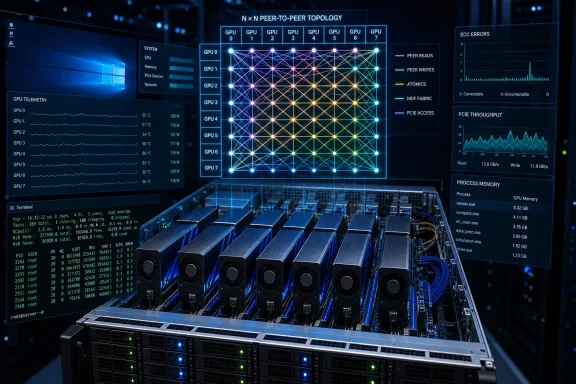 The P2P matrix answers a question monitoring tools often skip
Multi-GPU systems are not automatically peer-connected systems. Two Arc Pro cards may both be detected, run drivers correctly, and expose their individual telemetry while still lacking the direct path a workload expects for GPU-to-GPU memory movement. The limitation can be physical topology, platform firmware, PCIe arrangement, driver support, or a capability restriction exposed through the underlying Level Zero stack.
Until now, an administrator could inspect individual device data and topology information, then infer whether a particular configuration ought to work. XPU Manager 2.1 puts the relevant capability check behind a dedicated p2p command. The output is designed as a matrix: each GPU is compared against every other GPU, making an uneven four- or eight-GPU layout visible without manually cross-referencing bus IDs.
That matters for workloads configured around tensor parallelism or other forms of work sharing. A machine may have four identical GPUs but two very different kinds of GPU pairs: cards that can exchange data over a supported peer path and cards that fall back to host-mediated transfers or cannot use a requested operation at all. A clean topology report cannot guarantee application compatibility, but it gives the systems team an evidence-based starting point before blaming the model runtime, container image, or scheduler.
Intel’s own Arc Pro-focused software work makes the target audience clear. Its LLM Scaler documentation describes platform evaluation that includes peer-to-peer and collective-communication checks across GPUs. The new XPU-SMI view does not replace workload testing, but it gives the person operating the host a lower-level confirmation of what the driver and platform say the hardware can do.
Bulk device selection is a small change with real operational value
Version 2.1 also allows commands using --device to accept comma-separated GPU indices or PCI bus-domain-function addresses. That sounds minor until a host has more than one adapter and administrators need to gather or change settings consistently.
Previously, routine work across several cards could mean either repeating a command per device or resorting to shell loops and locally maintained scripts. Native multiple-device selection makes operations such as configuration checks and reporting less error-prone, especially when slot order changes after servicing a system or replacing a GPU. PCI BDF addressing is useful here because it lets an operator work from the physical layout and the host’s PCIe inventory rather than trusting a numbered GPU order that may not remain stable.
This is the kind of feature that distinguishes a command-line display tool from an operations tool. Intel positions XPU Manager as a monitoring and management layer built on oneAPI Level Zero System Management APIs, with XPU-SMI serving as the daemon-less local CLI. The project already supports telemetry, firmware work, configuration, diagnostics, and inventory functions; 2.1 makes its multi-GPU controls less awkward to use in automation.
The change should also be read alongside Intel’s limited Windows support. Windows Server users can obtain XPU-SMI binaries, but the documented feature set is narrower than the Linux management stack. A script built around telemetry and firmware inventory may be portable; an assumption that every XPU Manager feature or remote-management component exists on Windows is not supported by Intel’s own compatibility list.
Monitoring fixes improve the quality of the data, not GPU performance
The release contains several corrections that are more consequential than their short release-note descriptions suggest. PCIe throughput will now report 0.0 rather than N/A when an accessible link is idle. For monitoring systems, that is a meaningful distinction: N/A may imply a missing counter, unsupported platform, permissions problem, or collection fault, while a numerical zero represents a valid measurement of no traffic.
Intel also split ECC reporting into correctable and uncorrectable errors. That change brings the output closer to how administrators actually triage hardware health. A correctable error is a service signal worth tracking; an uncorrectable error can indicate a workload-impacting reliability issue and warrants a different escalation path. Combining the two creates noise and can hide the severity of a genuine fault behind a single aggregate number.
Another correction changes how XPU-SMI obtains GPU process memory use. Intel says version 2.1 reads it from the kernel’s DRM accounting instead of estimating usage from open file descriptors. The distinction is important because file-descriptor counting is an indirect proxy: one process can have multiple descriptors, and an open descriptor does not necessarily map cleanly to the memory currently attributed to that process. Kernel-level accounting should produce a more defensible figure for incident response, capacity planning, and identifying a process that has retained GPU memory after a workload should have exited.
Intel also lists fixes for multi-GPU topology reporting, serial-number detection, JSON output for virtual-GPU commands, and a host crash when resetting a device with active virtual functions. The last item should make administrators cautious about reading 2.1 merely as a telemetry release. A device reset in an SR-IOV environment is an operationally sensitive action; eliminating a host-crash condition is a reliability fix, but it does not make resets risk-free for workloads attached to virtual functions. Maintenance procedures should still drain affected GPU guests or jobs before attempting a reset.
Windows support remains server-bound and function-limited
The release is being described as improving Arc Pro monitoring on Linux and Windows, which is technically true only with an important qualification. Intel’s repository currently lists Ubuntu 24.04.3 and Ubuntu 26.04 for XPU-SMI, alongside Windows Server 2022 and Windows Server 2025. The Windows entry says supported functions are limited to GPU device information, telemetry, firmware updates, and configuration.
There is no published Windows 11 support statement in the current XPU Manager project documentation. That means Arc Pro owners testing an ordinary Windows workstation should not treat a downloadable Windows binary as equivalent to a supported client-OS deployment. It may run in a particular environment, but Intel has not documented that environment as a supported target for this release.
The same documentation defines xpu-smi as a local CLI built on the Level Zero driver stack. Intel’s broader XPU Manager product can provide remote management and integrations, including a REST interface and telemetry export for Prometheus-compatible monitoring, but those capabilities should not be assumed to accompany the Windows Server CLI package. Intel’s published compatibility wording draws a line between the two products and their supported modes.
For Linux operators with Arc Pro hardware, XPU Manager 2.1 is a sensible update where multi-GPU topology, ECC interpretation, process-memory attribution, or virtual-GPU management are part of day-to-day operations. For Windows Server operators, it is a useful refinement to the available XPU-SMI toolkit, particularly for inventory and telemetry, but it does not close the feature gap with the Linux-oriented management stack.
The immediate operational step is simple: install the 2.1 package matching Intel’s supported platform, run the new P2P topology view before deploying a multi-GPU workload, and compare its matrix with the GPU pairs the workload intends to use. That check cannot manufacture peer access where a platform lacks it, but it can prevent hours spent tuning software around a hardware path that was never available.
