
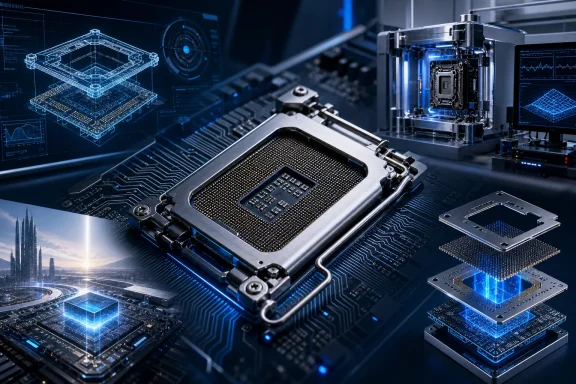
The record’s URL identifies an “ILM Kit for the LGA1954 NVL-S Interposer for the Gen5 VR Test Tool.” In practical terms, Intel has publicly exposed a name connecting the LGA1954 socket designation with NVL-S in the context of a validation kit. That substantially strengthens what had previously been an evidence trail built around third-party shipping and customs-record reports.
For PC builders, though, the most important part of this discovery may be its limits. It does not announce retail Nova Lake-S processors, establish a launch date, list CPU models or prices, identify a finished chipset family, or provide a motherboard and cooler compatibility matrix. Treat it as official naming evidence around Intel’s internal or partner-facing validation ecosystem—not as a final buying guide for the next desktop platform.
What the Intel listing actually establishes
Intel’s Design and Validation Tools page uses a URL slug containing the complete kit name: ILM Kit for the LGA1954 NVL-S Interposer for the Gen5 VR Test Tool. The presence of that wording on an Intel-operated property is the central development.
The individual terms are revealing in context:
- LGA1954 is presented as a socket-related designation.
- NVL-S is paired with it in the kit name and has been associated in reporting with Nova Lake-S.
- ILM commonly refers to the socket’s independent loading mechanism, the hardware that holds a processor in place.
- An interposer is specialized intermediary hardware, and the page name places it alongside a Gen5 voltage-regulator test tool.
Independent reporting characterizes the item as validation hardware rather than a consumer product. That distinction matters. Test fixtures and interposer kits exist to aid electrical, power-delivery, mechanical, and platform validation work. Their existence can reveal that a platform is being worked on, but they are not equivalent to a processor box appearing at retail or a motherboard vendor publishing final specifications.
There is also a key constraint on the primary evidence. The retrieved Intel page displayed a generic Design and Validation Tools title rather than a full product description, publication date, technical data sheet, or availability information. The URL itself is therefore strong evidence that Intel published a record bearing this name. It is not, by itself, a detailed Intel specification for the socket, the processors, or the supporting desktop ecosystem.
Why this is stronger than the earlier LGA1954 reports
The LGA1954 and NVL-S pairing did not emerge from nowhere. On April 19, 2025, reports based on third-party shipping or customs information described voltage-regulator test tooling associated with LGA1954-NVL-S. Those reports were useful early signals, but they were still reports about supply-chain records rather than direct Intel confirmation.
The newly visible Intel-hosted tool record changes the quality of the evidence. It does not validate every detail that circulated alongside the earlier leaks, but it does mean the LGA1954 and NVL-S labels are no longer supported solely by third-party records.
That is a meaningful upgrade in confidence for the basic association. It should not be stretched into confirmation of every rumored platform detail. A validation-tool name can establish nomenclature without disclosing the electrical pinout, mounting geometry, chipset capabilities, memory support, PCIe lane allocation, processor configurations, or actual retail compatibility rules.
Nova Lake itself was already public
Calling the listing Intel’s first official confirmation of Nova Lake would be inaccurate.
Intel had publicly referred to a next-generation client family codenamed Nova Lake in January 2025. In July 2025, Intel said Nova Lake was due at the end of 2026. Separately, an Intel software-download page explicitly identifies a Windows Zero Copy version as applicable to Nova Lake-S Beta, lists Intel Nova Lake platforms, and describes the platform phase as Nova Lake beta releases.
Taken together, those records show three distinct things:
- Intel had already acknowledged Nova Lake as a future client family.
- Intel had publicly connected Nova Lake to an end-of-2026 target.
- Intel has published software material explicitly naming Nova Lake-S Beta.
The validation-tools listing adds a narrower but important new element: an Intel-hosted public pairing of LGA1954 and NVL-S.
That framing is more precise than treating one tool-store page as a first reveal of an entire product family. It also gives readers a clearer way to judge the significance of future disclosures. An Intel processor launch page, chipset brief, board partner specification, or compatibility document would answer very different questions from a validation-tool listing.
The motherboard question: likely implication, not final confirmation
The obvious question for desktop upgraders is whether Nova Lake-S will need a new motherboard.
Today’s Arrow Lake-S desktop products use LGA1851. Intel Marketplace-hosted motherboard specifications identify Arrow Lake-S and Core Ultra 200S processors with that socket. LGA1954 is plainly a different socket designation, and the number suggests a different contact count. It is therefore reasonable to infer that a shift from LGA1851 to LGA1954 would involve a platform transition rather than ordinary drop-in CPU support.
But that inference should not be presented as a confirmed retail compatibility verdict yet. Intel has not supplied a final Nova Lake-S motherboard compatibility matrix in the material available here. No primary document establishes whether every LGA1851 board will be unsupported, how firmware policies may work, whether any transitional products could exist, or what the finalized mechanical requirements will be.
For most buyers, the safe conclusion is straightforward: do not buy an LGA1851 motherboard on the assumption that it has a documented Nova Lake-S upgrade path. Conversely, do not postpone a needed PC upgrade solely because LGA1954 exists as a validation-tool label. A currently available Arrow Lake-S system should be evaluated on its present performance, price, and feature set—not on support for an unreleased platform that Intel has not formally mapped to retail boards.
What has not been confirmed about LGA1954
Several attractive details have circulated beyond the bare socket designation. They deserve careful handling.
Reports have claimed that LGA1954 may use a dual-lever, or “2L-ILM,” retention design intended to reduce integrated heat spreader bending and improve heat dissipation. Other reports have discussed a prospective 900-series chipset family, including names such as Z990 and Z970. These claims may prove accurate, but the available evidence does not include a primary Intel socket specification, mechanical design document, or chipset announcement that verifies them.
As a result, readers should regard the following as unresolved:
- Whether the socket uses one lever or a dual-lever retention mechanism.
- Whether any revised loading mechanism changes processor flex, thermal behavior, or installation pressure.
- Whether existing coolers will fit, including coolers designed around LGA1700 or LGA1851 mounting patterns.
- Whether Z990 and Z970 are final names, shipping products, or part of a finalized “900-series” desktop chipset lineup.
- The chipset feature set, board tiers, memory support, connectivity, and overclocking rules.
This is not pedantry. Socket mechanics determine whether a cooler can be reused. Chipset specifications influence storage, networking, USB, and expansion decisions. Without official documentation, treating leaked names and mechanical claims as settled facts can lead to expensive purchasing mistakes.
Why validation hardware should not be mistaken for a launch signal
A common mistake in pre-release platform coverage is to view every tooling reference as proof that the product is about to arrive. The evidence here does not support that conclusion.
The tool page lacks a publication date, and Intel has not used it to announce a processor lineup or retail schedule. The associated kit is described as validation hardware, which is normally part of development and ecosystem preparation. Such hardware may appear well before a consumer launch, and its public visibility does not establish final specifications.
Intel’s earlier end-of-2026 Nova Lake target is the relevant public schedule indicator in this dossier. Even that should be treated as a corporate roadmap statement, not a guarantee of a particular retail day, region, SKU set, or motherboard availability. Product plans can evolve, and the tool listing supplies no new official timing detail.
There is a counterargument worth acknowledging: public documentation of a named socket-related validation kit is more concrete than a vague roadmap mention, and it plausibly indicates coordinated work across platform engineering and validation. That is fair. It is evidence of tangible platform work. It still does not prove an “advanced stage” of development, because the document does not define Intel’s development milestones or say where Nova Lake-S sits within them.
What Windows users should do now
For users planning a desktop purchase, the practical answer depends on timing rather than rumor enthusiasm.
If you need a PC now, choose based on available platforms and verified capabilities. Arrow Lake-S systems and LGA1851 motherboards are current products with published specifications. Their value does not depend on an unconfirmed forward-upgrade promise.
If your purchase is flexible and your priority is maximum platform longevity, wait for documents that answer the questions the tool listing cannot: Intel’s processor announcement, a confirmed socket and chipset specification, motherboard partner support pages, BIOS policy information, and cooler compatibility guidance. Those materials will matter much more than the naming of a test interposer.
System builders and IT buyers should also avoid treating “Nova Lake-S Beta” software references as evidence of broad Windows readiness for future retail systems. The wording confirms that Intel has software associated with a beta platform. It does not provide a consumer support commitment, driver maturity assessment, enterprise deployment guidance, or a release build timeline.
A useful confirmation, with disciplined boundaries
The LGA1954 NVL-S validation-tool entry is credible, concrete evidence that Intel has publicly used those labels together. It corroborates earlier third-party reports and adds substance to the picture of Nova Lake-S platform work.
Its significance is real precisely because it is narrow: Intel’s own tooling record links LGA1954 and NVL-S. Beyond that, the most consequential consumer questions remain open. There is no verified retail CPU list, no final board compatibility statement, no official chipset specification, no confirmed cooler-mounting story, and no new launch date supplied by the listing.
That makes this an important pre-release breadcrumb rather than a finished platform reveal. For now, it is best used to sharpen expectations and to avoid assumptions—not to make a motherboard purchase based on features Intel has yet to announce.
