
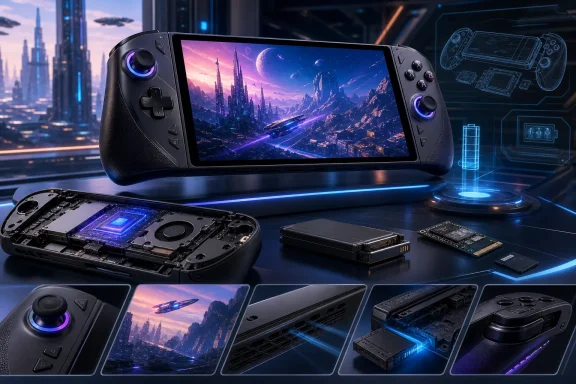
For prospective Windows handheld buyers, the Apex Air’s appeal is clear on paper: an 8-inch 120Hz variable-refresh-rate screen, a removable 85Wh battery, 32GB of LPDDR5X memory, and both microSD and Mini SSD expansion. It also sits in an awkwardly demanding part of the market. At its observed store price, it is not positioned as a value device. Its success will depend less on whether its specification list is long—which it is—and more on final build quality, software behavior, battery implementation, regional support, and independent performance testing that is not yet available.
A retail listing, not a first announcement
The timing matters because the Apex Air is sometimes described as a newly launched handheld based on the later store listing. Intel announced Arc G3 and Arc G3 Extreme on May 28, 2026, describing them as processors for Windows 11 handheld gaming systems and naming OneXPlayer among the initial hardware partners. Intel projected partner systems would begin arriving from June.
OneXPlayer then publicly debuted the device, styled as the ONEXFLY Apex Air, on June 23 alongside the OneXPlayer 3, X2, and X2 Mini. By August 29, the global store showed an Apex Air configuration at $1,839.
That sequence makes the August development evidence of sales availability or, at minimum, a retail presentation for a specific configuration—not the first announcement of the hardware. It is also worth treating the OneXPlayer and OneXFly names as branding variations for the same Apex Air rather than separate handhelds. The June presentation used ONEXFLY Apex Air, while the store groups it under ONEXPLAYER APEX & APEX Air.
What the $1,839 model includes
The configuration displayed in the global store pairs Intel Arc G3 Extreme with 32GB of memory and a 1TB SSD. A separate retail listing provides fuller component detail: 32GB LPDDR5X-8533 memory and a 1TB M.2 2280 PCIe 4.0 SSD.
The key qualification is that the global store page displayed this as its Apex Air option. That establishes the observed configuration and price, but it does not prove that every territory will receive only this version. Buyers should therefore avoid assuming that future regional stores, local retailers, or later batches cannot offer different memory, storage, bundle, warranty, or price combinations.
The $1,839 figure also needs to be read as a store-channel price before the realities of a cross-region purchase: applicable tax, shipping, currency conversion, delivery timing, import charges where relevant, and warranty treatment are not settled by the listing alone. For a product in this price tier, those details can affect the real cost as much as a modest difference in the headline price.
Display, controls and expansion are central to the design
The Apex Air is an 8-inch handheld with a 1,920 × 1,200 LCD running at up to 120Hz with variable refresh rate. Its integrated game controls are not detachable. That differentiates it from designs that treat controllers as modular components, and it should make the physical package more conventional for a portable Windows gaming PC.
The native 16:10 1,920 × 1,200 resolution is a practical choice for a Windows device. The extra vertical space can be useful outside games for desktop interfaces, launchers, setup dialogs, browsing, and streaming services. But it also means that the display has more pixels to drive than a 1,920 × 1,080 panel. The 120Hz VRR capability can help smooth variable frame rates where games and drivers cooperate, yet it does not guarantee that current games will run at 120 frames per second at the panel’s native resolution.
Independent event reporting describes a maximum stated 45W TDP, along with USB4, microSD, and a Mini SSD interface. The separate retailer listing also specifies Wi-Fi 7 and Bluetooth 5.4. Those are promising connectivity and I/O provisions for users who want to dock a handheld, attach fast external storage, use modern wireless peripherals, or move between a desk setup and portable play.
Storage expansion deserves careful wording. The evidence confirms both a Mini SSD slot and a microSD slot. The retailer explicitly says the microSD slot supports cards up to 2TB. It does not establish a 2TB maximum for the Mini SSD slot itself. A buyer planning a high-capacity internal expansion should wait for an explicit supported-drive list or a final technical manual rather than treating the microSD limit as an SSD limit.
The removable 85Wh battery is promising, but not fully proven in use
OneXPlayer’s most distinctive hardware claim is its 85Wh removable, swappable battery. The company also sells a separate 85Wh battery and a dedicated charging dock. In principle, this could be more useful than simply fitting a large sealed pack: a second battery could extend a gaming session, while a removable pack could offer a path to replacement if battery health declines over time.
That advantage comes with two important unknowns.
First, the company markets the battery-and-dock arrangement as a solution for uninterrupted gaming, but available material does not independently demonstrate a true no-interruption hot swap. There is a substantial practical difference between a battery that can be physically replaced and one that can be replaced while a game remains running without a shutdown, sleep transition, or external power source. Until operational testing is available, buyers should regard “uninterrupted” as marketing language rather than a verified behavior.
Second, 85Wh describes capacity, not guaranteed runtime. Game choice, display brightness, frame-rate cap, power profile, wireless activity, and the device’s actual operating power all affect endurance. The stated 45W maximum TDP suggests that demanding modes can draw heavily; a large battery helps, but it cannot by itself determine how long a given title will last.
Weight is a material unresolved specification
Portability claims require more caution than usual because reported Apex Air weight figures conflict. One report gives a device-only weight of 699g and assigns 380g to the 85Wh battery. A June 23 specification post instead reports 639g without the battery, while retaining the same 380g battery figure.
That 60g discrepancy is too large to dismiss as a rounding difference. If the two battery and device figures were simply added, the resulting combined masses would be 1,079g or 1,019g respectively. Those totals are arithmetic implications of conflicting reports, not confirmed final specifications.
The immediate consequence is simple: do not buy the Apex Air on an assumption that it is exceptionally light for its battery size. A removable pack can be advantageous for servicing and extended sessions, but it also means the travel weight depends on whether the device is carried with its battery installed and whether spare batteries and a dock are part of the kit. A final manufacturer text specification sheet should resolve this before weight becomes a decisive purchase criterion.
The MSI Claw comparison is useful—but narrow
The closest documented comparison point is MSI’s Claw 8 EX AI+. MSI lists that model with the same Intel Arc G3 Extreme processor family, up to 32GB of LPDDR5X memory, an 80Wh battery, and a 785g weight with battery. Independent U.S. reviews list its price at $1,799.
Against the observed $1,839 Apex Air store price, the numerical difference is $40 before tax, shipping, and regional price variation. This makes the two systems close enough in headline cost that buyers should compare the whole package rather than treating price as a major divider.
The Apex Air appears to differentiate itself with its 85Wh removable-battery concept, its 8-inch 1,920 × 1,200 120Hz VRR display, and its Mini SSD expansion provision. The Claw’s verified 785g figure includes its 80Wh battery; the Apex Air’s contradictory weight data means a clean weight comparison is not possible yet. It would be misleading to declare either system lighter in like-for-like use until OneXPlayer publishes an unambiguous final measurement and the configuration being weighed is clear.
Nor should the shared processor designation be used as proof of identical game performance. Handheld results can vary with sustained power limits, cooling, BIOS tuning, memory behavior, display resolution, drivers, and system software. Performance coverage for the MSI device cannot be transferred automatically to the Apex Air. The same caution applies to broader claims that the Apex Air has already proven itself against other high-profile handhelds, including Lenovo’s Legion Go 2 or the ROG Xbox Ally X20. Device-specific benchmark and usability testing is still needed.
What Windows handheld buyers should wait to learn
The Apex Air has the ingredients of a premium Windows handheld, but several purchase-critical questions remain open. The public specification picture is strongest for the processor, memory, storage, display, battery capacity, interfaces, and the observed global-store price. It is weaker on the issues that often decide daily satisfaction:
- Final weight and ergonomics: The unresolved 639g-versus-699g device-only claim needs clarification, especially given the 380g battery.
- Sustained gaming performance: The stated maximum 45W TDP is not equivalent to measured performance, noise, heat, or frame-rate consistency.
- Windows controls and software polish: Integrated controls are confirmed, but no retrieved evidence settles how well device controls, power profiles, sleep behavior, and launcher workflows function in real Windows use.
- Battery swapping behavior: A replaceable 85Wh pack is confirmed; transparent evidence of genuinely interruption-free swapping is not.
- Regional purchase terms: The displayed $1,839 configuration does not answer local delivery, final checkout costs, warranty coverage, or which models will be sold in each market.
A high-spec option that needs independent validation
The OneXPlayer/OneXFly Apex Air is no longer merely a teaser: an Arc G3 Extreme, 32GB, 1TB model is visibly listed at $1,839 in the global OneXPlayer store. Its hardware proposition is unusually ambitious, combining a high-refresh 8-inch display, robust-looking I/O, expandable storage options, and a large removable battery.
Yet the strongest conclusion is not that it has already won the premium handheld contest. It is that OneXPlayer has established a credible specification and price position in it. The weight discrepancy, uncertain hot-swap behavior, unknown regional sales terms, and absence of device-specific performance results are significant gaps. Windows gamers interested in the Apex Air should view it as a potentially compelling alternative to similarly priced Arc G3 Extreme handhelds, while waiting for final documentation and independent testing to determine whether its practical execution matches its unusually aggressive feature list.
