

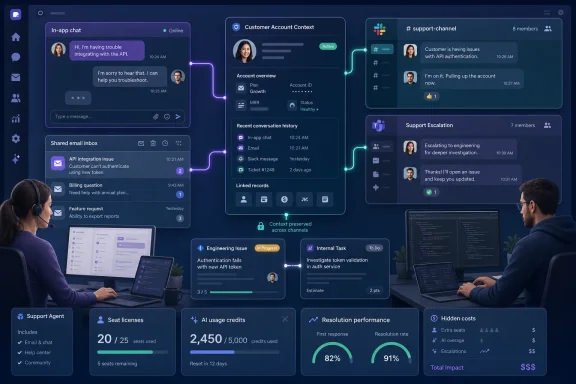
For product-led teams, that usually means an in-app platform such as Intercom. For account-based B2B vendors, the center of gravity may be Slack Connect, Microsoft Teams, a CRM account record, and Linear or Jira rather than a ticket queue. Editorialge’s rankings reflect that split, placing Intercom first overall while recommending Pylon and Plain for B2B workflows, Help Scout for smaller email-led teams, and Zendesk for mature omnichannel operations.
A review of the vendors’ current pricing and plan pages supports most of the article’s major price anchors. It also reveals why SaaS teams should treat every starting price as a budgeting input rather than a decision: the features that make a platform useful often begin one or two tiers above the headline plan, while AI charges now sit beside seat licenses in almost every serious deployment.
The ten tools divide into four support operating models
Intercom remains the clearest option for companies whose users ask for help inside the product. Its Messenger, ticketing, help center, outbound communication, and Fin AI Agent are designed to run as one customer-facing layer. That is valuable when an agent needs to know which screen the user was on, what feature they were trying, and whether a conversation should become an in-product message instead of an email reply.
But Intercom’s current public pricing also illustrates the limits of a simple per-seat comparison. The Essential tier is marketed from $0.99 per Fin outcome alongside a per-seat charge; Intercom’s own help material describes Essential as starting at $29 per month for one seat on annual billing. Email campaigns, SMS, WhatsApp, and phone carry separate usage charges. A support leader forecasting costs needs the expected number of AI-resolved contacts and channel usage, not merely the number of agents.
Zendesk and Freshdesk occupy the more conventional service-desk side of the market. Zendesk Support Team is $19 per agent per month on annual billing, but its Suite Team tier starts at $55 per agent per month and is the relevant baseline for a team needing messaging, live chat, voice, a knowledge base, omnichannel routing, and AI. Freshdesk Growth also starts at $19 per agent per month annually, with a customer portal, knowledge base, ticketing, shared inbox, and the first 500 Freddy AI Agent sessions included.
The distinction is operational. Zendesk suits organizations that have reached the point where queues, roles, service levels, channels, reporting, and governance are separate jobs. Freshdesk provides a lower-friction version of that traditional model, but advanced routing, multiple SLA policies, and deeper reporting begin at its higher Pro tier. Neither product should be evaluated as an inexpensive shared email address if the intended workflow requires formal escalation and multichannel service.
Help Scout, Front, and Crisp are better understood as communication-first platforms. Help Scout retains the familiar rhythm of email while adding assignment, notes, chat, automation, and a knowledge base. Its Standard plan is $25 per user per month, while AI Answers is billed at $0.75 per resolved session after the trial period. That can be a sensible fit for a small SaaS team whose support is mostly email and whose customer records live elsewhere.
Front starts at $25 per seat monthly on annual billing, but that Starter plan supports a single channel type. Its $65-per-seat Professional plan is where omnichannel support becomes available. The roundup correctly flags the consequence for cross-functional SaaS companies: when support, account management, operations, and customer success all need access, the license count can grow faster than the formal support headcount.
Crisp takes a different commercial approach. Its Mini plan is $45 per workspace per month and includes four agents, a shared email inbox, 5,000 customer profiles, and roughly 90 automated AI conversations through included credits. That is easier to forecast for a four-person team than a per-agent model, but the low tier omits functions such as broader channels, routing rules, analytics, and a knowledge base that many SaaS teams eventually require.
Slack, Teams, and Linear change the definition of a ticket
The most consequential part of Editorialge’s list is its inclusion of Pylon, Plain, and Productlane. These products address a support pattern that legacy help desks have historically handled poorly: a customer reports an urgent issue inside a shared Slack channel or Microsoft Teams conversation, engineers discuss the issue in a separate internal thread, and the resolution is tracked in Linear or Jira.
Pylon is built around that B2B reality. Its documentation says it can ingest Slack, Microsoft Teams, Discord, email, chat, SMS, WhatsApp, phone, and other channels into a single ticketing workspace, with CRM and engineering-system connections. It also supports account-aware routing, SLAs, incident grouping, and links to external incident-management services. For vendors providing high-touch support in customer Slack channels, that is a legitimate architectural advantage over manually forwarding messages into an email-centric queue.
The caveat is commercial rather than functional: Pylon does not publish a standard self-service price card. Editorialge describes its pricing as custom, and the company’s public sales-led posture confirms that buyers must get a quote before they can calculate the total cost. That lack of transparency does not make Pylon unsuitable; it does mean a team cannot responsibly compare it with Intercom, Zendesk, or Freshdesk without including implementation scope, required seats, AI features, and integration access in the quote.
Plain has a more visible entry point. Its Foundation tier is listed at $35 per month with one seat and 2,000 monthly credits, adding $35 for each additional seat. It includes Slack, email, in-app channels, Linear and Jira integrations, customer cards, AI workflows, and an AI agent. For a developer-led SaaS company, that makes Plain potentially more useful than a broader help desk at the start of a deployment because the engineering handoff is part of the design rather than an integration project.
There is, however, a pricing discrepancy on Plain’s own current pricing page. The headline describes Horizon at $299 per month, which matches Editorialge’s August 4 price check, but a lower comparison table on the same page lists Horizon at $269 per month billed yearly. Horizon is also the plan where Microsoft Teams, SLAs, escalation paths, CRM integrations, a help center, and reporting appear. Buyers should obtain a written quote before using either number in an approval request; the real Plain comparison is Foundation against Horizon, not $35 against competing entry plans.
Productlane belongs in this group because its value proposition is narrower and potentially valuable: it connects support conversations and feature feedback directly to Linear. Its Starter plan is $29 per user per month, includes 50 AI resolutions, and charges $0.79 for each additional resolution. The product is a credible candidate for a Linear-centered company that wants repeated customer problems to become visible product evidence, but it is less of a neutral service-desk replacement for organizations built around Jira, ServiceNow, or another engineering system.
AI pricing has turned support forecasting into a volume exercise
The headline seat price has lost much of its usefulness because vendors now charge for automation through outcomes, sessions, resolutions, and credits. Intercom bills Fin at $0.99 per outcome. Help Scout bills AI Answers at $0.75 per resolution. Freshdesk includes 500 Freddy AI Agent sessions on Growth and Pro, then sells additional sessions for $49 per 100. Productlane charges $0.79 per AI resolution beyond its plan allowance.
These models can be fairer than paying a large fixed AI add-on for a team that receives low volume. They also make monthly costs more dependent on how a vendor defines an outcome, session, or resolution. The underlying event may be a full self-service interaction, an answer the user accepts without requesting a human, or a conversation that crosses a vendor’s metering threshold. Those are related measures, but they are not interchangeable.
HubSpot Service Hub makes the tiering problem especially obvious. Service Hub Free supports two users, and Starter begins at $7 per seat per month annually. But Service Hub Professional begins at $90 per seat per month, requires a $1,500 onboarding fee, and is the tier that adds the broader service workspace, knowledge base, customer portal, customer feedback functions, and included HubSpot Credits. It is a rational purchase for a company already committed to HubSpot CRM, but it should not be presented to finance as a $7-per-seat help-desk alternative.
Editorialge’s warning about the “headline price” is therefore sound, but SaaS buyers should add one more line to the model: the activation tier. That is the least expensive plan that includes every required channel, escalation rule, CRM connection, audit control, reporting view, and knowledge-management feature. The entry plan is often a trial vehicle, not the plan an operating support team will keep.
The missing comparison is governance and recoverability
The roundup is strongest on workflow fit and weak on the controls that become important once support data includes enterprise accounts, billing information, incident reports, and internal engineering discussion. It does not compare retention controls, granular export options, audit logging, identity management, data residency, sandbox availability, or how a vendor handles historical conversation migration.
Those omissions matter most to IT administrators and support operations teams because changing a help desk is rarely a clean swap. Customer conversations are a working record of account commitments, known defects, product feedback, and service performance. If that record cannot be exported in a useful form, indexed, mapped to CRM accounts, and retained under a clear policy, the migration cost can outweigh a lower subscription price.
A pilot should therefore test a real escalation rather than a polished demo. Send an in-app question, an email, and a Slack or Teams request from the same test account. Attach a product-usage signal from the CRM, open an engineering issue in Linear or Jira, change its status twice, and verify that the agent can update the customer without copying information between systems. Then export the resulting case history and confirm whether the output retains account identity, timestamps, internal notes, attachments, and linked engineering records.
The right choice among these ten tools depends less on which vendor has the longest AI feature list than on whether that test stays intact. Intercom is still the leading fit for in-product support, Zendesk for formal multichannel operations, Help Scout for disciplined email-led teams, Pylon and Plain for B2B account support that lives in collaboration tools, and Productlane for Linear-led feedback loops. The purchase should proceed only after the intended escalation path has been proven on the plan the company will actually pay for.