
For Windows users accustomed to seeing a major operating-system upgrade trigger days of search reindexing, cache rebuilding, and post-install performance hiccups, Apple’s approach will sound familiar. The difference is that Spotlight is no longer merely a convenient iPhone search field. In iOS 27, it is set to become a foundational data layer for a more capable, conversational Siri that can understand personal context, work across apps, recognize onscreen information, and locate relevant details from an individual’s content. Macworld
That makes iOS 26.6 a notable release even without flashy interface changes. Apple appears to be using a stable public update to prepare devices for a major architectural shift—one in which the assistant’s intelligence depends in part on how well the phone has already cataloged the information it is allowed to access.
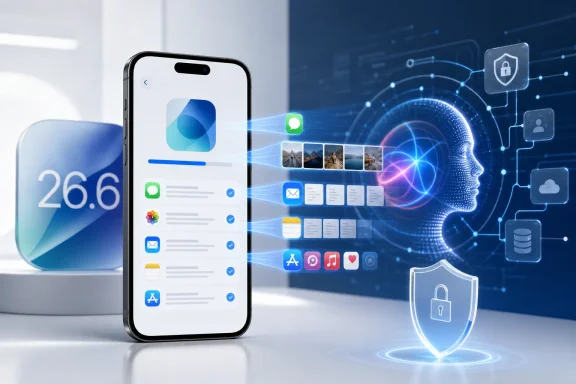 A Quiet Update With a Strategic Purpose
Most point releases arrive with a predictable formula: repair defects, close security holes, and polish features introduced in the preceding major version. iOS 26.6 follows that formula, but it also tells users that it is optimizing the Spotlight index for iOS 27. Apple has not publicly detailed exactly what is changing inside that index, yet the inclusion of that language in the release notes is unusually explicit for what would otherwise be invisible background maintenance. Macworld
The timing is the key. Apple has already made iOS 27 available in public beta form, and its headline direction is clear: a substantially expanded Siri AI experience alongside broader Apple Intelligence integration, performance work, and safety improvements. Macworld
Early testers, however, have exposed a practical issue. According to reporting from Macworld, iOS 27 beta users have sometimes faced a Spotlight optimization and update process that lasts for days. During that period, some features—particularly Siri AI capabilities tied to personal context—may not work as intended. Macworld
Apple’s likely answer is to move at least some preparation forward into iOS 26.6. Rather than leaving every compatible iPhone to start a large indexing job immediately after installing iOS 27, the company can begin reshaping or optimizing the search catalog while devices are still on the mature, stable release. This is an inference from Apple’s release-note language and the reported beta behavior, not a detailed implementation explanation from Apple. Macworld
The payoff could be significant. A major annual upgrade is most frustrating when the headline features are visible but unreliable: a new assistant that cannot find information, an incomplete search result, or a device that feels hot and slow while background tasks compete for processing time. Preparing the underlying index in advance is a sensible way to reduce that awkward transition period.
Spotlight Is Becoming an AI Data Foundation
To understand why the Spotlight index matters, it helps to look beyond the familiar swipe-down search interface. Today, Spotlight is Apple’s system-wide discovery mechanism: it indexes apps, contacts, messages, documents, photos, and other local content so the iPhone can surface results quickly. Most people notice it only when a file, an app, or a recent message fails to appear in search. Macworld
In iOS 27, the role of that index is expected to broaden dramatically. Siri AI is described as being able to understand personal context from sources including messages, email, notes, and photos; recognize what is on screen; answer more open-ended questions; and perform actions in supported apps. Macworld
That kind of assistant cannot operate like the older command-and-response Siri model. Asking it to find an item from a conversation, retrieve a detail from an old email, identify a relevant photo, or use information from multiple apps requires fast and structured retrieval. In other words, Siri AI needs an index that is more comprehensive, more current, and more semantically useful than a traditional app launcher search database.
Search indexing versus personal understanding
There is an important distinction here. An index does not necessarily mean an AI model is reading every item on an iPhone in the human sense. At its most basic level, indexing is a way for software to organize and retrieve content efficiently. But when an assistant is designed to use personal context, the quality, scope, and permissions surrounding that catalog become central to the user experience.
Apple’s reported iOS 27 plans include Siri AI support for finding information stored across devices, including photos, emails, notes, and messages, as well as taking natural-language actions within apps such as Messages, Music, and Reminders. Macworld
The technical challenge is not simply making more information searchable. It is ensuring that the assistant can identify the right information at the right moment, distinguish between similarly named contacts or events, understand dates and relationships, and avoid exposing private data in the wrong context. A smarter Siri will be judged less on the novelty of its interface than on whether it can reliably retrieve the correct personal detail without demanding a long series of corrective prompts.
Why first- and third-party apps matter
The Stuff report describes Spotlight as becoming Siri AI’s means of learning personal context from both first-party and third-party apps. Stuff That is potentially the most meaningful change in this story.
Apple has long had a strong advantage inside its own app ecosystem. Mail, Messages, Calendar, Notes, Photos, Contacts, Reminders, and Safari offer predictable data formats and deeply integrated system permissions. Extending contextual intelligence beyond those core apps is harder because developers differ widely in how they structure content, expose search metadata, and implement privacy controls.
For iPhone owners, the upside could be substantial:
- Less manual hunting through fragmented app histories.
- More useful follow-up requests, where Siri remembers the context of a previous task.
- Cross-app workflows that reduce app switching and copy-and-paste work.
- Faster answers when relevant data has already been cataloged locally.
- A more coherent assistant experience across Apple’s system apps and supported third-party software.
The corresponding risk is that results will initially be inconsistent. Not every app will expose the same depth of useful information, and early generative AI assistants often struggle when asked to combine data from multiple sources. Apple may be able to make the system feel seamless in its own apps before it can deliver the same consistency across the broader App Store ecosystem.
The Real Reason Apple Is Starting Early
The phrase “optimize the Spotlight index” does not necessarily mean every iPhone is performing one giant, uninterrupted reindexing task. Apple has not supplied a technical breakdown, and it would be unwise to turn a short release-note sentence into a detailed claim about databases, embeddings, local models, or cloud synchronization.
Still, the broad logic is clear. Major index changes can be computationally expensive, and modern smartphones must balance those background tasks against battery life, temperature, performance, storage constraints, and the user’s actual activity. If iOS 27 needs a new or substantially revised index to support Siri AI, completing preparatory work earlier could make the fall upgrade less disruptive.
Macworld’s reporting offers the clearest explanation of the apparent motivation: beta testers have seen Spotlight indexing take days, and Siri AI personal-context functions can be impaired while that work remains unfinished. Macworld
Avoiding the “new feature, not ready yet” problem
Apple’s approach may be designed to prevent an increasingly common problem with AI features: software ships, but the system requires significant time to become useful. The iPhone may technically be on iOS 27, yet the assistant could be missing context, still processing a photo library, or returning incomplete results.
This is especially important because Siri AI is expected to be more than a visual redesign. Reported iOS 27 capabilities include personal-context retrieval, app actions, onscreen awareness, improved dictation, conversational interaction, and a dedicated app for reviewing past conversations. Macworld
If those features arrive with a noticeable activation delay, the public narrative could shift from “Siri is finally useful” to “Siri is still getting ready.” Moving some work into iOS 26.6 is therefore not just a performance optimization; it is a product-launch safeguard.
A familiar strategy for Windows users
There is a useful parallel with Windows Search, Windows indexing, and major Windows feature updates. After a large update, a PC may need to rebuild search indexes, recompile or cache components, optimize storage, and re-establish background services. Search quality and system responsiveness can fluctuate temporarily, especially on devices with smaller SSDs, older processors, or very large local libraries.
Apple is trying to reduce that kind of post-upgrade penalty on the iPhone. The difference is that the consequences are no longer confined to finding a filename or document. If Spotlight becomes intertwined with Siri AI’s personal-context system, indexing becomes part of whether the assistant can fulfil a request at all.
That raises the bar sharply. A missed search result is annoying. An AI assistant confidently acting on the wrong conversation, date, photo, or message thread is a trust problem.
Security Updates Remain the Immediate Reason to Install
The iOS 27 preparation language is attention-grabbing, but security is the most immediate and concrete reason to update to iOS 26.6. Apple’s security advisory confirms that iOS 26.6 and iPadOS 26.6 were released on July 27, 2026, and documents fixes across a broad set of components. Apple Support
The advisory includes issues affecting Accessibility, Accounts Framework, the App Store, Apple Neural Engine, and other parts of the operating system. Apple notes, for example, that one Accessibility issue could allow someone with physical access to access sensitive user data during iPhone Mirroring, while an Accounts Framework flaw could allow an app to fingerprint a user. Apple Support
That does not mean every iPhone owner faces an urgent, remotely exploitable threat from each listed item. Security advisories frequently cover different attack conditions and device configurations. It does mean that delaying a current public release means delaying fixes for vulnerabilities Apple has already investigated and addressed.
Macworld counted 77 security fixes in the release, including 13 kernel-related entries and eight concerning WebKit. That total is a secondary-source count rather than an Apple headline figure, but it underlines the scale of the maintenance work in this update. Macworld
Why the security angle matters for AI preparation
There is also a deeper connection between security and the Siri AI story. A system that can access more personal context must be treated as a higher-value target. The more useful an assistant becomes—particularly if it can reference messages, mail, photos, and app content—the more important it is that its underlying permissions, isolation boundaries, and indexing behavior are robust.
Apple’s public messaging around iOS 27, as reported by Macworld, places privacy and security alongside the planned cloud-processing elements of Siri AI. Macworld But the practical test will be the design details: what is indexed locally, what requires cloud processing, what users can control, and how clearly the system explains those boundaries.
The Strengths of Apple’s Pre-Indexing Strategy
Apple’s iOS 26.6 move has several clear strengths, even if the company has not yet explained every technical detail.
It treats AI readiness as an operating-system problem
The strongest part of the strategy is its recognition that better AI is not only about a larger language model or a more natural voice. It is also about data availability, retrieval speed, data quality, and device preparation.
A personal assistant cannot reliably use personal context if the relevant content is missing from, delayed in, or poorly represented within its retrieval system. Preparing Spotlight ahead of iOS 27 indicates that Apple is addressing that unglamorous but essential layer.
It could improve the upgrade-day experience
Users generally expect annual iOS releases to work immediately after installation. If some index conversion or preparation can happen during iOS 26.6, the iOS 27 upgrade may avoid prolonged periods in which the newest Siri features are partially unavailable.
That could be especially helpful for people with substantial photo collections, years of Messages history, large mailboxes, or lots of documents stored across Apple apps. The actual benefit will naturally vary by device, storage capacity, network conditions, and the amount of local content that needs processing.
It keeps the work inside a stable public release
Unlike an iOS 27 beta, iOS 26.6 is a mainstream public release focused on fixes, security updates, and system preparation rather than experimental features. Macworld
That is an important operational choice. Apple can begin groundwork across a large installed base without asking users to enroll in a beta program or accept the instability that comes with unfinished annual-release software.
The Risks: Privacy, Battery Life, and Expectations
The same design that makes Siri AI potentially useful also creates legitimate questions. Personal context is powerful precisely because it is personal. An assistant that can retrieve useful details from messages, mail, notes, photos, and third-party apps must earn user confidence continuously.
Background processing may be noticeable
Indexing and optimization are background processes, but users may still notice them through warmer devices, slower performance, elevated battery usage, or an unusual amount of temporary system activity. Apple has not said what the iOS 26.6 optimization process looks like in day-to-day use, how long it takes, or which devices are most affected.
That uncertainty should not be exaggerated into a claim that iOS 26.6 will harm battery life. It does, however, mean that users who install the update and observe temporary changes should recognize that background preparation is a plausible factor—particularly if their phones are large, content-heavy, or just completing the update.
Better retrieval can still produce worse answers
A richer index gives Siri AI more potential context. It does not guarantee better judgment. Generative AI systems can misinterpret ambiguous instructions, prioritize the wrong record, or present a convincing answer that is not the answer the user intended.
For example, an assistant asked to identify “the restaurant Alex recommended” may need to distinguish among several people named Alex, multiple conversations, old recommendations, links, and changing plans. A high-quality index narrows the search problem; it does not eliminate the reasoning problem.
Apple’s challenge is therefore twofold:
- Find the correct information quickly.
- Explain or verify the basis for the answer before acting.
The second issue may matter even more than the first when Siri AI begins taking actions inside apps. A reminder created for the wrong day or a message edited in the wrong thread is far more consequential than a bad search result.
Transparency cannot stop at a privacy policy
Users will need useful controls, not just broad assurances. A robust Siri AI design should make it clear:
- Which apps are eligible to provide personal context.
- Whether individual apps or categories can be excluded.
- When a result comes from local content, web information, or a connected service.
- What the assistant is permitted to do without confirmation.
- How users can correct, delete, or restrict context that leads to bad results.
Those details are not fully answered by the iOS 26.6 release notes. They will be central to whether Siri AI feels like a genuinely helpful evolution of the iPhone or an opaque layer sitting above personal data.
What iPhone Owners Should Do Now
For most users, iOS 26.6 is a sensible update to install. It includes Apple’s latest security fixes and lays groundwork that may make the eventual iOS 27 transition smoother. Apple’s own security documentation makes clear that the release addresses a broad range of issues, while the Spotlight optimization provides an additional reason not to ignore it. Apple Support
The update path remains straightforward:
- Open Settings.
- Select General.
- Tap Software Update.
- Choose Update Now or follow the displayed installation prompt.
That is the standard installation process described in Macworld’s iOS 26.6 coverage. Macworld
As with any operating-system update, a current backup remains prudent before installation. Users should also give the phone time after updating, ideally while it is connected to power and Wi-Fi, rather than assuming every background maintenance task will be completed the instant the restart finishes.
The more important takeaway is that iOS 26.6 is not simply the last stop before the next annual upgrade. It is Apple quietly preparing the runway for a version of Siri that will rely far more heavily on what the iPhone knows about its owner’s digital life.
The Bigger Picture: Siri’s Make-or-Break Transition
Apple’s decision to optimize Spotlight in iOS 26.6 reveals how seriously it views the transition to Siri AI. The company is not presenting the next assistant as an isolated app feature or a cosmetic rebrand. It is preparing core system search infrastructure months—or at least weeks—before the broader iOS 27 rollout.
That is the right technical instinct. Truly useful personal AI requires more than polished responses. It requires reliable retrieval, fast indexing, appropriate permissions, strong security, and clear user control. A generative assistant that cannot access the right context is limited; one that accesses too much without transparency is unacceptable.
iOS 26.6 therefore matters because it exposes the less visible side of Apple’s AI strategy. The coming Siri experience may be defined by its voice, conversation skills, and app actions, but its success will depend on the quiet work happening underneath: a better-organized iPhone, a more capable Spotlight index, and an operating system designed to make personal context available without making personal privacy negotiable.
