
For Windows users contemplating a move from Android, iPhone 16e buyers replacing an older handset, and anyone who simply wants an uncomplicated daily driver, this is a device built around sensible priorities. It does not attempt to imitate the iPhone Pro line. Instead, it puts a current-generation class of processor, a 6.1-inch OLED screen, USB-C, Face ID, IP68 resistance, and a capable 48MP camera into a package that has become much easier to justify as retailers clear stock.
That caveat matters. The iPhone 16e is no longer Apple’s current “e” model: Apple’s present iPhone lineup now features the iPhone 17e, while the iPhone 16e has moved into the discount-and-remaining-inventory stage of its life. Apple’s current iPhone lineup lists the iPhone 17e alongside the iPhone 17 family, not the iPhone 16e. That does not diminish the 16e’s core strengths, but it changes how buyers should assess its price.
At the right discount, the iPhone 16e is not merely “good enough.” It is one of the most rational ways to enter Apple’s ecosystem with hardware that should remain responsive and supported for years.
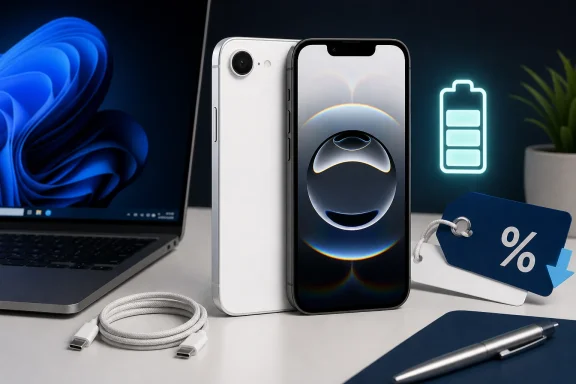 Overview: Why the iPhone 16e Still Makes Sense
Apple introduced the iPhone 16e in February 2025 as the more affordable member of the iPhone 16 family. Its formula was straightforward: use a durable, proven 6.1-inch chassis; install the A18 chip; include Apple’s first in-house cellular modem, C1; and make a number of targeted compromises in areas such as the rear camera system and display presentation. Apple’s launch announcement describes it as a value-focused iPhone with A18 performance, Apple Intelligence support, a 48MP two-in-one camera system, and extended battery life.
This is precisely why the phone has aged better than many budget-oriented handsets. Entry devices often compromise on the processor first, creating a mismatch between a new purchase and the software demands it will face two or three years later. The iPhone 16e takes the opposite route. Its design may be familiar, but its computational foundation was thoroughly contemporary at launch.
That distinction is more important than it sounds. A smartphone is not judged solely by its launch-day feature list. It has to handle years of browser tabs, messaging, video calls, banking apps, operating-system updates, photos, games, navigation, and increasingly AI-assisted features. A high-end processor makes a meaningful difference in the friction of daily use.
The iPhone 16e is therefore best understood as a performance-first value iPhone. It is not a miniature iPhone Pro, nor a bargain-basement device dressed in Apple branding. It is a mainstream iPhone that trades visual novelty and photographic flexibility for lower cost.
The Real Value Proposition Is the A18 Chip
A current-class processor changes the ownership experience
The iPhone 16e’s defining specification is the A18 chip. Apple said the six-core CPU is up to 80 percent faster than the A13 Bionic processor in the iPhone 11, while its four-core GPU supports demanding graphics workloads and hardware-accelerated ray tracing. Apple’s iPhone 16e announcement also says its 16-core Neural Engine can run machine-learning models up to six times faster than the A13 generation.
Benchmark percentages should never be treated as a complete description of real-world speed. Apple’s figures are vendor claims, measured against a specified older handset. Still, the practical conclusion is hard to dispute: the iPhone 16e has abundant performance for mainstream smartphone workloads.
That means it should have no difficulty with the tasks that define ordinary ownership:
- Web browsing with multiple active tabs
- Microsoft 365, Outlook, Teams, OneDrive, and cloud-storage applications
- Streaming and downloaded media
- Mobile banking and authentication apps
- Maps, ride-sharing, food delivery, and travel services
- Social platforms and video messaging
- Photo editing for everyday images
- Casual gaming and many graphically intense titles
- On-device machine-learning tasks supported by iOS
For a Windows PC user, this matters because the iPhone is often a companion device rather than a standalone productivity machine. It needs to be quick enough that moving between a Windows desktop, a browser session, a password manager, and the phone does not feel slow or dated. The iPhone 16e clears that bar easily.
Apple Intelligence support is a meaningful differentiator
The A18 also lets the iPhone 16e support Apple Intelligence, something that separates it from older, cheaper iPhones that may still look attractive on the used market. Apple positioned the device as built for Apple Intelligence from the beginning, with a focus on on-device processing and privacy-conscious AI features. Apple’s product launch release confirms the 16e was designed around that capability.
Whether Apple Intelligence is a decisive purchasing reason depends heavily on language, region, and the tools a person actually uses. It should not be treated as an automatic upgrade justification. But from a longevity standpoint, having the required hardware means the phone is not locked out of one of Apple’s major software platforms before the buyer has even opened the box.
The iPhone 16e is also compatible with iOS 27, according to Apple’s current compatibility list. Apple’s iOS 27 page includes the iPhone 16e among supported devices. That does not constitute a promise of a particular number of future updates, because Apple does not publish a fixed support timetable for each iPhone model. It does, however, confirm that the handset remains within the active software generation.
Design: Older in Style, Still Strong in Substance
The iPhone 14-era silhouette is not a deal-breaker
The iPhone 16e retains the older notched approach rather than adopting the Dynamic Island used elsewhere in Apple’s recent lineup. Its broader design language is closer to the iPhone 14 than to the more visibly updated models that followed. That is an obvious compromise, and buyers who want their phone to look unmistakably new may find it difficult to overlook.
Yet “older” is not synonymous with “inferior.” The 6.1-inch footprint remains one of the most practical sizes in the smartphone market. It is large enough for email, maps, documents, and video, but it does not become awkward to hold or pocket in the way that many oversized flagship phones do.
Apple equipped the handset with a 6.1-inch Super Retina XDR OLED display, Ceramic Shield front glass, and an IP68 rating for dust and water resistance. Apple’s specifications overview in its launch release also confirms Face ID and the edge-to-edge OLED panel. These are not throwaway specs; they are the everyday quality markers that make the 16e feel like a real iPhone rather than a compromised entry model.
The screen is excellent, but not the most advanced
OLED remains one of the iPhone 16e’s biggest strengths. It provides deep blacks, high contrast, and crisp text—the qualities users notice when reading in dark mode, watching HDR video, or catching up on email. For the majority of buyers, it is a substantial visual upgrade over an older LCD-based iPhone SE.
The limitation is refresh rate. The iPhone 16e does not deliver the ultra-smooth ProMotion experience found on Apple’s Pro devices. Users coming from a 120Hz Android phone may notice that scrolling and animations are less fluid. Those coming from an older iPhone, however, are unlikely to regard it as a decisive problem.
This is a classic example of Apple’s segmentation strategy. The company has preserved a clearly better display experience for higher-priced phones, but the 16e still provides a display that is sharp, color-rich, and more than sufficient for everyday content.
USB-C is more important than it first appears
The move to USB-C deserves more credit than it often receives. Apple explicitly noted that the port allows one cable to charge an iPhone, Mac, iPad, AirPods, and other compatible devices. Apple’s release makes that case directly.
For mixed-device households—and especially for Windows users who may already rely on USB-C charging for laptops, monitors, docks, headphones, power banks, and Android accessories—that reduces unnecessary cable clutter. It is not glamorous, but it is a significant quality-of-life improvement over Lightning.
Battery Life and the C1 Modem Are Quiet Advantages
Efficiency is the story, not just battery capacity
Battery endurance is one of the iPhone 16e’s most attractive characteristics because Apple designed the phone around efficiency rather than merely increasing battery size. The A18 chip, C1 modem, revised internal architecture, and iOS power management all contribute to the handset’s longevity. Apple says the 16e offered the best battery life it had delivered in a 6.1-inch iPhone at launch.
Apple’s comparison was especially striking: the company claimed up to six hours more battery life than the iPhone 11 and up to 12 hours more than any iPhone SE generation. Apple’s launch material provides those figures. As always, laboratory battery estimates depend on test methods and will not map perfectly to an individual’s screen brightness, mobile signal quality, app behavior, and usage pattern.
Still, the broader conclusion is reliable. The iPhone 16e is an iPhone for people who want to leave home in the morning and not spend the entire day thinking about a charger.
Apple’s first modem adds strategic significance
The C1 modem is more than an obscure internal component. Apple described it as the first cellular modem designed in-house and the most power-efficient modem ever used in an iPhone. Apple’s iPhone 16e launch announcement tied that modem directly to fast 5G connectivity and improved power efficiency.
For the buyer, modem branding is less important than stable connectivity and reasonable battery drain when the phone is away from Wi-Fi. Yet it gives the 16e a distinct place in Apple history: it is the handset that brought Apple’s modem strategy to consumers.
There is a sensible caution here. Network experience is shaped by carrier coverage, local bands, congestion, and physical environment. No one should buy a phone on the assumption that a modem alone guarantees stronger reception in every location. But the C1 contributes to the 16e’s image as a thoroughly modern device beneath its conservative exterior.
The Camera Is Good—But the Single-Lens Trade-Off Is Real
A 48MP Fusion camera that serves everyday photography well
The iPhone 16e uses a 48MP Fusion camera with what Apple calls an integrated 2x telephoto capability. The company presents it as a two-in-one system that can create high-resolution images and provide 2x optical-quality zoom without a separate telephoto lens. Apple’s camera description also highlights Night mode, Portrait mode, and computational-photography processing.
For daily photography, this is enough. Family photos, pets, receipts, casual travel shots, video clips, social media posts, and document captures are all well within the phone’s comfort zone. Apple’s image processing is also typically effective at making results look balanced without requiring manual control.
The important phrase is daily photography. A buyer who largely captures people, meals, landscapes from normal distances, and unplanned moments will probably appreciate the simplicity of one dependable main camera more than they will miss extra lenses.
Where the iPhone 16e falls short
The single rear camera is also the iPhone 16e’s most consequential weakness. There is no ultra-wide lens for expansive landscapes, tight interior shots, or dramatic perspective. There is no dedicated long-range telephoto camera for concerts, wildlife, sporting events, or distant architectural details.
That makes the decision simple:
- Choose the iPhone 16e if a strong standard camera and 2x framing option cover most of your photography.
- Consider an iPhone with multiple rear lenses if you routinely use ultra-wide shots or serious zoom.
- Avoid assuming that “48MP” automatically makes the 16e equivalent to a Pro iPhone camera system.
- Prioritize camera versatility over processor parity if photography is your main reason for upgrading.
The 16e’s camera is not poor. In fact, it is likely better than the camera on many older iPhones still in circulation. But it is intentionally narrow in scope. Apple has made the upgrade path very clear.
Pricing: The Deal Is Good, but the Exact Number Needs Context
The original report highlighted an iPhone 16e price of €569 at Amazon and MediaMarkt, down from a €709 launch price for the 128GB model. Modernet Digital reported that discount as the central reason the device had become particularly attractive.
Pricing is volatile, though, and buyers should not treat a single published figure as permanent. MediaMarkt’s current Spanish listing shows the 128GB iPhone 16e at €579, rather than €569, compared with a displayed prior price of €709. MediaMarkt’s iPhone 16e page confirms the €579 price and 128GB capacity at the time of checking.
Independent price tracking adds further nuance. A July 19 market snapshot found 128GB iPhone 16e offers between €554.99 and €600, with Carrefour at €554.99 and MediaMarkt, Amazon, and Phone House reported at €569 at that point. Compra Smartphone’s price analysis also noted that lower historical prices had appeared at several retailers.
The practical conclusion is straightforward: €569 was plausible, but it was not a guaranteed always-on price. A price around €550 to €580 for a new 128GB unit is strong value. At €600 to €650, buyers should compare it more closely against the iPhone 17e, carrier offers, certified refurbished models, and competing Android phones.
A smarter buying checklist
Before buying a discounted iPhone 16e, verify the following:
- Confirm storage capacity. The headline price should apply to 128GB, not a refurbished, open-box, or contract-tied listing.
- Check the seller. Marketplace listings can differ materially from products sold directly by the retailer.
- Compare new and refurbished pricing. A modest gap may favor new hardware and a full warranty; a large gap could make certified refurbished more sensible.
- Verify return terms and warranty coverage. These are particularly important when purchasing remaining inventory.
- Avoid overpaying for higher storage. If a 256GB model approaches the price of a newer iPhone generation, the lower-priced model may no longer be the better value.
- Check regional compatibility. eSIM and carrier support can vary by country and provider.
Who Should Buy the iPhone 16e?
The iPhone 16e is an especially strong fit for people who value reliability over status. It is a phone for someone who needs their device to work every day, remain fast under ordinary pressure, take consistently good photos, and fit comfortably into the Apple software ecosystem.
It is particularly well suited to:
- Owners of an iPhone 11, iPhone SE, iPhone 12, or older device looking for a meaningful leap in speed and battery life
- Android users who want to try iPhone without buying a Pro model
- Students and families seeking a durable, current iPhone at a controlled cost
- Professionals who use a Windows PC but want iOS, Face ID, Apple Pay, and long-term update support
- Buyers who prefer a compact 6.1-inch device over a massive “Plus” or “Max” phone
- Users who care more about performance and battery than about multiple camera lenses
For these buyers, the iPhone 16e’s so-called compromises may barely register after the first week of ownership.
Who Should Skip It?
The best value phone is not automatically the right phone. The iPhone 16e is a poor fit for buyers who will constantly notice the features Apple left out.
Skip—or at least reconsider—the 16e if you need:
- An ultra-wide camera for travel, interiors, and group shots
- Strong optical zoom for events or sports
- The visual polish of Dynamic Island
- A high-refresh-rate display
- The most current Apple hardware rather than discounted prior-generation stock
- Larger-screen multitasking and media consumption
- High-end mobile gaming with maximum graphical headroom
- A phone that feels visually distinct from older iPhone designs
The biggest risk is not that the iPhone 16e will be slow or unreliable. It is that a buyer who already knows they want camera flexibility, premium display fluidity, or the latest styling will attempt to save money and then spend years wishing they had bought the next model up.
The Bottom Line
The iPhone 16e’s strongest argument is that it gets the fundamentals right. Its A18 processor remains powerful, its OLED display is high quality, its C1 modem and efficient architecture support strong battery life, its main camera is dependable, and its software compatibility is still current with iOS 27. Apple’s iOS compatibility list confirms that the phone remains supported by the latest iPhone software generation.
The old-style notch, single rear camera, and lack of ProMotion are not imaginary compromises. They are real, deliberate limitations designed to preserve the appeal of Apple’s more expensive phones. But for the majority of people, those omissions matter far less than all-day battery confidence, quick app performance, USB-C convenience, a sharp OLED panel, and a price that is now substantially lower than launch.
At roughly €550 to €580 for a new 128GB model, the iPhone 16e is a smart buy for users who want the practical Apple experience rather than the most prestigious one. It may no longer be the newest budget iPhone, but that is exactly why it has become one of the most sensible.
