
For Windows users, this is not merely Apple news. The iPhone remains one of the most consequential devices in the broader personal-computing market, influencing everything from laptop purchasing decisions and cross-platform messaging expectations to app development priorities, AI features, camera innovation, and premium smartphone pricing. A more fragmented Apple launch schedule could reshape how competitors time their own releases—and how buyers decide whether to wait, spend more, or remain on an existing device.
The crucial caveat is straightforward: Apple has not publicly confirmed its iPhone 18 release plans, model names, specifications, or launch windows. The outline now circulating is based on recurring supply-chain and industry reporting rather than an Apple announcement. That means the direction of travel looks increasingly credible, while the fine details—including the name of a foldable iPhone, the future of the iPhone Air, and the exact spring lineup—remain subject to change.
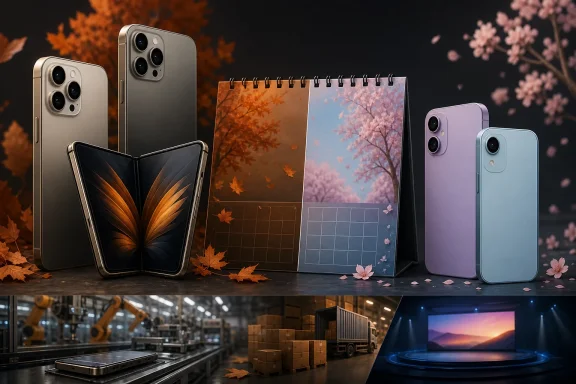 The iPhone 18 May Be Delayed—But Only the Standard Model
The phrase “iPhone 18 won’t launch this fall” is technically accurate only if it refers to the regular, non-Pro iPhone 18. It should not be interpreted as Apple skipping the iPhone 18 generation altogether.
The reported strategy is a split iPhone release schedule:
- Fall 2026: premium iPhone 18 Pro models and Apple’s first foldable iPhone
- Spring 2027: the regular iPhone 18, a lower-cost “e” model, and potentially a refreshed iPhone Air
Under that plan, Apple would maintain a major autumn event for its most expensive smartphones while reserving a second launch window for mainstream and value-oriented devices. The result would be a lineup that is refreshed twice per year rather than unveiled in a single September wave.
That distinction matters because Apple’s product naming has long trained buyers to think of every iPhone generation as one synchronized launch. A standard iPhone 18 arriving in March or April 2027 could feel “late” to buyers even if it is technically the newest entry-level model. Meanwhile, an iPhone 18 Pro purchased in September 2026 could be six months old before the standard model carrying the same generation number becomes available.
It is an unusual arrangement, but not without precedent. Apple has occasionally separated iPhone releases before, including during periods affected by supply constraints and in years when the company used spring events to expand the range with lower-cost or special-edition hardware. What would be new is making the division a deliberate, repeatable structure for the main iPhone family.
Why Apple Would Split Its Biggest Product Launch
The simplest explanation is that Apple’s iPhone range has become too large for a single event, a single production ramp, and a single marketing message.
Not long ago, Apple’s annual lineup was easy to explain. There was a standard iPhone, a larger model, and one or two Pro variants. Today’s portfolio is far more complicated. Apple must account for buyers seeking a lower entry price, a conventional flagship, a larger display, a thinner or differently positioned “Air” device, a Pro model, a Pro Max model, and possibly a foldable ultra-premium product.
A single launch containing six distinct handsets would make positioning difficult. It would also invite direct comparison between every product at the exact moment Apple most wants each buyer to focus on a single upgrade path.
A more manageable product story
A fall event built around the iPhone 18 Pro, iPhone 18 Pro Max, and a foldable flagship would have a much clearer narrative:
- New industrial design and cutting-edge components
- The best cameras and displays
- Advanced chips and AI capabilities
- Premium materials and new form factors
- The holiday-season appeal of high-end upgrades
Then, a spring event could focus on different priorities:
- Value and accessibility
- Mainstream upgrades from older iPhones
- Battery life, durability, and core performance
- New color options and less expensive storage configurations
- Wider availability in price-sensitive markets
This would give Apple two clean marketing stories rather than one crowded presentation in which a less costly iPhone is overshadowed by a foldable device or a Pro Max camera system.
Production complexity is becoming a strategic issue
A split schedule could also ease pressure on manufacturing. New iPhones demand massive component volumes, complex coordination across suppliers, and an enormous worldwide logistics effort. Adding a first-generation foldable device to that process would raise the stakes substantially.
Foldables typically present challenges that conventional slab-style smartphones do not. Hinge mechanisms, flexible display panels, ultra-thin protective layers, durability testing, battery design, yield rates, and repairability all create additional complexity. By concentrating its autumn launch on premium devices, Apple could give itself more room to manage the earliest production phase of a foldable iPhone without simultaneously ramping every mainstream model.
The standard iPhone 18, by contrast, could be introduced after the initial holiday production surge has passed. That may allow Apple and its manufacturing partners to distribute component demand more evenly throughout the year.
The calendar favors expensive hardware
There is also an obvious commercial incentive. The fall launch sits immediately before the holiday shopping season, when consumers are more likely to buy premium electronics as gifts or personal upgrades. Placing the most expensive iPhones in that window could help Apple maximize revenue during the most valuable quarter of the year.
A buyer who wants the newest iPhone in September 2026 may find that the regular iPhone 18 is simply unavailable. That buyer could wait until spring 2027, choose an older non-Pro model, or pay more for an iPhone 18 Pro.
That does not guarantee a higher conversion rate to Pro models. Some buyers will wait, and others may decide that their current device is sufficient. Still, the strategy clearly creates a more premium-heavy launch moment than the traditional lineup structure.
The Reported iPhone 18 Family Is Not Yet a Final Product Map
The broad outline of a split launch has gained more credibility than many individual rumors surrounding it. It is important to separate the likely structure from the less certain naming and model assumptions.
The more consistently reported elements are:
- iPhone 18 Pro
- iPhone 18 Pro Max
- A first-generation foldable iPhone
- A standard iPhone 18 arriving later than the Pro models
- A lower-cost successor in the “e” range
Other details require greater caution.
“iPhone Ultra” may be a placeholder, not a confirmed name
The foldable iPhone is frequently described using labels such as iPhone Fold or iPhone Ultra. Neither should be treated as confirmed branding. Apple has used “Ultra” across other product categories, which makes the name plausible, but plausibility is not confirmation.
A foldable iPhone could carry a name that distinguishes it sharply from the conventional iPhone line. It could also be marketed as a Pro device, a separate family, or something entirely different. The final name will shape buyer expectations, especially if Apple positions the device closer to an iPad replacement than a large smartphone.
For now, the important point is not the possible name. It is the reported priority: Apple appears to be preparing a foldable iPhone for the premium fall window rather than treating it as a secondary spring experiment.
The fate of the iPhone Air remains uncertain
The iPhone Air is another variable. If Apple keeps the product line, it may become a distinctive middle tier between the standard model and the Pro range. A thin-and-light device can have broad consumer appeal, but it must be sufficiently differentiated to avoid becoming the model buyers skip.
Apple has a difficult history with additional iPhone variants. Compact “mini” models earned praise but struggled to generate the sales volumes needed to justify their place. Larger non-Pro “Plus” models addressed demand for bigger screens but faced their own challenge: buyers willing to pay for extra size were often tempted to spend more on a Pro Max.
A future iPhone Air would need a simple value proposition. It cannot merely be a slightly different iPhone. It would need to stand for something tangible—perhaps thinness, reduced weight, design, battery efficiency, or an unusually large display in a lighter chassis.
iPhone 18 and iPhone 18e convergence could be disruptive
One report suggests Apple may be seeking greater commonality in the manufacturing approaches used for the standard iPhone 18 and the lower-cost iPhone 18e. If accurate, that could mean the gap between the two products narrows.
That could benefit consumers if the less expensive model gains a better chip, longer software support, stronger cameras, newer connectivity, or a more modern display. It could also help Apple simplify manufacturing and component sourcing.
But there is a risk. If the iPhone 18e becomes too similar to the standard iPhone 18, buyers may question why the more expensive model exists. Conversely, if Apple protects the regular iPhone 18 by making too many cuts to the lower-cost option, the “e” model could feel like an awkward compromise rather than a compelling entry point.
The balance between those devices may be one of the most important product-design decisions Apple makes in the new schedule.
A New Sales Strategy Could Change How Buyers Upgrade
Apple’s reported two-season cycle is not only about launches. It is about changing the psychology of the iPhone upgrade.
For years, shoppers have generally understood the rhythm: new iPhones arrive in the fall, discounts on older models follow, and spring is a relatively safe time to buy because a replacement is usually months away. A split cycle would complicate that logic.
The fall buyer faces a more expensive menu
In fall 2026, consumers looking for the latest generation could reportedly choose from only premium hardware. The standard iPhone 18 would not be available, leaving the iPhone 18 Pro and Pro Max as the conventional choices, with a foldable model potentially sitting even higher in price.
That creates a clear upselling opportunity. Apple’s Pro models already command higher prices because they typically offer better cameras, faster processors, more advanced displays, and premium construction. Removing the newest standard iPhone from the fall menu could make Pro hardware the default option for buyers who care most about owning the current generation.
For buyers, however, the choice becomes less straightforward:
- Buy a premium iPhone 18 Pro in the fall.
- Buy an older standard iPhone at a reduced price.
- Wait until spring for the regular iPhone 18.
- Consider the lower-cost iPhone 18e, if and when it arrives.
- Move to a different platform rather than accept a higher price tier.
The first option benefits Apple financially. The third and fifth options introduce uncertainty.
Spring buyers may get a shorter “new model” window
A standard iPhone 18 released in spring 2027 could remain current in Apple’s lineup for a full year, but it would potentially be followed by the iPhone 19 Pro generation only months later. That may create a perception problem even if the device remains technically modern.
Buyers who prioritize value may not care. In fact, they may prefer a spring release because it reduces the need to shop during the crowded holiday period and may offer more stable availability. But enthusiasts who have traditionally bought the newest standard iPhone in September could feel pushed into waiting or paying for a Pro model.
Apple will need to frame the standard iPhone as a fresh, standalone launch rather than a delayed version of something consumers expected six months earlier.
Carrier promotions may become more complicated
The U.S. smartphone market is deeply influenced by carrier trade-in offers, installment plans, and upgrade incentives. A split iPhone calendar could force carriers to rethink their promotional timing.
In the traditional rhythm, fall iPhone offers drive a major annual customer-acquisition push. With a spring iPhone launch added to the calendar, carriers would have another opportunity to promote upgrades—but also a second period in which they must fund expensive trade-in incentives.
That may be good for consumers if competition produces stronger spring promotions. It may be less attractive if carriers respond by narrowing the best deals to the most expensive models or longer service commitments.
The Foldable iPhone Is the Real Reason the Schedule Matters
The standard iPhone 18’s apparent spring shift is eye-catching, but the foldable device is arguably the larger story. Apple has historically waited to enter emerging categories until it believes the experience can be refined, simplified, and scaled.
A foldable iPhone would test that philosophy.
Apple enters a mature but still unsettled category
Samsung and other Android manufacturers have already spent years iterating on foldable smartphones. They have confronted the compromises that come with flexible displays: visible creases, weight, thickness, hinge reliability, camera trade-offs, high repair costs, and premium pricing.
Apple’s potential advantage is that it can learn from those experiments. Its challenge is that buyers may expect the company to deliver a more polished first-generation device precisely because it waited so long.
The foldable iPhone would need more than a flexible screen to justify its place. It would need a compelling software model, useful multitasking, high-quality app support, strong durability, and an experience that feels meaningfully better than a conventional large-screen iPhone.
Windows users should watch the productivity angle
For Windows enthusiasts, a foldable iPhone’s potential relevance is not limited to smartphone competition. If Apple presents the device as a portable productivity system—with expanded multitasking, document workflows, external display support, and cross-device continuity—it may influence expectations for foldable PCs and compact Windows tablets.
Microsoft has explored dual-screen and foldable concepts before, while Windows laptop makers continue experimenting with flexible displays, detachable designs, and AI-first hardware. A successful Apple foldable could reinforce the idea that mobile computing is moving toward devices that switch between phone, tablet, and workstation roles.
At the same time, a foldable iPhone may expose the limitations of Apple’s ecosystem approach. Windows remains central to enterprise work, gaming, specialist software, and open peripheral support. If Apple wants a foldable device to become a serious productivity companion, it will need to make cross-platform workflows less frustrating—not simply improve integration with Macs and iPads.
What Apple Gains From the Split-Launch Model
A two-season iPhone release schedule offers several practical advantages if Apple can execute it cleanly.
Better product segmentation
Apple can distinguish its tiers more clearly:
- Pro models become the fall flagship products.
- A foldable iPhone becomes the high-profile halo device.
- The standard iPhone becomes the mainstream spring upgrade.
- The “e” model targets value-conscious buyers.
- The Air range, if retained, could emphasize design and portability.
This structure is easier to explain than a six-device fall lineup in which every phone competes for attention at once.
More frequent marketing momentum
Two launches mean two major periods of media attention, retail activity, and carrier promotion. Instead of relying on one annual iPhone peak, Apple could sustain interest across the year.
That approach may be particularly valuable as smartphone upgrades slow. Consumers are holding onto phones longer because modern hardware remains capable for years, software support lasts longer, and annual performance gains no longer feel as transformational as they once did. More frequent launch moments give Apple additional opportunities to convince buyers that an upgrade is worthwhile.
Reduced manufacturing concentration
Staggering the release schedule could spread component orders and final assembly across a longer period. That may make operations more flexible, reduce bottlenecks, and give Apple more room to handle unexpected shortages.
It could also provide a buffer for a first-generation foldable device. If foldable production proves more difficult than expected, Apple would not necessarily have to manage that complexity alongside the full volume of a standard iPhone launch.
The Risks Apple Cannot Ignore
The logic behind the new schedule is strong, but it is not risk-free. Apple would be changing a consumer habit that it spent more than a decade establishing.
The standard iPhone could lose prestige
The biggest danger is perception. A standard iPhone 18 that arrives six months after the Pro models may look like a second-class product, even if it is excellent on its own terms.
Apple can counter that by giving the standard model a strong design identity, meaningful feature upgrades, and a launch event with genuine attention. But it cannot fully escape the generational comparison. Buyers will know the Pro phones came first.
Customers may delay purchases rather than trade up
Apple may hope that consumers wanting the latest iPhone in fall will choose a Pro model. Some will. Others may simply wait.
If enough buyers postpone upgrades until spring, the fall Pro-heavy strategy could reduce unit sales even if average selling prices rise. This is especially relevant in an economy where premium smartphone purchases are increasingly weighed against longer replacement cycles and growing subscription costs.
The lineup could become too confusing
More models do not automatically mean more choice. They can mean more uncertainty.
A buyer faced with an older iPhone 17, a new iPhone 18 Pro, a future iPhone 18, a future iPhone 18e, a potential iPhone Air, and an expensive foldable may struggle to understand which model offers the best value. Apple’s retail experience and online store are usually strong at narrowing choices, but a split calendar makes the question of “Should I buy now or wait?” harder to answer.
The foldable must be more than an expensive curiosity
A foldable iPhone could generate enormous attention without becoming a mass-market success. That may be acceptable if Apple treats it as a halo product, but the device must still meet a high standard.
If it is too expensive, too fragile, too thick, or too compromised in cameras and battery life, it may validate Apple’s late entry rather than justify it. The company’s brand gives it an advantage, but it also raises expectations.
What the Shift Means for the Wider Smartphone Market
Apple’s competitors will be watching closely because the company’s release schedule often becomes a reference point for the entire industry.
Samsung, Google, and Chinese smartphone makers already operate on different calendars, with multiple flagships released throughout the year. Apple adopting a similar cadence would make the market more competitive in spring, not just in late summer and fall.
For Android manufacturers, the new schedule creates both opportunity and pressure. A delayed standard iPhone gives rivals more time to promote their own mainstream flagships against Apple’s older base model. Yet a spring iPhone launch could also crowd out Android releases that previously had more breathing room after the holiday season.
The foldable dimension is even more significant. Apple’s entry could expand consumer awareness of foldables, attract developer attention, and normalize premium pricing for larger flexible-screen devices. It could also intensify competition around durability, thinness, multitasking software, and camera quality—areas where current foldables still involve compromises.
The Bottom Line
The expected delay of the regular iPhone 18 until spring 2027 is not best understood as a cancellation or a conventional product delay. It appears to be part of a broader effort to redesign the iPhone calendar around a larger, more segmented lineup.
The fall 2026 window is expected to belong to iPhone 18 Pro, iPhone 18 Pro Max, and Apple’s long-rumored foldable iPhone. The standard iPhone 18 would then arrive in spring 2027 alongside a lower-cost successor and possibly an iPhone Air refresh. Apple has not confirmed that plan, and several important details—especially final names and exact model count—remain uncertain.
If it happens, the change will reveal how Apple sees the next phase of the smartphone market. The company is no longer managing a simple annual lineup with one mainstream phone and a premium alternative. It is preparing for a portfolio where price, size, design, durability, AI capabilities, and form factor all demand their own moment.
That could make Apple’s launches more focused, production more flexible, and premium iPhones more prominent during the holiday season. It could also make the buying decision more confusing, dilute the status of the standard iPhone, and test whether consumers will accept a calendar that places the newest mainstream model six months behind its Pro-branded siblings.
The success of the strategy will ultimately depend on whether Apple can make each release feel intentional. If the fall models feel truly aspirational and the spring devices feel fresh rather than belated, the split schedule could become Apple’s next major product playbook. If not, the iPhone 18 cycle may demonstrate that more launches do not always create more clarity.
