

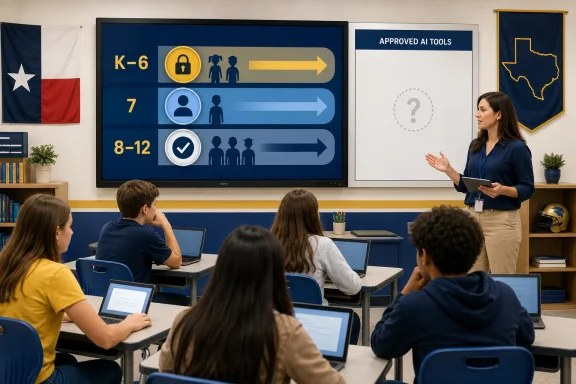
The core policy is clear. Students in kindergarten through sixth grade may not directly use general-purpose generative AI chat tools; seventh graders may use them only in teacher-directed, supervised activities; and students in eighth through 12th grade may use district-approved tools for specified educational purposes when a teacher authorizes it. Katy ISD announced the framework after its July 20 Board Work Study meeting, and Covering Katy News, the Houston Chronicle and ABC13 Houston have independently reported the same grade-band structure.
But the rollout contains a conspicuous implementation gap. Katy ISD’s public AI Framework page, checked on August 11, presents high-level categories such as AI literacy, digital citizenship, productivity tools and keyboarding. It does not publicly identify the approved generative AI products students can use, spell out what an acceptable AI disclosure looks like, or provide the teacher-facing permission rules families will need when assignments start arriving this week.
That does not undo the framework’s value. It does mean families should treat “district-approved” and “teacher permission” as the operative limits—not as a blanket green light for ChatGPT, Microsoft Copilot, Google Gemini, or whichever AI assistant happens to be installed on a student’s phone.
The rule applies to generative chat tools, not every program that uses AI
The first point of confusion is also the most important one. Katy ISD has not prohibited all software with an AI component in elementary and sixth-grade classrooms. The restriction concerns direct student use of generative AI—systems that take a prompt and produce new text, images, code, summaries or answers.
That is why a younger student can still encounter district-approved instructional software that uses AI features in the background, under teacher supervision, while being barred from opening a chatbot and asking it to write an answer. ABC13 reported that the district described those instructional uses as limited and supervised, including programs intended to support reading instruction or personalized learning.
The distinction is sensible from an IT and instructional-control perspective. A narrowly deployed literacy platform can be reviewed for its purpose, account model, privacy terms, settings and age suitability. A general-purpose chatbot can range far beyond a lesson, generate a persuasive but wrong answer, or produce work that is difficult to distinguish from a student’s own.
For parents, the immediate takeaway is simple: an elementary student saying “we use AI at school” does not necessarily mean the child has been granted access to ChatGPT, Copilot or Gemini. Conversely, a student being able to access one of those products outside a school Chromebook does not make it permitted for schoolwork.
Seventh grade is the transition point; eighth grade is not unrestricted access
Katy ISD calls its design a scaffolded approach. The practical dividing line is not merely elementary school versus secondary school; it is seventh grade versus eighth grade.
Seventh graders are entering an introduction phase. They may use generative AI only when the teacher structures and supervises the activity. In other words, access is tied to a lesson, a designated tool and adult direction. Students should not interpret seventh grade as authorization to independently use consumer AI services for homework, writing assignments or research.
Eighth through 12th grade students receive broader access, but the public descriptions consistently attach two conditions: the tool must be approved by the district, and the use must be authorized by the teacher for an educational purpose. The Houston Chronicle reported that students in the permitted grades must also verify AI-produced information, disclose and cite use of AI, and retain their own voice and authorship in submitted work.
That makes the policy closer to a classroom authorization system than a technology entitlement. A high school student may be allowed to use AI to compare explanations of a difficult concept, generate possible research keywords, critique a flawed answer or examine how prompts change output. The same student may be prohibited from using it for a timed response, a personal reflection, first-draft writing exercise, lab conclusion or any task designed to measure unaided mastery.
The details have to come from the teacher and assignment. Families should assume AI is off limits unless an educator has affirmatively permitted a defined use. The fact that a tool is publicly available, free, built into a browser, offered by a phone manufacturer or accessible through a personal account is irrelevant to whether it is authorized in a Katy ISD class.
“District-approved” is the policy’s strength—and its missing public detail
Katy ISD deserves credit for refusing to treat every product marketed as AI as equivalent. The district has said it will use only platforms that have been reviewed and comply with federal student-information protections. That is a necessary baseline, especially when students may be asked to enter prompts, upload work or interact through district accounts.
However, a policy built around approved tools only works cleanly when the approved list is public, current and specific. The district’s July announcement said more information about the AI Framework was available online, while the Houston Chronicle reported that Katy ISD planned to publish both its framework and a list of approved tools. As the school year begins, the public-facing framework page still does not provide that named list.
That omission creates an avoidable support burden for teachers and families. A parent cannot tell whether an assignment requires a district-managed version of a tool rather than a child’s personal version. A student cannot reliably know whether features embedded in Microsoft 365, Google Workspace, a search engine or an educational app fall inside the approval boundary. And a teacher may face the same basic questions repeatedly across classes: Which tools are permitted? Are personal accounts allowed? Can students paste assignment text into the system? What disclosure is expected?
The uncertainty is more than paperwork. Consumer and education versions of an AI product can have different identity controls, retention terms, administrative settings and data protections. “Use Copilot” and “use the district-approved Copilot configuration through a school account” are materially different instructions. The public rules do not yet give families enough information to distinguish those cases.
Katy ISD has also described the framework as a living resource, intended to evolve with input from teachers, principals, students and families. That is realistic; AI products, features and terms can change faster than a school board policy cycle. But a living framework needs a visible change log and a plainly maintained approved-tools register, or schools will drift toward campus-by-campus interpretations.
Academic integrity will turn on disclosure and teacher instructions
The district’s stated philosophy is that AI can assist learning without replacing the thinking, struggle and growth that make learning happen. Assistant Superintendent for Teaching and Learning Dr. Sanée Bell framed the central decision test at the board meeting as whether a use serves student learning and growth.
The phrase sounds broad, but it produces a practical rule: AI may be acceptable when the student remains responsible for the intellectual work; it becomes a problem when it performs the work the assignment was designed to assess.
A student using an approved tool to ask for three ways to understand a physics concept, then checking those explanations against class materials, may be using AI as a study aid. A student asking it to write the explanation submitted for a grade has handed off the central task. The finished text may look polished in both cases, but the learning record is radically different.
The Houston Chronicle reported that unauthorized AI use will be treated as a violation of the district’s student code of conduct. The available reporting does not establish a separate, fixed penalty schedule for every kind of AI misuse. Parents should therefore avoid assuming that an AI-related infraction will be treated identically across all assignments or campuses; the severity will likely depend on the assignment, the extent of the generated work, the student’s disclosure and the relevant academic-integrity procedures.
The district’s requirement that students disclose or cite AI use is a critical safeguard, but it is still underspecified publicly. “Cite AI” can mean very different things depending on whether a student used it for brainstorming, grammar feedback, translation, coding help, outlines, generated images or a complete draft. A workable rule needs teachers to say, in the assignment itself, whether AI is prohibited, allowed for limited assistance with disclosure, or required as an object of analysis.
Without that instruction, students will be left trying to infer policy from the tool they used rather than the learning objective their teacher set.
What families should do before the first AI-enabled assignment
The new framework is not a mandate for students to use AI. It is a controlled-access policy that places the teacher—not the chatbot—at the center of the decision. For families, that provides a clear short-term checklist:
- Students in kindergarten through sixth grade should not directly use generative AI chatbots for classroom work, even if a teacher uses AI-enabled instructional software as part of a supervised lesson.
- Seventh graders should use generative AI only when a teacher directs the activity and provides the approved tool or access route.
- Students in eighth through 12th grade should obtain teacher permission before using AI for schoolwork, use only the district-approved service designated for the assignment, and preserve enough of their own work to explain their process.
- Parents should ask teachers or campuses for the exact approved tool, account type and disclosure expectation before a student puts schoolwork, personal information or identifiable student data into an AI system.
Katy ISD’s fundamental decision—to phase in access rather than either ban every AI feature or hand every child an unrestricted chatbot—is defensible. The district has set the boundaries that matter most: no direct generative AI for K–6, supervised exposure in seventh grade, and permission-based use from eighth grade onward.
The unresolved issue is operational transparency. By the time students arrive on August 12, the district needs the public approved-tools list, a plain-language disclosure standard and assignment-ready teacher guidance to catch up with the policy it is putting into effect.