

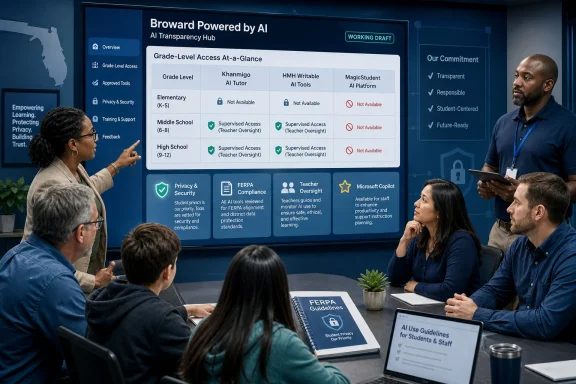
The official BCPS announcement, also reported by Caribbean National Weekly, presents the site as a transparency measure for a district already deep into an AI rollout involving Microsoft Copilot, MagicSchool, Khan Academy and other products. But a review of the live hub finds that its most important value is not a polished policy answer. It is a public admission that key parts of Broward’s AI program — including policy, future student access, parent notification, opt-out procedures and success metrics — are still unsettled.
That matters because Broward is no longer merely discussing classroom AI. The district has approved a three-year, $1.2 million MagicSchool agreement funded by a gift from Wayne and Lucretia Weiner, and it previously described its Microsoft 365 Copilot program as the world’s largest K–12 deployment. The new hub makes the boundaries of that expansion easier to see, while also exposing how much governance work remains before student access broadens.
The public-facing rules are more restrictive than the rollout rhetoric
BCPS says its guiding principle is “Human Intelligence First, Artificial Intelligence Second.” In practice, the hub states that AI will not replace teachers, independently assign final grades, make educational decisions, replace curriculum, or substitute for the teacher-student relationship. Teachers remain responsible for instruction, feedback, material review and grading.
For elementary students, the current rule is straightforward: no district-provided, student-facing AI applications. Students in kindergarten through grade 5 may receive AI literacy and digital-citizenship instruction — such as how generated content can be wrong or manipulated — but they do not receive access to an approved chatbot or AI tutor through the district.
The middle- and high-school position is also more limited than a generic claim that “students are using AI” would imply. Khanmigo through Khan Academy and HMH Writable/Revision Aid are approved for supported secondary settings, with teacher direction, monitoring and a defined instructional purpose. HMH Writable is framed as a writing-feedback and revision tool rather than a conversational bot, while BCPS characterizes Khanmigo as guided tutoring designed to prompt student reasoning rather than hand over answers.
MagicStudent, the student-facing component of MagicSchool, is explicitly unavailable. The district says teachers must complete further training before any potential future student rollout is considered, and it says families would be notified before MagicStudent is introduced to a class.
Those distinctions are important for IT administrators and parents alike. A product being licensed by a district does not mean students can use every feature that vendor sells. Broward’s current model separates teacher-facing productivity tools from student-facing instructional tools, a division that should be reflected in identity provisioning, single sign-on assignments, device controls and help-desk documentation.
MagicSchool’s status is still shaped by June’s board backlash
The hub arrives after the Broward County School Board paused the planned MagicSchool rollout on June 23 amid objections over privacy, cybersecurity, age appropriateness, screen time and instructional impact. CBS Miami and Caribbean National Weekly reported that the board sought a later staff report on safeguards rather than permanently canceling the program.
The district’s live guidance now calls MagicSchool a teacher-facing platform for planning, instructional resources, differentiation, communication and efficiency. Teachers may use approved AI tools only under district guidance, after required training, and according to professional judgment; the hub says use is optional, not mandatory.
That is a material change in how the program should be understood. In March, the board approved the MagicSchool agreement with $1.2 million in spending authority for 2026 through 2029. The current hub says MagicSchool does not “currently cost the district additional funds” because it was donated. Both statements can be true — the gift covers the approved contract — but the phrasing risks obscuring the scale and duration of the commitment. The district has a $1.2 million vendor agreement even if the money did not come from its operating budget.
The new site also confirms that policy is still pending. Its family guide says the School Board is reviewing AI-related policy and that the current site describes present practices and planned direction until that process is complete. Axios reported on August 6 that Superintendent Howard Hepburn said the forthcoming policy would focus on ethical use and student safety.
This is the core governance issue. A district can impose operational controls before a formal AI policy is ratified, but it should not present future safeguards as though they already exist. Broward’s own site lists parent choice, opt-out processes, notification procedures, public success measures and long-term monitoring among the matters still under review.
The transparency hub is live — but much of it is visibly unfinished
BCPS deserves credit for publishing a specific tool inventory and a grade-by-grade access chart rather than relying solely on general assurances about responsible AI. The hub identifies Microsoft Copilot, MagicSchool, Khanmigo, HMH Writable/Revision Aid and Prisms VR, and it describes a review sequence that includes a data-privacy agreement, FERPA check, security review and accessibility testing.
Yet the site also carries a striking disclaimer at the top: “Working draft for BCPS review.” It says content was drawn from national best practices as a starting point and that departments can edit, replace or retain sections. Elsewhere, it describes several portions as pending finalization, says a direct link to the formal board record will be added later, and labels professional-learning figures as “illustrative sample data” and placeholders awaiting district confirmation.
The most consequential inconsistency concerns Microsoft Copilot. One section describes limited student access for AI Academy students and plans for wider grade-based availability. The site’s main tool chart, however, labels Microsoft Copilot Premium as staff-facing and says it is not a student-facing tool. BCPS needs to clarify whether the limited student pilot is active, which Copilot product and license it uses, which students are included, and whether it is governed by different controls than the staff deployment.
There is a similar tension between the school board’s March resolution and the current access rules. The resolution endorsed universal access to AI tools and resources for all students, while the live family guide says elementary students currently have no district-approved student-facing tools. The current restriction is the more useful operational answer, but the district should distinguish an aspirational resolution from active entitlements and published access controls.
For a site whose stated commitments include transparency and accountability, draft status is not a minor design flaw. Parents, teachers and school staff may treat a polished public webpage as settled district policy. BCPS should either mark individual sections with their effective dates and approval status or remove unfinished language until it is ready for public reliance.
Privacy commitments need documents, not only summaries
Broward says approved tools must not use student information or interactions to train AI models, and that student data remains within the BCPS environment. It also says student-facing tools are reviewed for privacy, security, safety, accessibility, instructional value and age appropriateness before approval.
Those are the right questions, but the hub does not yet provide the contracts, data-protection addenda, security assessments, retention schedules, incident-notification terms or vendor-specific data-flow diagrams that would let the public verify the claims. It says privacy review includes a signed agreement, FERPA check and an independent privacy rating, but it does not identify the rating or publish the results for the listed platforms.
The difference is significant. “Enterprise data protection” is a product configuration claim; it is not a substitute for a public record showing what data is collected, where it is stored, how long it is retained, who can access it and what happens when a student leaves the district. That documentation is especially important when classroom tools can process student writing, learning records, teacher prompts or behavioral safety alerts.
BCPS also says it is reviewing how to control access to public AI services such as ChatGPT and Google AI features on school-issued devices, including when those devices are used from home networks. That is an honest acknowledgment of a technical limit: network filtering on campus does not automatically follow a managed device onto every household connection, and a policy cannot stop students from reaching public AI through personal phones and accounts.
What Broward has actually delivered
Broward Powered by AI is a useful starting point because it makes several decisions plain: elementary students do not have district AI access; MagicStudent is not active; teacher use is optional; final grading remains human; and approved secondary use is limited to named tools and supervised instructional settings.
But the district has launched the hub before it has finished the governance structure that would make its promises auditable. The page itself says the AI policy is pending, family-notification and opt-out procedures are unresolved, performance reporting is planned rather than demonstrated, and parts of the site remain a working draft.
The immediate consequence for Broward schools is that staff should treat the published access chart — not vendor marketing or the broader AI initiative — as the operative boundary for the opening of the 2026–27 school year. The next concrete dates are the August 27 Family Forum and the expected September follow-up session, where BCPS will need to turn its draft commitments into approved policy, documented controls and clear instructions that every school can actually enforce.