
The practical point for users and administrators is narrower than the KB title may suggest: this is a model-component servicing release, not a Windows feature update, driver release, or general AMD AI enablement package. Microsoft says it contains “improvements,” but supplies no changelog, security bulletin, known-issue list, download size, restart requirement, or explanation of which model behaviors have changed.
Microsoft’s Support documentation also makes the hardware boundary explicit: KB5124892 applies to Copilot+ PCs only. An ordinary AMD desktop or laptop does not qualify simply because it has an AMD processor, and the package should not be read as an expansion of Phi Silica support to every Ryzen system.
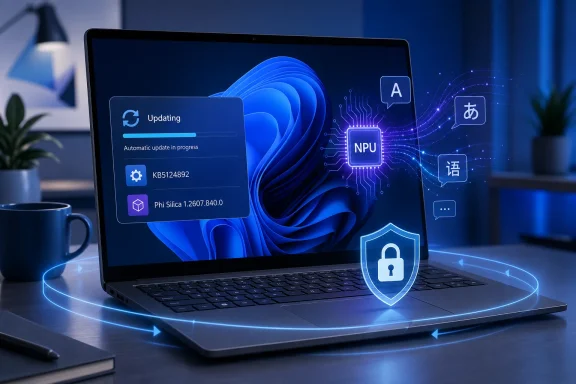 The same Phi Silica version has reached a new Windows branch
KB5124892 is noteworthy less for a new model number than for where Microsoft is shipping it. The 1.2607.840.0 component version already appeared in July through KB5121642 for AMD-powered Copilot+ PCs on Windows 11 versions 24H2 and 25H2. The August package brings that same listed Phi Silica version to the separate Windows 11 26H1 servicing branch.
That comparison matters because KB5124892 should not be treated as evidence that Phi Silica received a brand-new August capability set. Microsoft uses a new KB number for the 26H1-targeted delivery, while the displayed component version remains the same as the July release for the older branches. The available record supports a simpler conclusion: Microsoft is aligning the 26H1 branch with the already-published 1.2607.840.0 Phi Silica release, using the branch-specific update chain that Windows Update expects.
The predecessor confirms that pattern. KB5103202, released for Windows 11 26H1 in June, carried Phi Silica version 1.2605.856.0. KB5124892 supersedes it with version 1.2607.840.0. That is a genuine component-version advance for 26H1 devices, even if Microsoft has not disclosed what changed inside the model or its runtime package.
For IT teams, the version number in Update history is therefore more useful than the month in the update label. A compliant AMD Copilot+ PC on 26H1 should eventually show:
- 2026-08 Phi Silica version 1.2607.840.0 for AMD-powered systems (KB5124892).
If the device still shows the June 1.2605.856.0 entry after it has received the current 26H1 cumulative update and completed its normal update scan, it has not yet taken this replacement package.
This services a local language model, not Copilot as a whole
Phi Silica is Microsoft’s compact on-device language model for Windows. It provides text generation, summarization, rewriting, text understanding, and other language-processing functions exposed to applications through the Windows AI APIs. On a Copilot+ PC, Microsoft says Phi Silica runs on the NPU, the neural processing unit intended for sustained AI work with lower latency and lower power use than a general-purpose processor or graphics processor.
The component’s local design is important in privacy-sensitive environments. Microsoft’s current developer documentation says Phi Silica processes prompts and generates results on the device during inference, without sending those prompts and outputs to Microsoft or another third party. That does not exempt an application from its own telemetry, logging, storage, or synchronization choices; it describes the model inference path itself.
The KB does not identify which Windows features currently consume the updated component, and it does not name applications that would show an immediately visible difference. That omission is material. A Phi Silica update can improve the shared local model layer without adding a new button to Settings, changing the Copilot app, or making every AI-marketed Windows feature behave differently.
Developers have a more direct connection to it. Phi Silica is available through the Windows App SDK’s Windows AI APIs, though Microsoft’s documentation says the stable Phi Silica API remains a Limited Access Feature. Apps that use the model should continue to perform readiness checks rather than assuming the runtime is available merely because the device is branded as a Copilot+ PC.
AMD-powered does not mean every AMD AI-capable PC
Microsoft’s Support article restricts KB5124892 to AMD-powered Copilot+ PCs, which are systems meeting the Copilot+ hardware requirements, including an NPU with at least 40 TOPS of AI performance. That categorization is substantially narrower than “PC with AMD hardware.”
Microsoft’s newer Windows AI API documentation has expanded Phi Silica beyond the original Copilot+ PC design: supported non-Copilot+ systems can run the model on certain NVIDIA and AMD GPUs. But that is a different deployment path, with different prerequisites. Microsoft says GPU execution requires a supported GPU, a manufacturer-provided current driver, Developer Mode, and an applicable Windows Insider experimental configuration. GPU inference also carries higher power, thermal, latency, and graphics-resource costs than running the model on a Copilot+ PC’s NPU.
KB5124892 does not document a GPU rollout. Its prerequisite is simply the latest cumulative update for Windows 11 26H1, and its scope remains AMD-powered Copilot+ machines. Administrators should not use this package as a test for whether a non-Copilot+ Radeon system can run Phi Silica through the experimental GPU path.
That distinction also avoids a common inventory mistake. Processor architecture, GPU brand, Windows edition, Windows release branch, and NPU capability are separate variables. A fleet report that filters only for “AMD” will overcount potential recipients; the relevant population is AMD-powered Copilot+ PCs on Windows 11 26H1 with the current cumulative update installed.
The update is automatic, but Microsoft leaves deployment details unanswered
Microsoft says KB5124892 downloads and installs automatically from Windows Update. There is no standalone installer or Microsoft Update Catalog package identified in the support entry. The stated prerequisite means the normal operating-system servicing baseline comes first: devices that are paused, behind on cumulative updates, blocked by policy, or unable to complete the 26H1 cumulative update may not receive the AI component yet.
For a single machine, the verification path is straightforward: open Settings > Windows Update > Update history and look for the August Phi Silica entry and KB5124892 number. For a managed fleet, the check needs to be more deliberate. The KB does not say whether the component’s deployment state is exposed through standard Windows Update for Business reports, Intune inventory, WSUS synchronization, or Configuration Manager compliance views. Microsoft also does not state whether the update requires a reboot, whether it can be removed separately, or whether it changes the model footprint on disk.
Those gaps mean this is not a release that justifies a rushed change-control event absent a local symptom or application dependency. It is an automatically serviced Windows AI component with no disclosed security fix and no public functional changelog. The sensible operational response is to let eligible 26H1 AMD Copilot+ PCs take it through the established Windows Update process, record the resulting component version where AI functionality is business-relevant, and investigate only when a device fails to advance beyond KB5103202 or an application reports Phi Silica readiness errors.
Phi Silica itself has a limited remaining runway
There is a larger lifecycle issue behind an otherwise routine component update. Microsoft’s Windows AI API documentation says Phi Silica is scheduled to be replaced by Aion Instruct, another local model. Microsoft lists an October 2026 start for Windows Insider Preview rollout and November 2026 for retail rollout, at which point it says Phi Silica will be removed.
That makes KB5124892 a maintenance release for the currently supported 26H1 Phi Silica path, rather than a reason to make new long-term product bets on the model alone. Developers with Phi Silica integrations should track Microsoft’s Aion Instruct transition guidance and avoid assuming that a successful 1.2607.840.0 deployment settles their future runtime dependency.
For everyone else, the immediate outcome is modest and concrete: eligible AMD-based Copilot+ PCs on Windows 11 26H1 will move from Phi Silica 1.2605.856.0 to 1.2607.840.0 through Windows Update, while Microsoft has yet to say exactly what those “improvements” change in use.
