
Microsoft Support’s notice is narrowly framed: it is an AI-model component update, not a Windows cumulative update, and it contains no published bug-fix list, model-size figure, release-channel breakdown, or performance claims. For administrators and developers, that means the practical change is version movement on a locally installed language-model runtime—not a newly documented Windows feature to enable or configure.
The immediate action is simple. Intel Copilot+ PCs must first have the latest cumulative update for their installed Windows 11 release; Windows Update then downloads and installs KB5124880 automatically. Microsoft directs users to check Settings > Windows Update > Update history rather than offering a separate installer or a manual remediation path.
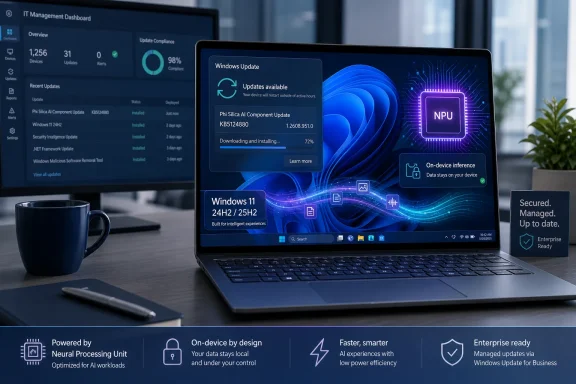 KB5124880 is limited to Intel Copilot+ hardware
The wording “Intel-powered systems” is significant. KB5124880 is not a general Phi Silica update for every Windows 11 PC, every NPU vendor, or even every Intel laptop. Microsoft explicitly limits it to Copilot+ PCs, the hardware category that requires an NPU capable of at least 40 TOPS of AI performance.
Microsoft’s Copilot+ developer documentation identifies Intel Core Ultra 200V systems among the supported Intel hardware families. The company’s broader Windows AI documentation says Phi Silica uses the NPU on Copilot+ systems for low-latency, power-efficient local inference. A conventional Intel PC without qualifying Copilot+ hardware should not expect this component to arrive simply because it runs Windows 11 24H2 or 25H2.
That distinction avoids an easy misreading of the support article. Windows Update history can contain many components labeled as “AI” that are tied to device capabilities, drivers, and installed Windows features. KB5124880 is a model update for a specific supported hardware path; it is not evidence that Microsoft has extended all Phi Silica functionality to Intel Windows PCs generally.
Microsoft has not published the exact Intel processor list for KB5124880, nor has it listed a minimum NPU driver version in the article. In managed fleets, the useful eligibility test is therefore more concrete than the processor badge: verify that the endpoint is recognized as an Intel-based Copilot+ PC, is running Windows 11 24H2 or 25H2, and has received the latest cumulative update for that release.
The component matters chiefly to apps using Windows AI APIs
Phi Silica is Microsoft’s on-device small language model, or SLM. It provides local text generation, summarization, rewriting, and text-to-table functions through the Windows AI APIs, rather than sending the prompt to a cloud-hosted model as part of inference.
Microsoft’s developer documentation says the NPU version is preinstalled and system-managed on Copilot+ PCs. That makes KB5124880 different from an ordinary app update: developers do not package this specific model version with each application, and users do not need to visit an app store to receive it. Windows supplies the underlying component.
For application developers, the lack of a detailed changelog is the notable limitation. Microsoft has not said whether version 1.2608.951.0 changes output quality, latency, prompt handling, safety filtering, memory use, or API behavior. An app that relies on tightly evaluated Phi Silica prompts should treat the update as a reason to run regression checks, especially where generated text is compared against expected formatting or constrained outputs.
The update also does not change the core warning attached to local language models. Microsoft’s own Phi Silica transparency material says the model can produce inaccurate or fabricated content and should not be used as the sole factual authority in medical, legal, financial, safety-critical, or other high-stakes workflows. Keeping inference on-device can reduce the need to transmit a prompt to a remote AI service, but it does not make the output automatically reliable.
GPU availability does not broaden KB5124880’s scope
Microsoft’s current Phi Silica documentation now describes a separate route for supported non-Copilot+ Windows 11 PCs: GPU-based inference on certain NVIDIA GeForce RTX 30-series-or-newer GPUs and AMD Radeon RX 9060-series-or-newer GPUs, each with at least 6GB of VRAM. That support has separate requirements, including Developer Mode, experimental Windows and Windows App SDK builds, and vendor-provided GPU drivers.
Those GPU systems should not be confused with the Intel package in KB5124880. Microsoft says the GPU model is downloaded on demand when an app calls the relevant readiness API, can consume several gigabytes, and can be removed through Settings > System > AI Components. By contrast, the NPU model on a Copilot+ PC is managed as part of the system’s AI component delivery.
The distinction has operational consequences. A help-desk ticket about the new KB appearing automatically belongs to the managed Copilot+ device path. A developer testing Phi Silica on a desktop RTX GPU faces a different deployment model, different driver dependencies, potentially higher power use, and no NPU-specific advantages such as prompt compression and speculative decoding.
Microsoft also says GPU-based Phi Silica inference can have higher latency and more variable performance because it depends on GPU generation, VRAM, workload contention, and drivers. KB5124880 offers no basis for extrapolating performance or compatibility results from an Intel Copilot+ notebook to those GPU configurations.
A new Phi Silica build arrives shortly before its planned replacement
The deeper context is that Microsoft has already set an end date for Phi Silica. Its Windows App SDK documentation says Phi Silica is being replaced by Aion Instruct, a new on-device model. Microsoft plans to make a standalone Aion package available for testing and LoRA training in early October 2026, begin an Insider rollout later that month, and roll it out to retail devices in November 2026; the company says Phi Silica will then be removed.
That timetable makes KB5124880 a maintenance release near the end of Phi Silica’s life as the active Windows-supplied language model. It is still relevant for existing applications and supported Intel Copilot+ PCs over the next several weeks, but it should not be mistaken for a long-term platform commitment to this particular model.
Microsoft says Aion Instruct will initially coexist with Phi Silica during the Insider phase, with the active model selected through a Windows Controlled Feature Rollout. Developers will be able to test the two side by side through a registry key, according to the company’s documentation. That is a much more consequential upcoming compatibility point than the silent version increment in KB5124880.
For now, enterprises should confirm that eligible Intel Copilot+ devices are current on their cumulative updates and check Update history for KB5124880 if validating model-component compliance. Developers with Phi Silica integrations should record the 1.2608.951.0 baseline, test critical local-generation flows, and begin planning for Aion Instruct before Microsoft’s stated November 2026 removal of Phi Silica from retail Windows devices.
