
The practical message is unusually direct: software must stop treating a particular Microsoft certificate, thumbprint, issuer, key length, or hashing algorithm as the definition of trust. Microsoft says it has already identified applications that break when those signing details change, even though the operating system’s own Authenticode validation succeeds.
The schedule is short. Microsoft says a replacement production CA is already being introduced in the coming weeks, stronger signing configurations including RSA-3072 and SHA-384 are planned by the end of 2026, and Windows production signing is expected to move to post-quantum cryptography by default in 2027. For organizations running Windows 10 LTSC or Windows Server estates alongside newer Windows 11 deployments, this is one of those infrastructure changes where a latent bug can appear everywhere at once.
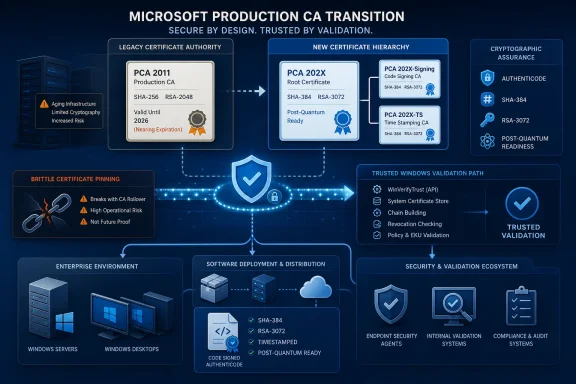 Certificate pinning is the failure mode Microsoft is warning about
A signed Windows executable carries more than a yes-or-no trust result. It also contains a certificate chain, named issuers, serial numbers, public keys, signature algorithms, timestamps, and other metadata. Developers sometimes inspect those details directly to answer a narrower question: “Was this file signed by this exact Microsoft certificate hierarchy?”
That practice is commonly called certificate pinning when the application demands a known certificate or CA identity rather than asking whether the operating system trusts the signature for the intended purpose. It can feel like a security improvement. In this case, it turns a normal certificate renewal into an outage trigger.
Microsoft’s KB5125813 specifically calls out code that pins Microsoft certificate subjects, issuers, thumbprints, serial numbers, or intermediate CAs. It also warns against validation logic that insists on SHA-256, RSA-2048, or another fixed cryptographic combination. A tool can therefore produce an alarming but misleading result: Windows accepts a Microsoft-signed file; the tool calls it invalid because its embedded allowlist describes the certificate chain that existed years earlier.
This is a false rejection problem, not evidence that the newly signed file is unsafe. It is also broader than consumer desktop software. The likely exposure points include software inventory agents that validate update packages, endpoint security products that make signer-based decisions, application-control wrappers, installers, recovery utilities, patch-management systems, and internal compliance tools that examine PE signatures or catalog files outside the Windows trust pipeline.
Microsoft’s advisory does not name affected products, publish a list of incompatible applications, or provide the replacement CA’s identity. That omission is important. IT teams cannot safely solve this by adding one new thumbprint to an allowlist today, and they should not assume that a future CA replacement will be a one-time exception. Microsoft is explicitly setting the expectation that certificate rotations and algorithm changes will continue.
Windows trust APIs are the supported contract
Microsoft’s prescribed remedy is to validate Windows’ trust decision, rather than parse Authenticode data or certificate chains in custom code. For a file signed with the normal Authenticode policy, that generally means using WinVerifyTrust with the appropriate verification action. Microsoft Learn describes WinVerifyTrust as a way to send an object to a registered trust provider; the Authenticode policy can determine whether a PE file comes from a trusted publisher and has not been altered since signing.
The detail that developers must get right is mundane but consequential: WinVerifyTrust returns a LONG, and only a return value of zero means success. Treating its output as an HRESULT and applying macros such as SUCCEEDED() is itself incorrect, because nonzero trust-provider return values must not be accepted as a successful trust result.
For certificate-chain scenarios rather than file Authenticode verification, Microsoft Learn points developers toward CertGetCertificateChain and CertVerifyCertificateChainPolicy. The decision between these APIs depends on what the application is actually trying to establish. A product verifying a downloaded Windows executable should not quietly substitute a generic chain check for the Authenticode policy it intends to enforce; conversely, a product with a certificate-policy use case should not scrape the signer data out of a PE file and reinvent chain validation.
The broader design rule is cryptographic agility: code should express the security property it needs—such as “Windows considers this package trusted under Authenticode policy”—without encoding the presently used CA, RSA modulus length, or digest algorithm as a permanent protocol requirement.
This does not mean every application must accept any signature Windows happens to validate. Products can have legitimate requirements around file origin, publisher identity, extended key usage, revocation, timestamps, or a managed enterprise publisher policy. But those requirements need to be expressed through an updateable policy and supported trust APIs, not a brittle assumption that a valid Microsoft signature must always contain a particular 2011-era CA name or RSA-2048/SHA-256 pairing.
The expiring PCA is also part of the Secure Boot transition
The Microsoft Windows Production PCA 2011 name is already prominent in Microsoft’s separate Secure Boot certificate-transition documentation. Microsoft Learn says that certificate expires on October 19, 2026, and identifies Windows UEFI CA 2023 as the replacement trust anchor used for signing the Windows boot loader in the Secure Boot database.
That context explains why the date is a hard operational milestone, but it must not be oversimplified. Secure Boot trust resides in UEFI firmware variables such as the signature database, while the new KB addresses Windows production signing compatibility more broadly. A tool that validates signed files within Windows and firmware that verifies the boot manager are related by PKI history, but they are not the same validation path and do not have the same remediation.
For example, Microsoft’s Azure Stack Hub guidance says systems that have not refreshed the required Secure Boot certificates may continue operating in the near term, yet become unable to take future updates that rely on newer signing authorities. Its documented fix includes OEM firmware packages and platform updates that ensure the newer certificate chain is present and the boot manager has transitioned. That is a firmware and platform-maintenance project, not an application-code change.
KB5125813, by contrast, tells developers to remove certificate and algorithm assumptions from signature validation. Administrators should avoid conflating the two: updating firmware addresses firmware trust anchors; updating an internal deployment agent may be necessary to stop it from rejecting an otherwise trusted Windows update, installer, catalog, or binary.
Microsoft has not said that every conventional Windows file signature will immediately switch to Windows UEFI CA 2023. The support article only says a replacement production CA with equivalent security properties is being deployed. Organizations should wait for Microsoft’s final certificate publication and test material rather than hard-coding an anticipated replacement based on the Secure Boot documentation.
What enterprise administrators should ask vendors now
The action item belongs with both Windows engineering and procurement teams. An administrator cannot remediate a vendor product’s embedded thumbprint comparison with a Group Policy setting or a cumulative update; the supplier has to change its validation logic or publish an updateable trust policy.
Start with the software that has permission to block execution, approve updates, validate Microsoft packages, inspect signatures, or mirror certificates internally. Microsoft’s own checklist asks customers to determine whether critical vendors use supported Windows trust APIs, pin Microsoft certificates or CAs, have tested replacement certificate hierarchies and SHA-384 signatures, maintain private trust stores, and have a plan for post-quantum signing changes.
A focused vendor questionnaire is more useful than a generic “Are you ready for PQC?” survey:
- Ask whether the product makes any signer decision based on a Microsoft certificate subject, issuer, thumbprint, serial number, intermediate CA, public-key length, or hash algorithm.
- Ask whether it uses
WinVerifyTrust, CryptoAPI chain-policy APIs, or proprietary Authenticode and PKCS#7 parsing for Windows file validation. - Ask for a tested release date, supported versions, and a documented workaround if the product has an independent trust store.
- Ask whether SHA-384 and RSA-3072 test artifacts have been validated in the exact product version deployed in production.
- Ask whether the supplier’s trust policy can be updated without a full product upgrade, especially for appliances and long-lived management servers.
In-house software deserves the same scrutiny. Search code repositories and deployment scripts for Microsoft certificate common names, SHA-256 requirements, RSA-2048 checks, fixed certificate hashes, embedded certificate bundles, and direct parsing of Authenticode or CMS/PKCS#7 structures. The most problematic code may not be the main Windows application; it may be a small updater, installer bootstrapper, endpoint agent, or CI/CD gate that has not been revised in years.
The 2027 PQC deadline changes the engineering priority
Microsoft’s 2027 post-quantum plan is the longer-term reason this advisory should not be treated as a one-off certificate expiration. The company says future Windows signatures may use new algorithms and hybrid signature constructions, with rapid adjustments possible as PQC standards and customer requirements develop.
For developers, that makes the correct fix architectural. Replacing the Microsoft Windows Production PCA 2011 thumbprint with a new thumbprint only postpones the next incident. Replacing an RSA-2048/SHA-256 assertion with an RSA-3072/SHA-384 assertion does the same. The durable fix is to remove identity and algorithm assumptions that were never a supported stability contract.
The first live deadline is October 19, 2026, but the most urgent work should happen before Microsoft’s replacement CA rollout reaches the systems and tools that control your Windows estate. Audit signature-validation paths now, obtain a vendor answer for every critical control point, and treat any product that cannot validate a Windows-trusted signature without recognizing a specific old certificate as a compatibility defect awaiting activation.