
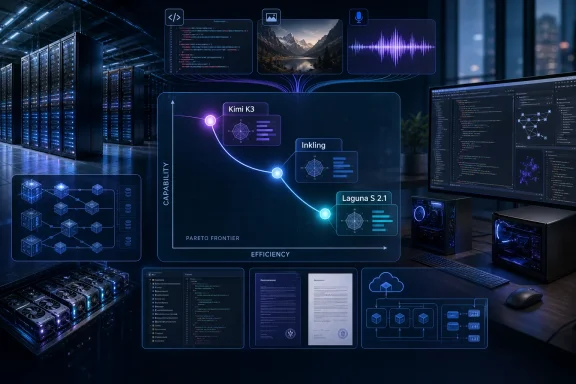
Three newly released open-weight models—Poolside’s Laguna S 2.1, Thinking Machines Lab’s Inkling, and Moonshot AI’s Kimi K3—make a more useful point than their benchmark charts alone: organizations can now choose among materially different capability, deployment, and licensing trade-offs instead of treating “open models” as one category.
That is the practical takeaway from Interconnects AI’s latest open-artifacts roundup. The three releases arrived within roughly two weeks of one another in July: Inkling on July 15, Kimi K3’s public model release later in the month, and Laguna S 2.1 on July 21. Each is positioned for long-running coding and agent workflows, but they occupy very different points on the cost, hardware, and legal Pareto frontier—the set of choices where improving one property means accepting a cost elsewhere.
For Windows developers and IT teams, the important change is not that a local chatbot can answer questions. It is that model weights capable of planning code changes, using tools, handling large repositories, and processing multimodal inputs are increasingly available for self-hosting. The catch is that “available weights” does not automatically mean “runs on a Windows workstation,” “fits a typical GPU,” or “can be embedded in a commercial service without review.”
Moonshot AI’s Kimi K3 is the headline-grabber on raw scale: a 2.8-trillion-parameter mixture-of-experts model with 104 billion active parameters per token, native vision support, and a one-million-token context window. Moonshot’s technical report says it trails the strongest proprietary systems in its own evaluations, while outperforming the other models it tested across several coding, agentic, reasoning, and vision tasks.
The full weights are publicly available, and Moonshot has published recipes for vLLM, SGLang, and TokenSpeed. The released model also uses MXFP4 weights and MXFP8 activations, a quantization-oriented design intended to reduce the otherwise impossible deployment burden of a 2.8T-parameter model.
But Kimi K3 is not Apache-licensed software, and that distinction is easy to lose in the rush to call it “open source.” Its Kimi K3 License permits use, modification, redistribution, fine-tuning, and commercial deployment. It then imposes a separate-agreement requirement on an operator of a “Model as a Service” business once aggregate revenue across the operator and affiliates exceeds $20 million over any consecutive 12-month period.
The license also requires prominent Kimi K3 branding in commercial products or services that exceed either 100 million monthly active users or $20 million in monthly revenue. Internal use is expressly excluded from those conditions, as is use through Moonshot’s official products or certified inference partners.
That means Interconnects AI’s reference to “revenue-share licenses like Kimi K3” overstates what the published Kimi K3 License actually says. The document requires a separate agreement above a revenue threshold for qualifying model-service operators; it does not state a revenue-share percentage, a mandatory Moonshot-hosted inference contract, or a payment requirement for internal deployment. A large company offering Kimi K3 through its own API should absolutely have counsel read the terms. A company running the model internally for coding assistance, document analysis, or test automation faces a different licensing picture.
There is a second operational limitation. Kimi K3 is open-weight, but its scale puts it far beyond the usual “download it and run it locally” expectation. Moonshot’s own documentation recommends server-class inference stacks, and the company’s Kimi subscription service temporarily paused new subscriptions after demand exceeded available capacity. The model can be self-hosted, but the hardware and serving expertise required make it a data-center or specialist-provider decision, not a straightforward Windows desktop deployment.
The significant detail is its license: Apache 2.0. Inkling’s model card explicitly identifies Apache 2.0 as the model license, putting it in a familiar legal category for enterprise software teams. Apache 2.0 permits commercial use, modification, distribution, and private use, along with an express patent grant, subject to its notice and license requirements.
Thinking Machines separately publishes an acceptable-use policy that prohibits illegal activity, certain weaponization, malicious code and cyberweapons, prohibited biometric applications, and export-control violations. Those restrictions matter operationally, but they do not turn Inkling into a bespoke commercial licensing negotiation in the way Kimi K3 can become for a large model-serving business.
Reuters described Inkling as one of the few prominent U.S.-based alternatives to the Chinese labs’ open-weight releases. That framing holds up on the legal record more than it does on the simplistic question of which model has the largest parameter count. Inkling gives a U.S. enterprise a permissively licensed, multimodal model that can be fine-tuned and integrated without a scale-triggered branding rule or separate commercial agreement.
Its drawback is physical rather than contractual. Forty-one billion active parameters is far more manageable than Kimi K3’s 104 billion, but Inkling remains a serious inference workload. A Windows team can build against it through containers, WSL, remote Linux servers, or hosted inference, yet it is not a sensible target for most PCs with a single consumer GPU. “Open-weight” means the deployment option exists; it does not eliminate capacity planning.
Poolside says Laguna S 2.1 scored 70.2% on Terminal-Bench 2.1, 59.4% on SWE-Bench Pro’s public dataset, and 40.4% on DeepSWE v1.1. Those are vendor-supplied results, and the comparisons require care because agent benchmarks often vary by harness, tool permissions, prompt strategy, reasoning settings, budgets, and number of attempts. Poolside’s own table compares systems using the highest publicly cited results, which is useful context but not a controlled head-to-head evaluation.
The more consequential claim is deployment. Poolside says Laguna S 2.1 can run on a single NVIDIA DGX Spark. That is a much more precise proposition than “runs on a single desktop.” A DGX Spark is a purpose-built AI workstation with 128GB of unified memory, not the average Windows tower with a 16GB or 24GB graphics card.
Community reports from NVIDIA’s DGX Spark forum and local-model users show Laguna S 2.1 can run at usable token rates on that class of hardware and on large-memory Apple Silicon machines, particularly through quantized variants. They also document early compatibility quirks, including looping behavior and differences among runtimes and conversions. Those reports are too inconsistent to establish a universal performance figure, but they confirm the key deployment truth: the model is plausible on a high-memory workstation, not on ordinary consumer gaming hardware.
Poolside distributes Laguna S 2.1 under OpenMDW-1.1 rather than Apache 2.0. That makes it less legally frictionless than Inkling, although Poolside describes the model as free to use. Enterprises should review OpenMDW-1.1 before treating it as interchangeable with an OSI-style permissive license. This is exactly why model selection should begin with the license and serving plan, not a leaderboard.
Kimi K3 offers extreme scale and one-million-token context, but comes with infrastructure demands and a license that changes for high-revenue model-service businesses. Inkling provides multimodal capability and an Apache 2.0 license, but its 975B total-parameter architecture remains a heavy deployment target. Laguna S 2.1 is smaller and tuned around coding agents, making it the closest fit for a controlled on-premises deployment—provided “on premises” includes a DGX Spark-class machine or a server with comparable memory.
For Windows shops, the near-term opportunity is a split architecture: run a smaller coding-oriented model such as Laguna S 2.1 behind an internal OpenAI-compatible endpoint for routine repository work, keep sensitive source and documents inside the organization, and reserve proprietary cloud models for tasks where their higher capability justifies sending data outside. Inkling and Kimi K3 belong in the evaluation queue for teams with bigger GPU budgets or a managed inference provider.
The release cadence is the real pressure on closed-model vendors. A year ago, choosing self-hosted weights usually meant accepting a clear capability penalty. In August 2026, the choice is increasingly about which compromise a team prefers: hardware cost, response latency, license obligations, multimodal requirements, or dependence on a vendor’s API.
For Windows developers and IT teams, the important change is not that a local chatbot can answer questions. It is that model weights capable of planning code changes, using tools, handling large repositories, and processing multimodal inputs are increasingly available for self-hosting. The catch is that “available weights” does not automatically mean “runs on a Windows workstation,” “fits a typical GPU,” or “can be embedded in a commercial service without review.”
Kimi K3 is open-weight, but its license has a commercial trigger
Moonshot AI’s Kimi K3 is the headline-grabber on raw scale: a 2.8-trillion-parameter mixture-of-experts model with 104 billion active parameters per token, native vision support, and a one-million-token context window. Moonshot’s technical report says it trails the strongest proprietary systems in its own evaluations, while outperforming the other models it tested across several coding, agentic, reasoning, and vision tasks.The full weights are publicly available, and Moonshot has published recipes for vLLM, SGLang, and TokenSpeed. The released model also uses MXFP4 weights and MXFP8 activations, a quantization-oriented design intended to reduce the otherwise impossible deployment burden of a 2.8T-parameter model.
But Kimi K3 is not Apache-licensed software, and that distinction is easy to lose in the rush to call it “open source.” Its Kimi K3 License permits use, modification, redistribution, fine-tuning, and commercial deployment. It then imposes a separate-agreement requirement on an operator of a “Model as a Service” business once aggregate revenue across the operator and affiliates exceeds $20 million over any consecutive 12-month period.
The license also requires prominent Kimi K3 branding in commercial products or services that exceed either 100 million monthly active users or $20 million in monthly revenue. Internal use is expressly excluded from those conditions, as is use through Moonshot’s official products or certified inference partners.
That means Interconnects AI’s reference to “revenue-share licenses like Kimi K3” overstates what the published Kimi K3 License actually says. The document requires a separate agreement above a revenue threshold for qualifying model-service operators; it does not state a revenue-share percentage, a mandatory Moonshot-hosted inference contract, or a payment requirement for internal deployment. A large company offering Kimi K3 through its own API should absolutely have counsel read the terms. A company running the model internally for coding assistance, document analysis, or test automation faces a different licensing picture.
There is a second operational limitation. Kimi K3 is open-weight, but its scale puts it far beyond the usual “download it and run it locally” expectation. Moonshot’s own documentation recommends server-class inference stacks, and the company’s Kimi subscription service temporarily paused new subscriptions after demand exceeded available capacity. The model can be self-hosted, but the hardware and serving expertise required make it a data-center or specialist-provider decision, not a straightforward Windows desktop deployment.
Inkling is the clearest licensing option, not the smallest model
Thinking Machines Lab’s Inkling takes nearly the opposite route. It is a 975-billion-parameter multimodal mixture-of-experts model, activating roughly 41 billion parameters for a given token according to the company’s release materials. It accepts text, image, and audio inputs and produces text output, including code and structured data. Thinking Machines says the model supports configurable reasoning effort, allowing operators to trade latency and cost for stronger results.The significant detail is its license: Apache 2.0. Inkling’s model card explicitly identifies Apache 2.0 as the model license, putting it in a familiar legal category for enterprise software teams. Apache 2.0 permits commercial use, modification, distribution, and private use, along with an express patent grant, subject to its notice and license requirements.
Thinking Machines separately publishes an acceptable-use policy that prohibits illegal activity, certain weaponization, malicious code and cyberweapons, prohibited biometric applications, and export-control violations. Those restrictions matter operationally, but they do not turn Inkling into a bespoke commercial licensing negotiation in the way Kimi K3 can become for a large model-serving business.
Reuters described Inkling as one of the few prominent U.S.-based alternatives to the Chinese labs’ open-weight releases. That framing holds up on the legal record more than it does on the simplistic question of which model has the largest parameter count. Inkling gives a U.S. enterprise a permissively licensed, multimodal model that can be fine-tuned and integrated without a scale-triggered branding rule or separate commercial agreement.
Its drawback is physical rather than contractual. Forty-one billion active parameters is far more manageable than Kimi K3’s 104 billion, but Inkling remains a serious inference workload. A Windows team can build against it through containers, WSL, remote Linux servers, or hosted inference, yet it is not a sensible target for most PCs with a single consumer GPU. “Open-weight” means the deployment option exists; it does not eliminate capacity planning.
Laguna S 2.1 targets the hardware gap between a laptop model and a cluster model
Poolside’s Laguna S 2.1 is the most immediately relevant of the three for organizations that care about self-hosted coding agents but cannot justify Kimi K3- or Inkling-class infrastructure. Poolside released it as a 118-billion-parameter mixture-of-experts model with 8 billion active parameters per token, designed around agentic coding and long-horizon work.Poolside says Laguna S 2.1 scored 70.2% on Terminal-Bench 2.1, 59.4% on SWE-Bench Pro’s public dataset, and 40.4% on DeepSWE v1.1. Those are vendor-supplied results, and the comparisons require care because agent benchmarks often vary by harness, tool permissions, prompt strategy, reasoning settings, budgets, and number of attempts. Poolside’s own table compares systems using the highest publicly cited results, which is useful context but not a controlled head-to-head evaluation.
The more consequential claim is deployment. Poolside says Laguna S 2.1 can run on a single NVIDIA DGX Spark. That is a much more precise proposition than “runs on a single desktop.” A DGX Spark is a purpose-built AI workstation with 128GB of unified memory, not the average Windows tower with a 16GB or 24GB graphics card.
Community reports from NVIDIA’s DGX Spark forum and local-model users show Laguna S 2.1 can run at usable token rates on that class of hardware and on large-memory Apple Silicon machines, particularly through quantized variants. They also document early compatibility quirks, including looping behavior and differences among runtimes and conversions. Those reports are too inconsistent to establish a universal performance figure, but they confirm the key deployment truth: the model is plausible on a high-memory workstation, not on ordinary consumer gaming hardware.
Poolside distributes Laguna S 2.1 under OpenMDW-1.1 rather than Apache 2.0. That makes it less legally frictionless than Inkling, although Poolside describes the model as free to use. Enterprises should review OpenMDW-1.1 before treating it as interchangeable with an OSI-style permissive license. This is exactly why model selection should begin with the license and serving plan, not a leaderboard.
The benchmark story is useful only after the deployment story
These releases are evidence against the simplistic view that frontier model development must collapse into a handful of closed API providers. Poolside, Thinking Machines Lab, and Moonshot have all spent heavily to train models, then released weights instead of reserving all capability for their own hosted products. The resulting market has more viable choices, but it has also made the term “open” less precise.Kimi K3 offers extreme scale and one-million-token context, but comes with infrastructure demands and a license that changes for high-revenue model-service businesses. Inkling provides multimodal capability and an Apache 2.0 license, but its 975B total-parameter architecture remains a heavy deployment target. Laguna S 2.1 is smaller and tuned around coding agents, making it the closest fit for a controlled on-premises deployment—provided “on premises” includes a DGX Spark-class machine or a server with comparable memory.
For Windows shops, the near-term opportunity is a split architecture: run a smaller coding-oriented model such as Laguna S 2.1 behind an internal OpenAI-compatible endpoint for routine repository work, keep sensitive source and documents inside the organization, and reserve proprietary cloud models for tasks where their higher capability justifies sending data outside. Inkling and Kimi K3 belong in the evaluation queue for teams with bigger GPU budgets or a managed inference provider.
The release cadence is the real pressure on closed-model vendors. A year ago, choosing self-hosted weights usually meant accepting a clear capability penalty. In August 2026, the choice is increasingly about which compromise a team prefers: hardware cost, response latency, license obligations, multimodal requirements, or dependence on a vendor’s API.
References
- Primary source: interconnects.ai
Published: 2026-08-02T13:01:40+00:00
Loading…
www.interconnects.ai - Related coverage: tomsguide.com
Loading…
www.tomsguide.com - Related coverage: tomshardware.com
Moonshot AI releases weights for Kimi-K3, firing a shot across the bow of OpenAI and Anthropic — open-weight model performs almost as well as frontier models while being 2-3x easier to run | Tom's Hardware
Cached prompts can reach a 10x inference cost gain versus Anthropic and OpenAI's offeringswww.tomshardware.com - Related coverage: itpro.com
Big tech faces an adapt or die predicament with open weight AI models | IT Pro
An array of US tech providers are now defending the AI models that undermine the illusion of big tech exceptionalismwww.itpro.com - Related coverage: tomsguide.com
Loading…
www.tomsguide.com - Related coverage: theweek.com
Moonshot’s Kimi K3, the Chinese AI model spooking Silicon Valley | The Week
Beijing start-up’s new release is as powerful as most rivals and cheaper to run, threatening US dominancetheweek.com - Related coverage: theweek.com
Loading…
theweek.com - Related coverage: github.com
Loading…
github.com - Related coverage: kimi-k3.net
Loading…
kimi-k3.net - Related coverage: modal.com
Loading…
modal.com - Related coverage: huggingface.co
Loading…
huggingface.co - Related coverage: ibm.com
Loading…
www.ibm.com - Related coverage: vorplabs.com
Loading…
vorplabs.com - Related coverage: docs.empiriolabs.ai
Loading…
docs.empiriolabs.ai - Related coverage: huggingface.co
Loading…
huggingface.co - Related coverage: intuitionlabs.ai
- Related coverage: techradar.com
Moonshot reveals new AI model, and it's a big surprise — here's why Kimi K3 is a threat to the likes of OpenAI | TechRadar
Boldly catching up with US AI giants on the frontierwww.techradar.com - Related coverage: omni.se
Loading…
omni.se - Related coverage: cincodias.elpais.com
Loading…
cincodias.elpais.com - Related coverage: github.com
Loading…
github.com - Related coverage: forums.developer.nvidia.com
Loading…
forums.developer.nvidia.com - Related coverage: constellationr.com
Loading…
www.constellationr.com - Related coverage: geeky-gadgets.com
Loading…
www.geeky-gadgets.com - Related coverage: boards.4chan.org
Loading…
boards.4chan.org - Related coverage: tomshardware.com
China's Moonshot AI reportedly used Nvidia Blackwell chips for training Kimi K3 — company circumvented both U.S. export and Chinese import controls to acquire compute | Tom's Hardware
The US gov't says Moonshot has purchased Blackwell systems and rented time on foreign clouds to help it train models.www.tomshardware.com - Related coverage: thinkingmachines.ai
Loading…
thinkingmachines.ai - Related coverage: techcrunch.com
Loading…
techcrunch.com - Related coverage: thinkingmachines.ai
Loading…
thinkingmachines.ai - Related coverage: globenewswire.com
Loading…
www.globenewswire.com - Related coverage: poolside.ai
Loading…
poolside.ai - Related coverage: kimi.com
Loading…
www.kimi.com - Related coverage: kimi.com
Loading…
www.kimi.com - Related coverage: axios.com
Loading…
www.axios.com