
Supply Chain Dive reported Wednesday that Lenovo is expanding its “global local” manufacturing strategy as AI infrastructure demand consumes available memory and other server components. Lenovo’s Ben Massie, vice president of global supply chain for servers and storage, told the publication that the company has accumulated a “very large” server-order backlog and is giving shorter lead times to long-term customers that plan purchases with Lenovo.
The record supports the broad expansion. Lenovo announced the Whitsett investment on July 24, saying production at the enlarged facility was already under way. The company also confirmed its Saudi partnership with Alat in February 2025, saying the Riyadh operation would make laptops, desktops and servers for the region. But the latest reporting exposes a more consequential limitation: more regional assembly capacity does not create more constrained chips, memory modules, power-management parts or board-management controllers.
For IT departments, Lenovo’s manufacturing shift may improve where systems are built, customized and shipped. It does not eliminate the need to order infrastructure early, qualify alternatives, and get specific commitments on configuration-level delivery dates.
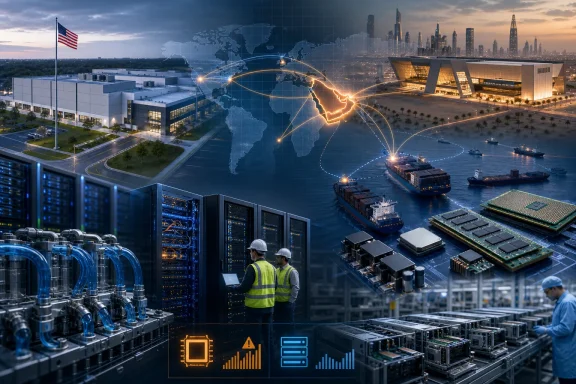 Whitsett’s footprint doubled, but Lenovo says capacity rose 35%
The North Carolina announcement deserves a closer reading than the shorthand that Lenovo “doubled capacity.” Lenovo says the Whitsett campus footprint is now 890,000 square feet—twice its previous size—and that it has added 35% more manufacturing capacity. Those are related measurements, but they are not interchangeable.
Floor space includes warehousing, staging, testing, logistics, engineering and future expansion room. Manufacturing output depends on assembly lines, labor, component availability, test equipment, rack integration capacity and the mix of systems being built. A facility producing compact PCs can turn out more units per square foot than one assembling GPU-dense, liquid-cooled AI server racks. Lenovo says Whitsett is prepared for 20 megawatts of power and designed around the next two generations of high-performance computing systems, which suggests the expansion is aimed at more than routine x86 server assembly.
The company also says the Whitsett operation will create roughly 1,000 jobs over time, with more than 400 positions already filled when it announced the expansion. Tom’s Hardware separately reported from the site following the July ribbon-cutting, describing seven assembly lines at the facility. That independently supports the physical expansion, though neither Lenovo nor its construction partner has published a product-by-product throughput target.
That missing number matters. A 35% increase in factory capacity could materially improve Lenovo’s ability to configure and ship systems for U.S. customers, especially hyperscalers and enterprises buying standardizable rack designs. It does not tell buyers how much of that capacity is allocated to AI racks, conventional ThinkSystem servers, storage, or client hardware, nor whether it is sufficient to reduce existing order queues.
Lenovo’s July announcement also frames the investment as an expansion of U.S. server production. In a tariff-sensitive environment, that may reduce exposure on finished-system imports and shorten the final leg between factory and customer. It cannot localize every upstream dependency. Motherboards, processors, memory, accelerators, networking silicon and power components remain global supply-chain products even when final assembly occurs in North Carolina.
Riyadh production creates a second regional node
Lenovo’s Saudi plant is the other half of the strategy, and it has been in development longer than this week’s report may imply. Lenovo and Alat broke ground in Riyadh in February 2025 after completing a $2 billion strategic investment agreement. Lenovo said then that the site would make millions of “Saudi Made” laptops and desktops as well as servers, and would become part of its network of more than 30 manufacturing sites across 11 markets.
Supply Chain Dive now reports that Riyadh began producing PCs in December 2025, while the broader facility’s opening has slipped until the fall of 2026 after the Iran war delayed a planned summer launch. That timing and the reason for the delay come from Supply Chain Dive’s interview with Massie; Lenovo’s public materials located for this report confirm the planned manufacturing hub but do not provide the same updated operational timetable.
The reported scale is considerable. Supply Chain Dive describes an 11-building, 2.15 million-square-foot campus developed with Alat, a Saudi Public Investment Fund-backed company. Lenovo’s original announcement described a 200,000-square-meter manufacturing site in Riyadh’s Special Integrated Logistics Zone near King Khalid International Airport. The figures are broadly compatible: 200,000 square meters is roughly 2.15 million square feet.
Regional production can make a practical difference for organizations in the Middle East and Africa that otherwise rely on products built farther away. A locally oriented factory can shorten freight routes, simplify regional configuration and support requirements around local content, procurement preferences and service responsiveness. Lenovo has also built a regional headquarters in Riyadh and has trained Saudi engineers through a manufacturing program tied to the project.
Yet the factory should not be mistaken for a fully self-contained local supply chain. The benefit is flexibility: Lenovo can decide which final products to build in which geography as trade rules, freight conditions and demand change. The vulnerable step remains the availability of globally supplied components that must arrive before a server can be completed.
AI demand is constraining ordinary server parts too
Lenovo’s server backlog is occurring against a broader component squeeze. TrendForce said in April that component lead times for general-purpose servers were approaching a year in some categories, including PCBs and CPUs, because suppliers were prioritizing higher-margin AI server products. It also cited increasing lead times for power-management ICs and baseboard-management-controller chips.
That detail changes how to interpret Lenovo’s factory expansion. AI infrastructure demand is not limited to GPU availability. It competes for conventional server inputs and factory resources, while high-power GPU systems demand more sophisticated cooling, power delivery and validation. Lenovo’s Whitsett site has expanded direct liquid-cooling capacity, an indication that it is preparing for systems with more demanding thermal requirements. But a finished rack remains delayed if a lower-profile component such as a BMC, PMIC or memory module is unavailable.
The pressure on memory is especially relevant to Windows Server and virtualization deployments. Organizations refreshing dense Hyper-V clusters, SQL Server estates or VDI infrastructure may find that the same DRAM market dynamics driving AI systems affect the cost and availability of traditional compute nodes. TrendForce has reported tight server-memory conditions through 2026, with suppliers favoring AI-related demand and long-term agreements.
Lenovo says it has increased inventory and uses its iChain supply-chain platform to monitor availability through first-, second- and third-tier suppliers. Such visibility can identify exposure early and help the company move orders between manufacturing nodes. It does not turn monitoring into additional supply.
Massie’s comment that long-term customers with planning commitments receive shorter lead times is equally revealing. Lenovo is signaling that allocation is being managed by relationship and forecast quality, not simply by the order in which a purchase request arrives. That may be commercially rational during scarcity, but it means late buyers and organizations running ad hoc procurement cycles could have less leverage.
A $54 billion pipeline is demand evidence, not a delivery schedule
Lenovo reported in its August first-quarter fiscal 2026/27 results that its AI server pipeline reached $54 billion, up 157% quarter over quarter. The company also said its Infrastructure Solutions Group revenue nearly doubled year over year. Those figures help explain why Lenovo is spending on manufacturing capacity in North Carolina and Saudi Arabia.
A pipeline, however, is not the same as booked revenue or a count of systems ready to ship. It represents prospective opportunities at varying stages of qualification, negotiation and commitment. Lenovo’s separate reference to a very large server backlog is more immediately relevant to delivery pressure, but the company has not disclosed the value, age, configuration mix or expected clearance date for that backlog.
That leaves enterprise buyers without the numbers needed to judge whether the new factory capacity will quickly change availability. Lenovo has not publicly said which server families will be built at Whitsett, when full Riyadh server production begins, which countries each site can serve, or how much the facilities will reduce lead times for customers.
The most useful reading of Lenovo’s “global local” push is therefore a disciplined one. The company is adding options: a larger U.S. server-manufacturing node, a new Saudi production base, and the ability to shift work as tariffs or geopolitical conditions change. It is a sensible response to volatile trade conditions and concentrated component supply.
But customers should treat it as a resiliency improvement rather than an availability guarantee. For server projects planned for late 2026, the prudent move is to lock configurations early, ask Lenovo for component-specific lead-time commitments, qualify equivalent memory and storage options where possible, and separate critical deployments from discretionary refreshes. The new plants may shorten the route to the customer; the bottleneck is still whether every part of the server reaches the line.
