
The company formally opened the 324,000-square-foot D1 facility on July 21. Wistron says it is the first U.S. mass-production site among Nvidia’s ODM partners to build GB300 baseboards, the core assemblies behind Nvidia’s Grace Blackwell Ultra AI systems. The factory is currently dedicated to Nvidia and handles Level 6 server manufacturing, a stage centered on board-level production and integration.
Wistron Chairman and Chief Strategy Officer Simon Lin told CommonWealth that the plant has roughly 500 employees today and is expected to reach about 1,000 by the end of 2026. That relatively lean staffing model is central to the economics: Wistron is betting that automation, digital-twin factory planning, and high-value AI hardware can offset the much higher cost of operating in the United States.
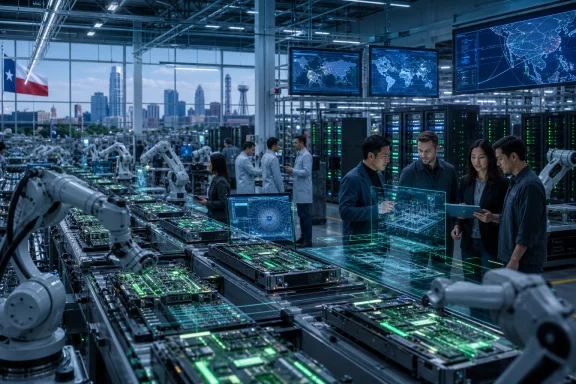 A Texas factory built around one customer
Wistron’s own opening announcement described D1 as its first U.S. smart factory and confirmed mass production of GB300 systems. The company says digital-twin modeling was used to design the site, cutting new-factory setup time by an estimated five or six months.
The D1 plant is not a broad U.S. manufacturing beachhead—at least not yet. It is a Nvidia-focused production node, with Wistron’s planned D2 facility nearby intended for other customers and potentially more advanced Level 10 and Level 11 assembly work. Those latter stages matter because they bring a manufacturer closer to complete rack-scale systems, validation, and deployment-ready integration.
For enterprise buyers and AI infrastructure operators, the practical takeaway is clear: more of Nvidia’s complex server supply chain is being assembled in North America, but crucial upstream components—including PCBs and semiconductors—will remain tied to Asian suppliers for the foreseeable future.
The engineering teams may matter more than the production floor
CommonWealth’s reporting makes the longer-term objective explicit. Wistron has established R&D teams in California and Texas that work directly with Nvidia engineers on new products, using its U.S. footprint as a recruiting lever for higher-end technical staff.
That is a different ambition from simply winning more contract-manufacturing volume. Lin acknowledged that Wistron’s gross margins have remained broadly unchanged despite rapid growth, and suggested that greater use of AI tokens could eventually support a higher-margin business. The details of that prospective operation remain unclear, but the direction is not: Wistron wants to capture more engineering and services value around AI infrastructure.
The timing is favorable. Wistron added NT$1.1 trillion in revenue during 2025, according to CommonWealth, surpassing Quanta to become the second-largest company in its peer group behind Foxconn. It plans NT$60 billion in capital expenditures this year while hiring 5,000 employees in Taiwan, on top of targeted expansion in Texas, Mexico, Vietnam, Malaysia, and China.
U.S. production will complement, not replace, Taiwan
Texas may be Wistron’s most visible new AI manufacturing investment, but Lin stressed that Taiwan remains the company’s primary production base. A new Kaohsiung facility is expected to begin operations by the end of 2026, while Mexico is positioned for higher-level server manufacturing and Vietnam for general-purpose servers.
That split is likely to define the next phase of AI hardware manufacturing. U.S. plants can provide proximity to Nvidia, hyperscalers, and domestic customers; Asian operations retain the deep component ecosystem, scale, and cost advantages that a new Texas assembly line cannot reproduce overnight.
D1 therefore represents more than a “Made in USA” Nvidia milestone. It is Wistron’s attempt to turn proximity to the AI industry’s most important customer into engineering capability—and eventually into a business with better margins than building boards alone.
