
Australia’s planned News Bargaining Incentive is becoming narrower in what it taxes and tougher in what platforms must do to avoid the charge. The revised design, reported by The Sydney Morning Herald ahead of the government’s expected Monday release, would apply a 2.5% levy to qualifying platforms’ Australian digital-advertising revenue rather than their total Australian revenue, while raising the minimum number of publisher deals required for relief from four to six.
For Windows and Microsoft watchers, the consequential change is the reported inclusion of LinkedIn and other “professional networking services.” Microsoft was expressly outside the April exposure draft because LinkedIn was excluded from the definition of a social-media service. If the reported revision survives into the bill, Microsoft’s Australian operations could no longer rely on that categorical exemption — but the government has not yet published the legal text that would show precisely which Microsoft revenue is in scope or how its existing Nine Entertainment AI-content agreement would be treated.
The change is therefore a significant policy turn, but not yet a bill that Microsoft, publishers, or tax advisers can apply to a balance sheet.
The Albanese government’s April 2026 exposure draft was built around a blunt backstop. A corporate group with more than A$250 million in Australian-attributable revenue that operated a significant social-media or search service could face a 2.25% News Media Bargaining Incentive charge if it did not make qualifying agreements with Australian news businesses.
Treasury’s draft set further service thresholds: at least five million active Australian users for social media, or 10 million for search. The government said the scheme was designed to catch Meta, Google, and TikTok, rather than create a general levy on every online business. It also made a critical change from Australia’s 2021 News Media Bargaining Code: a platform could not sidestep the framework merely by removing news links or refusing to host news content.
That was a direct response to Meta’s 2024 decision not to renew its commercial news agreements in Australia. Meta has argued that publishers voluntarily post to its services and receive value from the traffic and distribution; the government’s response has been to detach the new obligation from whether a platform chooses to carry news at all.
According to The Sydney Morning Herald, the final plan no longer uses total group revenue as the levy base. It instead targets revenue from digital advertising, while increasing the statutory charge from 2.25% to 2.5% to preserve the intended revenue. The paper reports that Treasury still expects the policy to return A$200 million to A$250 million a year to Australian journalism.
That is the “carrot” in the design. The platform can offset its charge through commercial arrangements with news publishers, making deals cheaper than simply paying the levy. Under the April draft, an ordinary qualifying agreement generated a 150% offset: spending roughly 1.5% of the relevant revenue could erase a 2.25% charge. Agreements with smaller publishers could earn a 170% offset, creating a stronger incentive to fund outlets with annual turnover below A$50 million.
The revised plan reportedly leaves the voluntary-deal rate unchanged. But its higher levy and six-publisher minimum make the avoidance route more demanding. A platform will need both enough money committed and a broader stable of counterparties.
The Digital Publishers Alliance, representing independent digital outlets, argued during consultation that four deals could still concentrate the benefit among a handful of large incumbent media groups. Its submission asked the government to require a larger number of agreements, reserve a share of levy proceeds for small and medium publishers, and broaden the eligibility test beyond traditional “core news” businesses.
The reported move from four to six deals answers part of that criticism, but it does not answer the more important distribution question: who counts as one of the six, and what minimum share of the money must reach smaller publishers?
A six-deal rule can widen access if it requires distinct, genuinely independent publishers and meaningful commitments. It can also become a compliance exercise if a platform assembles six low-value agreements, concentrates most expenditure with a few major groups, and claims the full offset. The April draft had no simple public rule requiring a percentage of offset-eligible spending to go to smaller outlets; the Digital Publishers Alliance specifically proposed one.
The government’s reported payment-scheme revisions appear aimed at the same concern. The Sydney Morning Herald says the definition of journalists will be expanded to include other essential newsroom roles and freelancers, with more funding directed to regional and community-serving publishers. It also reports a proposed grants program for very small publishers and start-ups with revenue below A$150,000.
Those changes matter only if platforms choose the levy route and money flows through the statutory distribution scheme. The government’s stated preference is that no charge is collected because platforms sign commercial agreements instead. In other words, the grants and weighted distribution model are a fallback, not the primary path.
That position was disputed during consultation. The Digital Publishers Alliance argued that LinkedIn carries publishers’ posts, serves as a news-distribution channel, and sells advertising against the attention generated on the service. Its submission called for the professional-networking exclusion to be removed. It also criticized the draft for explicitly excluding large language models and AI chatbots such as ChatGPT from the definition of a search service.
The reported final design appears to accept the first argument while leaving the second unresolved. LinkedIn may now be in scope, but no announced revision has said that AI assistants or large language models will be brought under the incentive. That distinction carries real implications for Microsoft.
Microsoft announced a content agreement with Nine Entertainment on July 3 under which Copilot can reference material from Nine’s mastheads to ground AI search outputs. Microsoft has described the arrangement as an Australian first for a major news company and its Copilot service. Nine has publicly portrayed the deal as revenue returning to journalism, while Microsoft says the system will provide attribution and links to original reporting.
Yet the April NBI draft excluded AI services from the targeted search-service definition. A revised law that includes LinkedIn but continues to exclude AI assistants would create an unusual split: Microsoft could face a levy tied to LinkedIn’s advertising activity while its Copilot content arrangements remain outside the service category that triggers the charge.
The unpublished final text is decisive here. It must answer several practical questions that neither the April draft nor the reported outline resolves:
Moving to digital-advertising revenue is a concession to that argument. It makes the policy look less like a charge on a company’s entire Australian presence and more like an intervention in the advertising markets that have displaced publishers’ traditional revenue.
But it also introduces a harder accounting problem. “Digital advertising revenue” is not self-executing language for companies that bundle ads with analytics, commerce, cloud measurement, enterprise sales tools, audience networks, or cross-platform campaigns. The final law will need workable rules on attribution, related-party arrangements, reporting periods, and the treatment of advertising sold outside Australia but displayed to Australian users.
The original design’s simplicity was politically costly: 2.25% of broad Australian revenue was easy to explain and difficult to evade through internal allocation. An advertising-only approach better tracks the government’s rationale, but gives companies and advisers more room to dispute the taxable base.
That tension is especially relevant for Microsoft. LinkedIn’s advertising business, Bing’s search advertising, Microsoft Audience Network activity, and AI-related advertising products do not necessarily map cleanly onto a single local revenue line. The government has not published a model showing what it considers Australian digital-advertising revenue for a multinational group, or whether the amount is measured before or after commissions, rebates, and partner payments.
The reported changes preserve that architecture. They make the levy more targeted, tighten the deal requirement, and potentially bring LinkedIn into a regime from which it was previously excluded. The consequence for Microsoft is immediate at the policy level but still conditional at the legal level.
When the legislation is introduced, the most important pages will not be the headline 2.5% rate. They will be the definitions of “digital advertising revenue,” “professional networking service,” qualifying news agreements, corporate-group liability, and offset eligibility. Those provisions will decide whether the plan is a new bargaining lever over Meta, Google, TikTok, and LinkedIn — or a framework broad enough to put Microsoft’s advertising and AI-news arrangements under a single Australian compliance calculation.
The change is therefore a significant policy turn, but not yet a bill that Microsoft, publishers, or tax advisers can apply to a balance sheet.
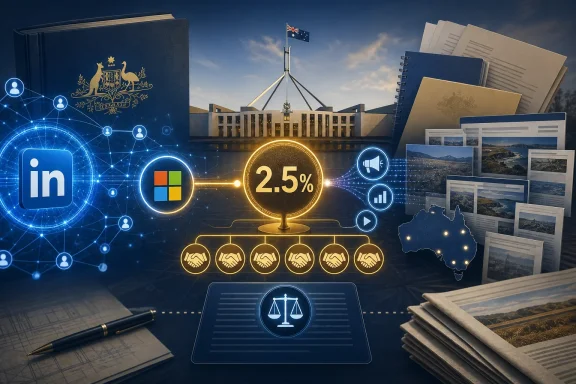 The tax base shrinks, but the commercial pressure grows
The Albanese government’s April 2026 exposure draft was built around a blunt backstop. A corporate group with more than A$250 million in Australian-attributable revenue that operated a significant social-media or search service could face a 2.25% News Media Bargaining Incentive charge if it did not make qualifying agreements with Australian news businesses.Treasury’s draft set further service thresholds: at least five million active Australian users for social media, or 10 million for search. The government said the scheme was designed to catch Meta, Google, and TikTok, rather than create a general levy on every online business. It also made a critical change from Australia’s 2021 News Media Bargaining Code: a platform could not sidestep the framework merely by removing news links or refusing to host news content.
That was a direct response to Meta’s 2024 decision not to renew its commercial news agreements in Australia. Meta has argued that publishers voluntarily post to its services and receive value from the traffic and distribution; the government’s response has been to detach the new obligation from whether a platform chooses to carry news at all.
According to The Sydney Morning Herald, the final plan no longer uses total group revenue as the levy base. It instead targets revenue from digital advertising, while increasing the statutory charge from 2.25% to 2.5% to preserve the intended revenue. The paper reports that Treasury still expects the policy to return A$200 million to A$250 million a year to Australian journalism.
That is the “carrot” in the design. The platform can offset its charge through commercial arrangements with news publishers, making deals cheaper than simply paying the levy. Under the April draft, an ordinary qualifying agreement generated a 150% offset: spending roughly 1.5% of the relevant revenue could erase a 2.25% charge. Agreements with smaller publishers could earn a 170% offset, creating a stronger incentive to fund outlets with annual turnover below A$50 million.
The revised plan reportedly leaves the voluntary-deal rate unchanged. But its higher levy and six-publisher minimum make the avoidance route more demanding. A platform will need both enough money committed and a broader stable of counterparties.
Six deals will not automatically mean six meaningful deals
The April proposal required agreements with at least four eligible news-business corporate groups. Assistant Treasurer Daniel Mulino told ABC Radio at the time that the threshold was intended to encourage wider participation, while the higher small-publisher offset was intended to support diversity.The Digital Publishers Alliance, representing independent digital outlets, argued during consultation that four deals could still concentrate the benefit among a handful of large incumbent media groups. Its submission asked the government to require a larger number of agreements, reserve a share of levy proceeds for small and medium publishers, and broaden the eligibility test beyond traditional “core news” businesses.
The reported move from four to six deals answers part of that criticism, but it does not answer the more important distribution question: who counts as one of the six, and what minimum share of the money must reach smaller publishers?
A six-deal rule can widen access if it requires distinct, genuinely independent publishers and meaningful commitments. It can also become a compliance exercise if a platform assembles six low-value agreements, concentrates most expenditure with a few major groups, and claims the full offset. The April draft had no simple public rule requiring a percentage of offset-eligible spending to go to smaller outlets; the Digital Publishers Alliance specifically proposed one.
The government’s reported payment-scheme revisions appear aimed at the same concern. The Sydney Morning Herald says the definition of journalists will be expanded to include other essential newsroom roles and freelancers, with more funding directed to regional and community-serving publishers. It also reports a proposed grants program for very small publishers and start-ups with revenue below A$150,000.
Those changes matter only if platforms choose the levy route and money flows through the statutory distribution scheme. The government’s stated preference is that no charge is collected because platforms sign commercial agreements instead. In other words, the grants and weighted distribution model are a fallback, not the primary path.
LinkedIn is the material Microsoft change
The April exposure draft deliberately excluded “professional networking services” from the social-media definition. Treasury’s own public explanation was explicit: LinkedIn did not have the same market power or relationship with Australian news businesses as Facebook and other covered platforms.That position was disputed during consultation. The Digital Publishers Alliance argued that LinkedIn carries publishers’ posts, serves as a news-distribution channel, and sells advertising against the attention generated on the service. Its submission called for the professional-networking exclusion to be removed. It also criticized the draft for explicitly excluding large language models and AI chatbots such as ChatGPT from the definition of a search service.
The reported final design appears to accept the first argument while leaving the second unresolved. LinkedIn may now be in scope, but no announced revision has said that AI assistants or large language models will be brought under the incentive. That distinction carries real implications for Microsoft.
Microsoft announced a content agreement with Nine Entertainment on July 3 under which Copilot can reference material from Nine’s mastheads to ground AI search outputs. Microsoft has described the arrangement as an Australian first for a major news company and its Copilot service. Nine has publicly portrayed the deal as revenue returning to journalism, while Microsoft says the system will provide attribution and links to original reporting.
Yet the April NBI draft excluded AI services from the targeted search-service definition. A revised law that includes LinkedIn but continues to exclude AI assistants would create an unusual split: Microsoft could face a levy tied to LinkedIn’s advertising activity while its Copilot content arrangements remain outside the service category that triggers the charge.
The unpublished final text is decisive here. It must answer several practical questions that neither the April draft nor the reported outline resolves:
- Whether Microsoft is assessed on LinkedIn’s Australian advertising revenue alone, a broader Australian advertising pool, or revenue across a corporate group.
- Whether Bing, LinkedIn, or both are the services that satisfy the user and significance tests.
- Whether Microsoft’s Nine-Copilot agreement is a qualifying agreement for an offset if Microsoft becomes liable through LinkedIn or Bing.
- Whether a deal connected to AI outputs can qualify when AI itself is excluded from the definition of a covered service.
- Whether the small-publisher uplift remains intact and whether the new six-deal rule applies across a corporate group or separately to each covered service.
Advertising-only revenue reduces one objection — and raises a new one
Tech companies objected strongly to the original draft’s use of total Australian revenue. Meta called the proposal a discriminatory and retroactive tax, while Google warned that a targeted tax could put commercial publisher agreements at risk. Their argument was straightforward: revenue from cloud services, subscriptions, enterprise software, hardware, app stores, or other non-news operations should not fund journalism simply because a company also operates a major digital platform.Moving to digital-advertising revenue is a concession to that argument. It makes the policy look less like a charge on a company’s entire Australian presence and more like an intervention in the advertising markets that have displaced publishers’ traditional revenue.
But it also introduces a harder accounting problem. “Digital advertising revenue” is not self-executing language for companies that bundle ads with analytics, commerce, cloud measurement, enterprise sales tools, audience networks, or cross-platform campaigns. The final law will need workable rules on attribution, related-party arrangements, reporting periods, and the treatment of advertising sold outside Australia but displayed to Australian users.
The original design’s simplicity was politically costly: 2.25% of broad Australian revenue was easy to explain and difficult to evade through internal allocation. An advertising-only approach better tracks the government’s rationale, but gives companies and advisers more room to dispute the taxable base.
That tension is especially relevant for Microsoft. LinkedIn’s advertising business, Bing’s search advertising, Microsoft Audience Network activity, and AI-related advertising products do not necessarily map cleanly onto a single local revenue line. The government has not published a model showing what it considers Australian digital-advertising revenue for a multinational group, or whether the amount is measured before or after commissions, rebates, and partner payments.
Parliament will receive the real test, not Monday’s outline
The federal government has been clear about its central objective since it announced the incentive in December 2024: it wants platforms to renew or enter commercial news agreements, not simply collect a tax. The original exposure draft was intended to close the loophole exposed when Meta stopped paying and removed news rather than negotiate.The reported changes preserve that architecture. They make the levy more targeted, tighten the deal requirement, and potentially bring LinkedIn into a regime from which it was previously excluded. The consequence for Microsoft is immediate at the policy level but still conditional at the legal level.
When the legislation is introduced, the most important pages will not be the headline 2.5% rate. They will be the definitions of “digital advertising revenue,” “professional networking service,” qualifying news agreements, corporate-group liability, and offset eligibility. Those provisions will decide whether the plan is a new bargaining lever over Meta, Google, TikTok, and LinkedIn — or a framework broad enough to put Microsoft’s advertising and AI-news arrangements under a single Australian compliance calculation.
References
- Primary source: smh.com.au
Published: 2026-08-02T14:01:00+00:00
News Bargaining Incentive: Government refines plan to force tech giants to pay for Australian journalism
Large tech companies have won some concessions, but face larger penalties, under a revamped plan aimed at helping local news publishers.www.smh.com.au
- Related coverage: ministers.treasury.gov.au
Consultation on the News Bargaining Incentive now open | Treasury Ministers
The Albanese Government is taking the next step to ensure Australian journalism is sustainable now and into the future.Draft legislation to establish a News Bargaining Incentive (NBI) is now available for consultation.ministers.treasury.gov.au
- Related coverage: ministers.treasury.gov.au
Albanese Government to establish News Bargaining Incentive | Treasury Ministers
The Albanese Government will establish the News Bargaining Incentive to ensure large digital platforms contribute to the sustainability of news media in Australia. A strong and diverse news sector is vital for a healthy democracy. - Related coverage: abc.net.au
Big tech hits back at Labor government's Media Bargaining Incentive plan - ABC News
US tech giant Meta has condemned Labor's plan to tax large digital platforms that fail to pay for using Australian journalism as "government-mandated transfer of wealth". www.abc.net.au
- Related coverage: lina.org.au
News Bargaining Incentive revenue distribution
LINA's recommendations to the government's consultation on revenue distribution for the News Bargaining Incentive.lina.org.au - Related coverage: minister.infrastructure.gov.au
Consultation on the News Bargaining Incentive now open
The Albanese Government is taking the next step to ensure Australian journalism is sustainable now and into the future.minister.infrastructure.gov.au
- Related coverage: linkedin.com
The Digital Divide - Part 4: Australia's News Bargaining Incentive Is Almost the Right Answer. And That's the Problem.
Today, the Albanese Government released draft legislation for the News Bargaining Incentive and a parallel consultation paper outlining how the resulting funds will be distributed to publishers. Submissions on both close 18 May.www.linkedin.com
- Related coverage: infrastructure.gov.au
News Bargaining Incentive Revenue Distribution—Statutory Payment Scheme
www.infrastructure.gov.au
- Related coverage: taxathand.com
Deloitte | tax@hand
www.taxathand.com
- Related coverage: progresschamber.org