

The distinction matters for anyone trying to buy a laptop rather than merely follow the “RAMageddon” storyline. A delayed build-to-order MacBook Air is not the same as a laptop that cannot be purchased. Third-party retailers were still listing in-stock Air inventory when Mashable checked, and neither Apple nor its major retail partners has publicly declared a product-wide MacBook Air shortage as of August 12.
What is confirmed is the broader pressure behind the report. Apple raised prices across Macs and iPads on June 25, explicitly blaming an extraordinary rise in memory and storage component costs caused by AI data-center demand. Reuters reported that the 512GB MacBook Air moved from $1,099 to $1,299 in the United States, making the supply report more consequential: buyers are now facing both a higher entry price and, for some configurations, a longer wait.
Apple’s delivery dates are the strongest public signal
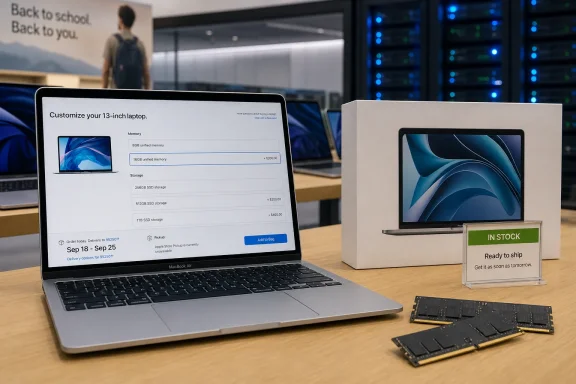
The most concrete evidence is Apple’s own storefront behavior. According to the August 3 reporting, every listed configuration of the 13-inch and 15-inch M5 MacBook Air had slipped into back-order territory, with some estimates reaching early September. Higher-memory systems were later than lower-memory models, and the 15-inch Air configured with 32GB of unified memory was reportedly delayed until mid-September.
That pattern is consistent with a constraint on memory rather than a general spike in demand for every version of the notebook. Apple Silicon systems use unified memory: the CPU, GPU, and other parts of the chip share a memory pool integrated into the system design. Customers cannot add RAM later. For a buyer who needs 24GB or 32GB for virtual machines, local AI tools, large development builds, Adobe workloads, or heavier multitasking, the desired configuration must be supplied at the time of purchase.
The basic 16GB models may therefore be a poor proxy for supply of the machines many professional users actually want. A retailer having a base 13-inch unit in stock does not mean it can promptly deliver a 32GB, 1TB, 15-inch configuration in a specific color. Apple’s build-to-order queue is where component constraints become visible first.
Apple has not issued a MacBook Air-specific supply advisory, disclosed allocation figures, or said which memory capacities are constrained. That leaves Bloomberg’s retail sourcing as the only direct reporting tying the current Air delays to the memory crunch. It is credible in light of Apple’s June pricing move and its subsequent earnings commentary, but it remains reporting rather than a formal Apple confirmation.
The “subject to availability” language proves less than it seems
Gurman also reported that Apple’s back-to-school marketing was steering customers toward the MacBook Air rather than the $1,999 base M5 MacBook Pro, with some promotional materials allegedly carrying a “MacBook Air subject to availability” disclaimer. That phrasing sounds ominous in a shortage story, but Apple’s official U.S. college offer terms already state that qualifying products and promotional items are subject to availability.
In other words, the disclaimer is not independent proof that Apple expects the Air to disappear from shelves. It is standard legal language in a promotion running during a period when colors, configurations, and store-level inventory routinely vary. The more meaningful indicator is the delivery-date spread between configurations—not the existence of boilerplate in advertising.
Apple’s 2026 U.S. education promotion began July 16 and was scheduled to run through August 27, offering education pricing plus a $100 Apple Gift Card with a qualifying MacBook Air purchase. For students and educators, the promotion softens part of the June price increase but does not restore the old price. Education buyers can still encounter longer fulfillment estimates for a custom configuration, and the gift card does little for a purchaser who needs a system before classes begin.
That creates a practical purchasing divide. Someone who only needs a standard configuration and can locate one at Apple, Best Buy, Amazon, Costco, or a local authorized reseller may avoid Apple’s build-to-order queue. Someone requiring more memory should expect availability to be more volatile and should verify the exact model number, memory capacity, keyboard layout, storage tier, and return policy before treating a retailer listing as an equivalent substitute.
Apple has already acknowledged the underlying memory problem
The MacBook Air report did not emerge in isolation. Apple’s June price increases were an unusually public admission that the company could no longer absorb the rise in memory and storage costs. Reuters reported that Apple attributed the move to AI infrastructure demand, which is pulling DRAM and storage capacity toward data centers.
At Apple’s July 30 earnings call, Chief Executive Tim Cook characterized memory pricing as a “100-year flood” and said costs would continue rising in the September quarter. Apple also reported strong Mac results for the June quarter, so the company is confronting component stress while demand remains healthy. That combination—firm demand, higher input costs, and limited supply—makes long configuration-specific delivery estimates far more believable than a temporary storefront glitch.
For the wider PC market, the Air’s situation is a useful warning rather than a uniquely Apple problem. DRAM and NAND are common inputs across laptops, desktops, workstations, servers, handhelds, and consumer devices. The effect will vary by manufacturer because each has different supply contracts, inventory positions, and product configurations. But the MacBook Air offers a particularly visible example because memory is not field-upgradeable and Apple’s online store exposes delivery estimates by configuration.
Windows buyers should resist two bad assumptions. The first is that every delayed MacBook Air means an equivalent Windows laptop is also unavailable; retailers may have ample inventory of particular Intel, AMD, Qualcomm, or Nvidia-based systems. The second is that Windows laptops are automatically immune because many models permit upgrades. Replaceable SO-DIMMs can help owners expand memory later, but they do not eliminate the possibility that OEMs will raise prices, reduce memory tiers, or shift inventories toward better-margin models as component costs climb.
What buyers and IT teams should do now
For an individual buyer, the sensible response is to decide whether a precise Air configuration is a requirement or merely a preference. If the machine is needed for a fixed deadline, such as a semester start or an employee onboarding date, an in-stock retail configuration is lower risk than an Apple build-to-order purchase with a September estimate. Do not assume a retailer can modify memory after purchase; it cannot on an M5 MacBook Air.
For IT administrators, the episode reinforces the importance of ordering against deployment dates rather than against historic assumptions about laptop lead times. A procurement plan that specifies “MacBook Air, 16GB minimum” gives purchasing staff meaningful substitution room. A plan that requires a particular display size, color, storage tier, and 32GB memory narrows the available pool sharply during a component squeeze.
The more durable lesson is that a memory shortage can affect PCs twice: first as a price increase and then as a configuration problem. Apple has already passed through part of the cost increase. If Bloomberg’s supply reporting is accurate, the next constraint is choice—especially for buyers who need the higher-memory MacBook Air configurations that cannot be upgraded after delivery.
Update: MacBook Air delivery estimates reportedly extend to five weeks for 32GB models (August 14, 2026)
Digital Today reports that Apple’s online store is now showing estimated delivery windows of two to three weeks for most M5 MacBook Air configurations, while 32GB unified-memory models can take four to five weeks. If accurate, the newer estimates indicate that delays are no longer confined primarily to selected build-to-order systems.
The report says the longer waits affect base configurations as well as higher-memory options, though the 32GB models remain the most constrained. That reinforces the earlier indication that memory availability is limiting Apple’s ability to fulfill the configurations professional and power users are most likely to require.
For buyers with fixed back-to-school or deployment deadlines, an Apple Store build-to-order order now carries more schedule risk than it did earlier in August. In-stock reseller inventory may remain the quickest route to a MacBook Air, but purchasers should confirm the exact memory and storage configuration rather than assuming a lower-priced listing is an equivalent replacement.