
The Next Web’s August 3 report follows recent coverage by TechRadar, while Majestic Labs’ own product material and April 28 announcement describe Prometheus as a server containing as many as 12 proprietary Ignite AI Processing Units. Each chip combines Arm application cores with RISC-V vector and tensor engines, connected to a coherent pool of 8TB to 128TB of LPDDR6 memory through custom memory-interface and aggregation silicon.
The architecture targets a real problem. During autoregressive large-language-model inference, the model weights and growing key-value cache must be repeatedly read from memory. More arithmetic units do not automatically help when those processors are waiting on data. IEEE Spectrum’s earlier examination of Prometheus likewise framed the system around the memory wall—the widening gap between accelerator compute throughput and the capacity and bandwidth available to feed it.
But Majestic’s story has been circulating longer than the latest reports imply. The company publicly announced Prometheus on April 28, 2026, and IEEE Spectrum covered it in June. This week’s reports add details about planned commercial timing and customer interest, but do not introduce shipped hardware or third-party benchmarks. Administrators should treat the specifications as a product roadmap and vendor claim, not a measured alternative to DGX B300 or Vera Rubin infrastructure.
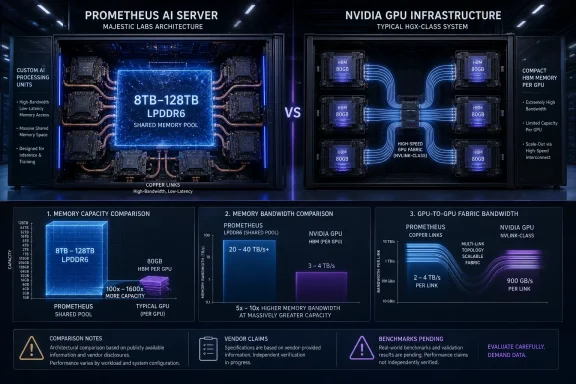 Prometheus is built around capacity first
Nvidia’s familiar design puts extremely wide HBM memory beside each GPU package. That is expensive and physically constrained, but it offers extraordinary bandwidth close to the compute engines. Majestic instead wants to make ordinary low-power DRAM act like a server-scale shared resource: memory sits behind custom aggregation chips, linked over copper connections reportedly reaching up to a meter.
That changes the capacity equation. Nvidia’s HGX B300 documentation lists eight Blackwell Ultra GPUs with 288GB of HBM3e each, or 2.3TB per node. A fully configured 128TB Prometheus system would therefore expose roughly 56 times that nominal memory capacity in one coherent pool. The scale of that claim is plausible arithmetically, even if the performance consequences remain unproven.
It is also a different resource from what an eight-GPU system delivers. A DGX B300 has eight independent HBM pools tied together by NVLink. Software can distribute model shards and data across those devices, but the programming and performance behavior are not the same as one giant uniform address space. Majestic is betting that avoiding sharding, copying, and cache duplication will improve efficiency for models that do not fit comfortably within an individual GPU’s memory allocation.
That could be valuable for long-context chat systems, retrieval-heavy agents, mixture-of-experts models, graph workloads, and large batch inference. It is less obviously decisive for workloads that primarily need dense matrix multiplication at maximum throughput, especially training, where accelerator compute, HBM bandwidth, interconnect behavior, collective communication, and software maturity all matter at once.
Majestic’s public materials focus overwhelmingly on inference and large memory footprints. They do not publish sustained tokens-per-second figures, first-token latency, batch-size curves, precision-specific throughput, or benchmark results against B300, GB300, AMD Instinct, or custom inference silicon. Without those numbers, “a rack of GPUs” is marketing shorthand rather than a useful capacity-planning comparison.
The bandwidth claim compares unlike interfaces
Majestic says Prometheus supplies 1.7 times the interconnect bandwidth of a DGX B300. The figure appears to derive from its stated 25.6TB/s system memory bandwidth compared with the DGX B300’s 14.4TB/s aggregate NVLink bandwidth. The ratio works numerically. The comparison does not describe the same thing.
Nvidia specifies the DGX B300’s 14.4TB/s as aggregate NVLink bandwidth among its eight GPUs. It is a device-to-device communication fabric. Nvidia also lists up to 8TB/s of HBM bandwidth per Blackwell Ultra GPU, which means the aggregate local HBM bandwidth available across eight GPUs is far higher than 25.6TB/s, though it is not a single shared memory pool.
Prometheus’ 25.6TB/s claim appears to describe the bandwidth of its pooled memory subsystem. For the workloads Majestic is targeting, that can be the more relevant number. Still, it should be compared with HBM memory bandwidth and application-level results—not presented as though it were a like-for-like substitute for NVLink fabric bandwidth.
The distinction affects procurement. A system with abundant, shared LPDDR6 capacity may keep a giant model resident without partitioning it across GPU memory spaces. Yet memory capacity does not establish how quickly every Ignite processor can access the right data under contention, how latency changes as more chips request a shared pool, or how much of the theoretical 25.6TB/s is available to a real vLLM workload. Those are the tests Majestic has not yet published.
The physical implementation is equally important. The company says custom aggregation chiplets let it stretch the memory interface across copper links up to a meter long. That is the enabling claim: conventional HBM is tightly integrated around an accelerator package, while a server-scale memory fabric needs different signaling, topology, error handling, and coherency behavior.
Majestic has not disclosed a block diagram detailed enough to establish its memory-controller count, DIMM or soldered-package layout, rack-unit height, cooling specification, or maximum power draw. A 128TB LPDDR6 configuration will require a substantial number of memory packages and aggregation devices. The company may have solved those integration challenges, but buyers cannot verify density, serviceability, or failure-domain behavior from the information released so far.
The Vera Rubin rack comparison needs a bill of materials
Majestic’s website says one Majestic rack holds the fast-memory capacity of 25 Nvidia Vera Rubin NVL72 racks. Nvidia’s current Vera Rubin NVL72 specifications list 20.7TB of HBM4 across 72 Rubin GPUs per rack. Twenty-five of those racks would contain 517.5TB of GPU HBM.
A single Prometheus server tops out at 128TB. Therefore, Majestic’s rack-level comparison requires at least five fully populated Prometheus systems per rack, and likely additional space for networking, power distribution, cooling, and storage. That may be physically achievable, but Majestic has not published the server’s rack-unit height, power envelope, or a rack configuration showing how it reaches that comparison.
The claim also omits an essential qualifier: Nvidia’s Vera Rubin NVL72 is not merely a memory appliance. It is a rack-scale system with 72 GPUs, 20.7TB of HBM4, 1,580TB/s of aggregate HBM bandwidth, and 260TB/s of NVLink Switch bandwidth, according to Nvidia’s preliminary specifications. Majestic may deliver far more addressable capacity per rack if its density claim holds, but it has not shown equivalent compute throughput, networking behavior, resiliency, or throughput on large distributed models.
This is where the startup’s framing is most aggressive. Capacity is often the limiting factor for deploying a model at all; it is not a substitute metric for serving that model quickly. A 128TB pool could let an operator hold a massive model, key-value cache, and data structures in one system. It does not establish that the system can deliver the same token rate, concurrency, or tail latency as a multi-GPU rack.
The software promise lacks operational detail
Majestic says Prometheus supports PyTorch, vLLM, and OpenAI’s Triton language for GPU programming, with no model rewrites required. That is the right promise for a company trying to displace Nvidia: hardware without an accessible toolchain is rarely adopted outside specialist deployments.
“Runs PyTorch” is not enough information for an operations team, however. Majestic has not published the compiler stack, supported PyTorch operations, distributed runtime, kernel-translation model, supported quantization formats, container images, driver lifecycle, telemetry interfaces, or debugging tools. There is also no published compatibility statement covering Windows Server, Hyper-V, Windows clients, WSL, or Linux distributions.
That omission matters because vLLM and production PyTorch inference generally live in Linux-based container environments. An organization will not replace a CUDA-based cluster merely because familiar framework names appear in a launch presentation. It needs evidence that model-serving behavior, observability, failover, security controls, upgrades, and support contracts work under real production load.
Majestic’s decision to combine Arm and RISC-V cores may also widen the software verification burden. The design could avoid some of the overhead associated with attaching a conventional host CPU to separate GPUs. But every custom execution path needs mature compilers, optimized kernels, numerical validation, and a predictable upgrade story. Nvidia’s durable advantage is not only its chips; it is the accumulated operational tooling around CUDA, NCCL, drivers, libraries, profilers, and enterprise support.
What buyers can verify now
TechRadar reports that Majestic employs about 40 people, raised $100 million in a late-2025 Series A round, and says it has taken orders from enterprises, neoclouds, and hyperscalers. The company has not named those customers, published purchase volumes, or disclosed deployment dates. TechRadar also reports a target of shipping next year, meaning 2027, but no other independently reported schedule appears to establish the timing.
For now, Prometheus is best understood as a credible architectural proposition with unproven commercial execution. The premise—that inference increasingly needs capacity, bandwidth, and coherency more than another increment of raw floating-point throughput—is sound. Nvidia itself is moving toward larger rack-scale memory systems, as the 20.7TB HBM4 figure for Vera Rubin NVL72 shows.
Majestic’s opportunity is to prove that LPDDR6 pooling can deliver enough effective bandwidth and low enough latency to make that capacity practical, while retaining the software behavior that customers expect from GPU infrastructure. Until the company publishes application benchmarks, a complete rack design, power measurements, and pricing, Prometheus should be evaluated as a forthcoming specialized inference platform—not as evidence that Nvidia’s GPU model has already been displaced.
