
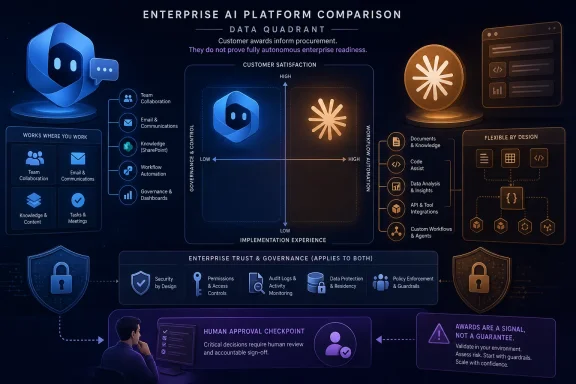
Info-Tech’s August 6 announcement places Claude first with an 8.5 Composite Score and Microsoft 365 Copilot AI Agents second with an 8.2. The firm says Claude users singled out ease of implementation, while Copilot users highlighted workflow automation. Those are meaningful differentiators: one points to getting an AI initiative started; the other points to fitting it into the work people already perform in Teams, Outlook, SharePoint, and the wider Microsoft 365 stack.
The more useful finding is what lies behind the rankings. SoftwareReviews’ Composite Score is not a laboratory benchmark of model quality, agent reliability, security posture, or cost. Its published methodology describes a satisfaction measure built from four areas: Net Emotional Footprint, vendor capabilities, product features, and likelihood to recommend. In other words, the Data Quadrant measures how surveyed customers feel about buying, using, and supporting the products—not whether an agent completed a particular finance, HR, IT service-management, or engineering workflow correctly.
That distinction should determine how IT leaders use the result.
 The scores have already moved after the award snapshot
The public SoftwareReviews category pages corroborate the Champion status for Claude and Microsoft 365 Copilot AI Agents, but they also show why the press release’s score should not be treated as a permanent ranking. SoftwareReviews explicitly warns that the live product pages reflect current data, which can differ from the figures used in reports and awards at publication.
As of August 6, the live category listing shows Claude at 8.6 from 49 reviews and Microsoft 365 Copilot AI Agents at 8.2 from 52 reviews. The Microsoft score matches Info-Tech’s award announcement; Claude’s live score is already one-tenth higher than the 8.5 listed in the release. The underlying sample has also changed, so these figures are not a correction to the award report—they are a demonstration that the ratings are rolling customer-sentiment measurements.
That is an important limitation in a new category with relatively modest review totals. A few reviews can move a one-decimal score, especially when the universe is dozens of respondents rather than hundreds or thousands. The award means both products cleared Info-Tech’s Champion threshold at the report’s measurement date. It does not establish that Claude is permanently ahead of Copilot by 0.3 points, nor that either is broadly preferred across every industry and deployment model.
Info-Tech also does not disclose in its announcement the participants’ company sizes, regulated-industry mix, agent complexity, license tiers, deployment maturity, or whether reviewers were using vendor-provided agents, low-code tools, custom integrations, or basic conversational workflows. Those missing details matter more in agentic AI than they did in the earlier chatbot era. A user who deploys a document-summary assistant and a team that authorizes an agent to update CRM records, open tickets, approve transactions, or query sensitive SharePoint content are not testing the same product risk.
Microsoft’s workflow advantage comes with an administration bill
Microsoft 365 Copilot AI Agents received recognition for workflow automation, and that result fits the product’s strongest practical advantage. Microsoft’s agents can be placed inside the applications knowledge workers already use and can be grounded in organizational information and processes rather than requiring employees to switch to a separate AI destination. For organizations with a mature Microsoft 365 tenant, that can lower the adoption friction that frequently derails standalone AI pilots.
SoftwareReviews’ current reviews offer a concrete illustration. One verified reviewer describes replacing more complicated automation tools with a simple Copilot Studio agent and says that a person who can describe a process in plain English can create an automation. That is a useful adoption story, especially for departments that lack developers but have repetitive internal workflows.
Yet Microsoft’s own deployment guidance makes clear that creating an agent is the beginning of the work, not the end. The company identifies security and governance, deployment complexity, user enablement, access management, and cost management as primary challenges when agents are enabled at scale. Its Purview guidance specifically warns that agents working with SharePoint and Microsoft Dataverse can amplify oversharing, data-loss, and insider-risk problems if grounding data and interactions are not secured.
Copilot agents inherit the quality of the tenant they are allowed to see. They respect the end user’s existing permissions; that prevents an agent from simply bypassing access control, but it does not repair overly broad SharePoint libraries, stale group membership, loosely managed sharing links, or years of accumulated data without appropriate labels and retention policies. If an employee already has access to content they should not broadly have, an agent can make that content easier to discover, summarize, and reuse.
Microsoft does provide the relevant controls: Purview sensitivity labels, data loss prevention, auditing, eDiscovery, retention, and access-management tooling. Its guidance says Copilot interaction data can be audited and retained within Microsoft 365 services, including prompts, responses, and referenced content. But organizations should note the practical consequence: a well-governed deployment may require Purview configuration, SharePoint remediation, data classification work, audit review, and licensing decisions before a broad agent rollout is defensible.
The Data Quadrant award does not change that operating requirement. It supports the argument that customers value the workflow layer; it does not eliminate the administrative work needed to make workflow automation safe.
Claude’s implementation result is narrower than an enterprise-platform verdict
Claude’s 8.5 report score and its recognition for ease of implementation reflect a genuine attraction for IT teams: a capable general-purpose assistant can show value rapidly for writing, analysis, coding, document work, knowledge retrieval, and prototype automation. SoftwareReviews’ current Claude listing emphasizes the familiar product surface—chat and API access—and customer reviews frequently praise usability, well-structured answers, long-document work, and productivity.
Those are strengths, but they should not be conflated with a complete enterprise agent platform deployment. A reviewer’s positive experience with Claude for coding, SQL, documentation, research, and brainstorming is valuable evidence about day-to-day usefulness. It does not, by itself, answer the enterprise questions that matter when the product must access line-of-business systems: identity integration, delegated authorization, least-privilege access, auditability, data-residency requirements, connector governance, action approval, lifecycle management, and incident response.
This is where the release’s framing is broader than the publicly visible detail. Info-Tech defines the category around reasoning, workflow automation, tool integration, orchestration, and governance, but the announcement does not publish the feature-level scores or break down how Claude and Copilot performed across those individual dimensions. Nor does it say whether ease of implementation reflects a simple end-user rollout, API integration, a managed enterprise deployment, or an agent executing actions through connected systems.
For Windows and Microsoft 365 administrators, the two winning products should therefore be assessed through different operational lenses. Copilot is likely to be the more direct fit where the work, identity, documents, permissions, and compliance controls are already centered on Microsoft 365. Claude may be appealing where teams want a flexible assistant experience or developer-facing capability and can define a separate governance and integration model. Neither award substitutes for running representative workflows against an organization’s real permissions and data.
The report is useful, but it does not settle the buying decision
Info-Tech’s Data Quadrant is more valuable than a vendor feature checklist because it captures what actual users report after procurement, implementation, and ongoing use. The firm also distinguishes its approach from analyst-led placement by saying the rankings are based on verified end-user feedback rather than analyst opinion or vendor influence. That makes the recognition worth noting.
There are still methodological boundaries. The announcement does not state the minimum recent-review threshold for the 2026 agentic AI report, publish the full respondent distribution, identify review incentives, reveal weighting within the Composite Score, or make the complete scorecards available in the release itself. SoftwareReviews’ public pages disclose that some reviewers received a nominal gift card as thanks for their time, and the service labels such entries as validated reviews. That is not evidence that the results are invalid, but it is a reason to treat the award as a snapshot of reported satisfaction rather than an independent audit of real-world autonomous-agent outcomes.
The category page also places Claude and Microsoft 365 Copilot AI Agents alongside products from Salesforce, Google, Amazon, IBM, UiPath, Automation Anywhere, and others. The report announcement names only the two Champions, leaving readers without the complete report unable to see how close the field was or which product categories were ineligible due to insufficient review data. A short winner list can obscure how immature the market still is.
For IT departments, the practical action is to use the Champion placements to refine a shortlist, then test the claims that the Data Quadrant cannot establish. Run a limited pilot with representative employee groups; measure completion accuracy, rework, escalation rates, permission exposure, administrative overhead, and the actual cost of each successful workflow. For Copilot specifically, review SharePoint and OneDrive permissions before expanding agent access, enable auditing, and decide which actions must retain a human approval step.
Claude and Microsoft 365 Copilot AI Agents have earned a credible customer-satisfaction endorsement from Info-Tech’s SoftwareReviews data. The next decision is not which badge looks stronger; it is whether the organization’s identity, data, controls, and operating model can support an agent that does more than draft text.
