
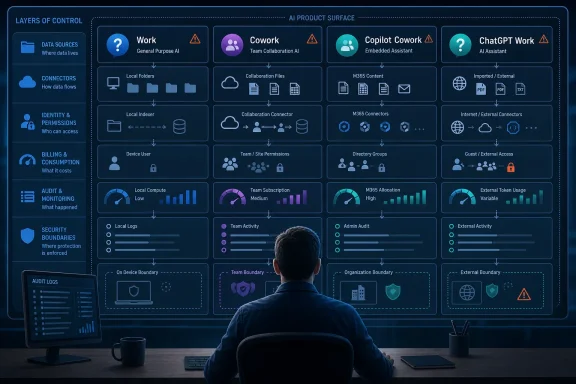
But the names also expose a more immediate problem for Windows users and Microsoft 365 administrators. “Work” and “Cowork” communicate almost nothing about deployment, permissions, billing, data boundaries, or the actual software being replaced. Those are the details that determine whether an agent belongs on an employee’s PC or in a production tenant. A generic suffix does not make that choice easier.
The naming critique published by 36Kr is directionally right, even if “unusable” overstates the case. These labels are understandable once a person already knows the agent market. The issue is that vendors are asking ordinary users to learn the product taxonomy before they can learn the product. That is the reverse of how mainstream productivity software usually wins adoption.
 “Work” is the new label for an agent that acts
The common origin is not hard to find. Anthropic introduced Claude Cowork as “Claude Code for the rest of your work” on January 12, 2026. The company’s later guidance is unusually candid about the product split: Claude chat is for answers and brainstorming; Claude Code is for developers; Claude Cowork is meant to be pointed at local folders and connected business tools so it can produce finished work.
That distinction is more useful than the name itself. Cowork is an agentic workspace: a system with delegated access, a task plan, tool calls, progress tracking, and the ability to create or modify artifacts. It inherits much of the technical model that made coding agents valuable: read a collection of files, decompose a goal, invoke tools, keep working over multiple steps, and leave behind a result that a human can review.
TRAE’s June 9 rename from TRAE SOLO to TRAE Work makes the same lineage explicit. ByteDance says TRAE began as a developer-oriented product, then found users applying it to requirements documents, datasets, marketing plans, research reports, and cross-functional coordination. The company now separates TRAE IDE, aimed at software engineering, from TRAE Work, aimed at broader professional tasks.
Alibaba’s QoderWork used nearly the same formula when it entered public beta on February 12. Qoder describes it as a desktop assistant that can work with local files and connected tools, moving from a chat response toward end-to-end workflows. Its initial public beta was available on macOS, a detail easily lost when the product is grouped into the broad “AI office” category. A product that manages local files is not automatically a Windows productivity tool simply because it has “Work” in its name.
OpenAI’s July 9 release of ChatGPT Work follows the pattern closely. OpenAI says the feature can work across connected apps and files, generate documents, spreadsheets, presentations, reports, and web apps, and remain on a complex project for hours. Crucially, OpenAI also says the feature incorporates Codex technology—the company’s coding-agent line—into a general-purpose work product.
This is not an accidental convergence in copywriting. The industry is repackaging the same underlying capability stack for people whose primary output is a deck, report, worksheet, customer brief, or operating plan rather than a pull request.
Microsoft chose the most confusing version of the pattern
Microsoft’s decision to call its product Microsoft 365 Copilot Cowork is the clearest demonstration of why this category needs better names, or at least better product boundaries.
Microsoft announced Copilot Cowork on March 9 as a research preview built in close collaboration with Anthropic and using the technology behind Claude Cowork. It reached general availability on June 16. The vendor’s stated pitch is straightforward: users describe an outcome, and Cowork grounds the job in Microsoft 365 data—email, meetings, messages, files, and business data—then carries out multi-step work.
The product relationship, however, is far less obvious from the name. “Copilot” already appears across Windows, Microsoft 365, Security, GitHub, Dynamics, and Power Platform. “Microsoft 365 Copilot” is itself a paid work product distinct from the consumer Copilot experience. Adding “Cowork,” a term already strongly associated with Anthropic’s product, creates a name that tells experienced AI followers where the technology came from while giving an average employee little help understanding where to click or what they are allowed to delegate.
The practical distinction is significant. Claude Cowork is framed around bringing Claude to user-selected folders and connected applications. Microsoft 365 Copilot Cowork is framed around the Microsoft 365 tenant and its governance boundaries. Those are different administrative propositions, even when both systems can research, draft, organize, and create deliverables.
Microsoft’s documentation also shows that Cowork is not simply a feature switched on with an existing Copilot seat. It requires a Microsoft 365 Copilot license and credit-based billing. Its general-availability launch moved the product into a metered consumption model, with administrators expected to set billing policies, budgets, and access controls.
That hidden operational difference is the story behind the confusing label. “Cowork” sounds like a friendly new mode. For an IT department, it can mean a new source of usage-based expenditure, new identity-scoped access to organizational data, and a need to decide which users can delegate high-cost, long-running jobs.
The name collision is a support problem, not merely a style problem
There is a reason ordinary software companies once fought to own distinctive product names. A unique name improves recall, searchability, help-desk communication, policy writing, procurement records, and incident response. The current AI-agent names do the opposite.
Consider what a user means when they report, “Cowork changed my files,” or “Work used my account.” In a mixed environment, that could refer to Claude Cowork, Copilot Cowork, ChatGPT Work, QoderWork, or a number of similarly branded local agents. The wording does not identify the vendor, account type, execution location, connector set, or approval path.
For Windows admins, this becomes more than semantic clutter when agents operate on endpoints. The essential questions are mundane but non-negotiable:
- Which application had permission to read or write the user’s local folders?
- Which connected services could the agent query or modify?
- Did the job run locally, in a sandboxed cloud environment, or through a browser session?
- Was the output reviewed before it was sent, saved, shared, or used to alter business data?
- Which subscription, license, or consumption policy paid for the run?
None of those answers is conveyed by “Work,” “Cowork,” or “Buddy.” The labels allude to autonomy without disclosing the scope of autonomy.
Microsoft at least has a governance advantage inside its own product family: it says Copilot Cowork operates under the organization’s Microsoft 365 identity, security, and compliance controls. That is useful, but it is not a substitute for clear rollout communication. The IT decision is not whether Cowork has a reassuring name. It is whether the tenant has scoped billing, appropriate data permissions, audit coverage, user training, and a clear exception process for sensitive functions.
The vendors are preserving developer lineage instead of translating it
The names are not random. They are compressed product architecture.
“Code” identifies a software-development surface. “Work” marks the broader, non-code surface. “Cowork” suggests that the system is not a passive assistant but a semi-autonomous collaborator. “Agent” describes the technical behavior: planning, tool use, state, and actions. The problem is that those terms were born in developer and AI-research circles, then copied directly into products aimed at finance teams, marketers, sales operations, HR, and executives.
Anthropic’s own June guidance demonstrates the gap. It tells users to choose among chat, Cowork, and Code based on whether they need answers, finished knowledge-work deliverables, or software shipped. That is a usable decision framework. But it exists in documentation because the product names do not carry it on their own.
OpenAI’s naming is marginally clearer because “ChatGPT Work” retains the consumer-recognizable ChatGPT brand and uses “Work” as a mode. Yet it introduces its own ambiguity: OpenAI’s release notes say the new app combines Chat, Work, and Codex, while “ChatGPT Classic” remains supported for existing enterprise capabilities. That is a product map a power user can learn, but it is not self-evident to an employee asked which version of ChatGPT is approved for customer data.
Microsoft’s arrangement is worse because it overlays an already dense Copilot catalog with a term borrowed from a close partner’s product. The company may have gained instant recognition among AI watchers, but it gave up a chance to establish a durable distinction between ordinary Microsoft 365 Copilot assistance and long-running delegated execution.
“AI office” is too broad to be a deployment category
The larger weakness in the current conversation is treating “AI office” as a single market. It covers at least three different classes of software:
- A chat assistant that drafts or summarizes content provided by the user.
- A tenant-connected assistant that can retrieve organization data under existing permissions.
- An endpoint or cloud agent that can plan and execute multi-step work across folders, applications, browsers, and connectors.
Those categories carry sharply different risk, cost, and support profiles. A tool that summarizes an Excel file after a user uploads it should not be evaluated the same way as an agent that can inspect a working directory, call external tools, generate new documents, and continue running while the user attends a meeting.
The naming trend conceals that distinction at precisely the moment it should be made explicit. Vendors want continuity with their successful coding agents because the technical inheritance is real and commercially valuable. Users need discontinuity: a plain explanation that the software has moved beyond generating text and now has permission to act.
The best near-term defense is not waiting for better branding. Organizations should write their own internal names and categories for approved agent tools, documenting the vendor, client surface, data sources, allowed actions, billing model, and escalation owner. “Microsoft 365 Copilot Cowork” can remain the marketing name; an internal service catalog should describe what it actually is.
The AI-office race has produced a crowded street of products called “Work.” The more consequential question is whether each one is a chat feature, a governed Microsoft 365 service, or an agent with the keys to an employee’s files.
