
As reported by Spectrum News 13, the program begins two weeks after students return and is intended to turn AI adoption from an individual-teacher experiment into a governed district practice. Fellows will present their findings at the end of the session, helping leaders decide which tools and initiatives should move forward.
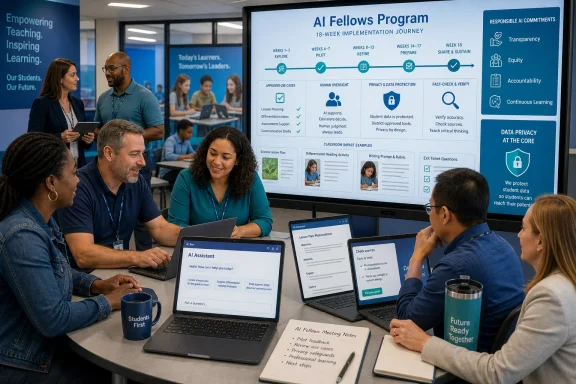 A Copilot rollout with human guardrails
Osceola’s guidance permits approved AI tools for curriculum support, lesson planning and workplace productivity, while placing strict limits on how they may be used. The district has been developing its policy since 2024 and says AI should augment—not replace— human expertise, relationships and decision-making.
For Windows-centric school IT teams, that distinction matters. A staff cohort can identify where Microsoft Copilot or other approved services genuinely reduce administrative work, but it can also surface gaps in access controls, staff training, output verification and data handling before a district-wide rollout makes those problems harder to unwind.
Spectrum News 13 reported that students aged 13 and older will be allowed to use Microsoft Copilot as a learning companion. They will be expected to independently fact-check its responses and prohibited from entering personal or confidential information.
The fellows become the district’s test bench
Chief Information and Technology Officer Peter Thorne told Spectrum News 13 that the selected group will act as district “spokespeople” for AI tools. That makes the initiative more than a professional-development course: it is a structured pilot with feedback intended to influence procurement, policy and classroom practice.
The strongest result would be a small, auditable set of repeatable uses—such as aligning draft lesson materials to standards or producing basic classroom charts—alongside clear examples of work that must remain outside an AI prompt. Teacher Kim Castro-Stevens told the outlet she already uses AI to accelerate lesson planning and basic chart creation.
The harder part will be ensuring the program does not mistake speed for reliability. In classrooms, a plausible but incorrect AI-generated explanation can be more damaging than a slow workflow, particularly when students are learning the underlying subject rather than simply completing a task.
Osceola’s approach puts governance and local evidence ahead of a blanket “use AI” directive. By the end of the 18-week program, the district should have a more practical answer to the question facing many K–12 IT departments: not whether staff and students can access AI, but which uses are safe, useful and supportable at scale.
