

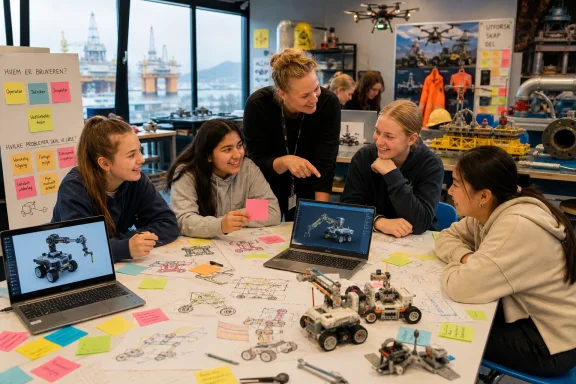
The Norwegian energy company ran four workshops at TENK Tech Camp on August 6 and 7 at Vitenfabrikken, asking girls to identify a need, choose a user, define what a proposed robot would do, create an AI-assisted visualization, and build a physical model. Aker BP’s account calls this a taste of workplace methods, while TENK describes the wider event as a free, national two-day technology camp for girls aged 13 to 19.
For Windows and IT professionals, the noteworthy detail is the workflow: problem definition came before Copilot. That is a far better introduction to generative AI than treating the tool as a machine that produces a finished idea on demand. The participants were asked to decide who their robot served and how it functioned, then use prompts to make the concept visible, rather than accepting an AI-generated design as the starting point.
That distinction also exposes the limitation of Aker BP’s announcement. The company has not published the robots the groups designed, the prompts used, the Microsoft Copilot product or licensing tier involved, or whether the workshop included discussion of inaccurate outputs, data handling, copyright, or bias. Those omissions matter because an image-generation exercise can teach prompt specificity, but it does not by itself teach whether an AI-generated concept is technically feasible, safe, or suitable for deployment.
A practical exercise wrapped in a recruitment problem
TENK Tech Camp is not an Aker BP-only event. TENK’s 2026 program lists camps in ten Norwegian locations, including Stavanger/Sandnes, Oslo, Trondheim, Bergen, Kristiansand, Horten, Harstad, Hammerfest, Tromsø, and Innlandet. The organization says the camp is for girls aged 13 to 19, whether they already have technology experience or have never written code.
Vitenfabrikken independently listed the Sandnes event for August 6–7, confirming the venue and dates. A school promotion for the Stavanger camp went further, saying the previous year’s event drew 320 participants and was the country’s largest. That attendance number describes 2025, however, not this year’s camp, and neither TENK nor Aker BP has published a 2026 attendance total for Sandnes.
There is also a small but telling inconsistency in the campaign material. Aker BP and TENK specify 13–19 as the intended range, while one local school invitation advertised the Sandnes camp to girls aged 10–19. The main TENK registration information is the stronger record here, but the difference suggests local outreach was broader than the official eligibility language. No organizer has publicly explained whether younger attendees were formally admitted, invited through a separate arrangement, or simply included in a promotional error.
The camp’s target audience exists because Norway’s broader education pattern remains sharply gendered in technical subjects. Norway’s Directorate for Education and Training has reported that girls made up only 6 percent of students in Electrical Engineering and Computer Technology in upper-secondary education, while a 2024 government commission found boys accounted for roughly 90 percent of students in electrical engineering, computer technology, and construction programs. A two-day workshop will not reverse that pipeline alone, but it is aimed at the point where technology is often still framed as an interest someone must already possess before being allowed to participate.
Aker BP’s stated rationale is that people building technology decide which needs are seen and which solutions are selected. That is a corporate diversity argument, but it is also operationally true in system design. A robot built to inspect pipes, record sensor data, or navigate a hazardous facility inherits assumptions about the user, the physical environment, the failure modes worth detecting, and the people who will act on its output.
Copilot was the visualization layer, not the robot engineer
The workshop sequence matters. Participants began with an observed problem, developed multiple ideas, selected one, then defined the robot’s audience and function. Only after those decisions did they use Microsoft Copilot to visualize the concept, before making a LEGO prototype.
This is a defensible use of generative AI in education because it keeps the model in the role it is currently best suited for: rapid ideation and communication. A rough image can give a group something specific to critique. It can help expose an ambiguity in a prompt — whether “underwater inspection robot” means a tethered remotely operated vehicle, a free-swimming drone, or a humanoid machine that cannot realistically operate in the environment at all.
But a generated image offers no engineering validation. It does not establish battery life, propulsion, material compatibility, communications range, maintenance requirements, pressure tolerance, sensor accuracy, electromagnetic interference, fail-safe behavior, or regulatory compliance. In industrial technology, those omissions are the work.
The camp announcement makes no claim that participants were building working robots, and it should not be read that way. The LEGO models were physical prototypes for communicating ideas, not proof-of-concept machines. That is an important boundary for readers accustomed to seeing slick generative-AI images framed as product designs: visualization can accelerate a design discussion, but it is not design verification.
Aker BP’s own workplace context makes that boundary especially clear. The company has been experimenting with robotics offshore for years. In 2020, it announced testing with Cognite involving robots and drones at the Skarv installation, including autonomous inspection, data capture, and automatic reporting. More recently, Aker BP said it had begun a pilot at the Fenris platform using a Taurob robot for observations, inspections, and data collection; Fenris is expected to enter production in the third quarter of 2027.
Those are not speculative classroom concepts. They are controlled industrial deployments with narrow tasks and real operational constraints. Aker BP has also described its strategy as integrating drones, platform robots, and remotely operated subsea vehicles into inspection and task execution, either autonomously or through remote control from shore.
The difference between that work and an AI-generated robot concept is not a failure of the workshop. It is precisely why the workshop’s first step — asking what need the robot solves — is more valuable than the resulting Copilot image.
Aker BP is teaching with the tools it is buying
The workshop was also a glimpse into Aker BP’s own technology direction. In a February 2026 earnings-call transcript published by the company, a Microsoft executive described Aker BP as an early adopter of Microsoft 365 Copilot and Copilot Studio. Aker BP has separately discussed using artificial intelligence, language models, and industrial data platforms in its operations.
That does not prove that the camp’s participants used the same tenant configuration, model protections, governance rules, or custom agents that Aker BP uses internally. The company did not say. It does show, however, that the choice of Copilot was not random branding bolted onto a STEM outreach day; it reflects a toolset Aker BP is publicly pursuing in its own organization.
The practical issue is what students are taught to expect from that toolset. Prompt writing should be framed as a way to specify intent, test interpretations, and revise outputs. It should not be framed as a substitute for subject expertise. In a professional environment, the user who writes the prompt remains responsible for checking the result, particularly when a visual could influence a safety, maintenance, procurement, or operational decision.
The strongest part of the Sandnes exercise was therefore its analogue component. LEGO is deliberately low-tech, but a physical prototype forces questions that a polished image can conceal: Where does the sensor sit? How does the robot move? Can an operator reach the controls? What happens when a part fails? Who carries it, repairs it, or interprets what it finds?
Those questions are closer to engineering than a visually impressive rendering.
The missing measurement is whether interest survives the event
Aker BP argues that early exposure to technology and a broader set of perspectives will help develop better future solutions. TENK makes a similar case, emphasizing workshops, female industry role models, and opportunities to see technology careers in concrete terms. The program’s scale across Norway gives it more reach than a one-off corporate classroom visit.
What neither organization has published alongside this year’s announcement is an outcome measure. There is no public figure for how many attendees later choose computing, engineering, vocational technology programs, or related university courses. There is no published breakdown of repeat attendance, geographic reach, socioeconomic access, or how many participants had previously considered a technology career.
That absence does not invalidate the event. It does mean the promotional claim remains aspirational rather than demonstrated. Attendance, enthusiasm, and a good workshop experience are meaningful outputs; a sustained change in education and career choices is a different result, requiring follow-up data over years.
For now, the Sandnes workshops show a sensible model for AI education: start with a real-world need, make the human user explicit, use Copilot to generate material for critique, and force the concept back into the physical world through a prototype. The robots the girls designed may remain LEGO models, but the design habit Aker BP chose to teach — define the problem before asking AI for an answer — is the part worth carrying into any future Windows, Copilot, or automation project.