
Windows Report first spotted the “Refer Friends to Edge App” card in the Microsoft Rewards flyout on August 4. Its screenshots show a referral link generator with sharing options for WhatsApp, Facebook, X, email, and a copy-link function, plus a QR code that opens Edge on mobile. The reported flow ties a desktop Edge share link to an Android install, launch, and Microsoft-account sign-in.
Microsoft has not announced the referral program on its Edge blog, Microsoft Rewards support documentation, or its public Edge channel documentation. No other independent outlet has reported the test’s terms, availability, or timing so far. That absence matters: a visible card in Canary establishes that Microsoft is testing the mechanism, but it does not establish a public rollout commitment, a supported country list, or even that every Canary user is eligible.
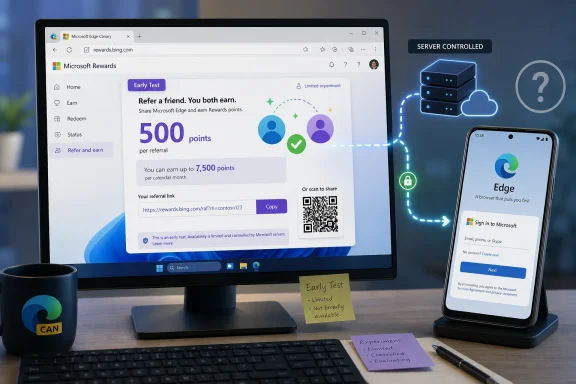 The 7,500-point headline means 15 completed referrals
The math behind the cap is straightforward. At 500 points each, a user would need 15 successful referrals in a calendar month to reach 7,500 points. Windows Report says the recipient is directed to a Microsoft-branded “Refer and Earn Rewards Points” landing page, then to Google Play when Edge is not installed, and finally prompted to sign in after opening the app.
That is a more demanding funnel than merely sharing a link or convincing someone to download the app. Microsoft appears to be requiring an attributable install and a Microsoft-account sign-in, which gives the company a way to distinguish a casual link click from an activated Edge mobile user. It also means referrals may fail to credit when the recipient already has Edge installed, abandons setup before signing in, uses a different account, or falls outside the offer’s undisclosed eligibility conditions.
The same reported prompt says both the referrer and the invited person can earn Rewards points, subject to the program terms. But the relevant terms have not been published alongside the experiment. Microsoft has not stated how many points the recipient receives, whether the offer applies to new Microsoft accounts, whether an existing Edge installation disqualifies a recipient, or how long a referral remains valid.
Those omissions are material. Referral incentives are easy to describe and difficult to administer fairly; the conditions that decide whether an install qualifies are the entire program. Until Microsoft publishes offer-specific rules, a user should treat the 500-point figure as a test parameter shown to a subset of Canary users, not a guaranteed payout.
This is an acquisition campaign centered on mobile sign-in
The referral link starts on desktop Edge, but the conversion event appears to occur on Android Edge. That makes the experiment an attempt to move an existing Microsoft user relationship across devices, rather than a broad reward for recommending the desktop browser.
Microsoft’s public Rewards rules already allow the company to present points offers for particular qualifying activities and Microsoft products. Those offers can vary by region, be time-limited, and carry separate conditions. The company also requires participants to have an active Rewards account, limits users to one Rewards account, limits households to six accounts, and says Rewards is for personal, noncommercial use.
In other words, Microsoft already has the program infrastructure needed to run a mobile-adoption incentive and to police obvious abuse. The referral program adds the missing acquisition link: a unique URL that can connect a desktop user’s invite to a newly activated mobile user.
That is also why the offer is located inside the Microsoft Rewards flyout rather than presented as a normal Edge feature. The practical goal is not to improve browsing for the person who sees the card. It is to turn that person into a distributor for Edge mobile, while encouraging the recipient to link the browser to a Microsoft identity. Once signed in, the user can sync favorites, passwords, history, settings, and other permitted browser data across devices, making a switch away from Edge less frictionless.
For Microsoft, a signed-in mobile install is more valuable than an app-store download count. It creates a measurable account relationship and opens the door to the company’s existing Bing, Rewards, shopping, and cross-device services. The referral reward is therefore best understood as a payment for a completed activation, not an altruistic bonus for sending a link.
Canary availability does not mean a feature is on the way
Windows Report found no corresponding experimental flag for the referral card and concluded the test is likely controlled from Microsoft’s servers. The conclusion is reasonable, although Microsoft has not confirmed the rollout method. A feature that appears in a Rewards flyout can be enabled or withdrawn for selected accounts without a new Canary build and without offering a switch in edge://flags.
That distinction is important for enthusiasts who use Canary to find features early. Microsoft describes Canary as its daily-updated, bleeding-edge Edge channel; it is not supported for production use, and features visible there are not promises that they will reach Dev, Beta, or Stable. The referral card may be limited by account, geography, platform, experimentation cohort, or all four at once.
There is no useful troubleshooting step for someone who does not see it. Reinstalling Canary, changing flags, or repeatedly signing in and out will not necessarily place an account into a server-controlled experiment. Users should also avoid VPN-based attempts to surface the offer: Microsoft’s Rewards rules specifically warn that masking geographic location can result in cancellation of the Rewards account and forfeiture of accrued points.
The Android focus is another limit that should not be overlooked. Windows Report documented the referral journey arriving at Google Play. It did not document an iPhone equivalent, an Apple App Store route, or a way to earn the referral points through an existing mobile installation. The test may expand later, but no such expansion has been announced.
The program’s most important details are still missing
Before treating this as a meaningful new Edge incentive, users should look for answers Microsoft has not yet supplied publicly:
- Microsoft has not published the participating countries or regions, even though Rewards offers and earning rates differ by market.
- Microsoft has not defined “successful referral” in public documentation, including whether the invited user must be new to Edge, new to Rewards, or active for a set period.
- Microsoft has not published an offer end date, a referral-link expiration date, or the time it takes for points to appear.
- Microsoft has not said whether the 7,500-point maximum applies per account, household, month, or promotional period beyond the in-product wording reported by Windows Report.
- Microsoft has not described an iOS path or said whether the Android-only flow is intentional.
The lack of terms also creates a support problem. Microsoft’s standard Rewards help pages explain broad redemption and account requirements, but they cannot resolve a disputed referral without the promotion’s specific qualifying conditions. A user who shares a link now may have no visible way to determine why an install did not register beyond the status tracker reportedly shown in Edge mobile.
For managed Windows environments, this is not a deployment development. Edge Canary is not a supported enterprise channel, and the program described by Windows Report depends on personal Microsoft Rewards participation and mobile-app onboarding. Administrators should not assume there is a policy to enable, disable, or centrally control the card. If Microsoft moves the offer into Stable Edge, the question will become whether it can be suppressed in managed browsers alongside other consumer-facing Rewards and promotional surfaces.
What Edge users should do now
For an individual Canary user who sees the card, the sensible approach is to read every in-product condition before sharing the link and to use it only with genuine contacts who intend to install and use Edge. Keep a record of the shown offer terms and referral status, especially if points do not arrive. Microsoft’s general rules prohibit false or misleading activity and restrict Rewards to personal, noncommercial use, so attempts to manufacture installs or cycle accounts carry more risk than the points are worth.
For everyone else, there is nothing to install or configure. The referral card is evidence of an active experiment, not evidence of general availability. The first concrete sign that this has become a real Edge program will be Microsoft publishing the promotion’s terms, supported markets, eligibility definition, and rollout scope—or placing the card beyond a selected group of Canary accounts.
