
Detailed by Microsoft’s Inside Track blog, the platform emerged from a high-pressure migration of the company’s Global Trade Services system from SAP ERP Central Component to SAP S/4HANA on Azure. GTS handles customs and invoice-generation processes needed to move products across borders, and Microsoft faced a December 2025 deadline that threatened to disrupt shipments if the migration slipped.
The immediate problem was not a shortage of test tools. It was the familiar enterprise combination of finite licenses, slow authoring, fragmented processes, expensive infrastructure and vendor remediation cycles that did not match Microsoft’s security and compliance needs.
Microsoft says it had roughly 80 third-party testing-tool licenses shared by more than 40 SAP service lines, at an annual cost of about $500,000. Security findings in those tools could remain unresolved for nine or 10 months, according to the company. That pushed the team toward a first-party platform where it could control both capacity and remediation.
 The AI Is Not Allowed to Be the Final Authority
The interesting part of Enterprise Test Platform is not simply that it uses generative AI to draft tests. Microsoft’s design attempts to separate the probabilistic part of AI—the authoring process—from the repeatable, evidence-producing work required for enterprise test execution.
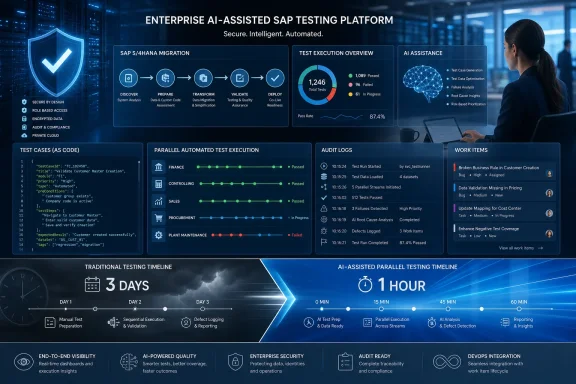
The platform ingests existing process documents, API references, functional specifications and other business artifacts, then proposes structured test cases for human review. Approved cases are converted into a Test Execution Context file, or TC JSON, which records the test steps, mappings, payloads, expected results and validation assertions.
That file is the critical control point. Microsoft says it turns an AI-generated proposal into a fixed, human-readable execution definition: the same test case should run the same way every time, rather than asking a model to improvise during a compliance-sensitive migration.
A second “policing” agent reviews generated output before it is finalized. Microsoft describes this as a multi-agent check on accuracy, while human approval remains in the loop before a case becomes executable. Results, evidence and bug work items flow back into Azure DevOps.
For Windows administrators and developers, that architecture is a more useful pattern than the usual promise of autonomous testing. AI can help turn institutional documentation into test coverage, but organizations still need a governed artifact that can be versioned, reviewed, executed repeatedly and traced to evidence.
A Migration Pilot Became the Proof Point
Microsoft used GTS as the initial proving ground rather than a low-risk pilot. The company reports that its first mock migration drill took 144 hours for cutover, the second took 36 hours, and the third took 11 hours. The eventual SAP S/4HANA go-live took six hours, while the delta migration was completed in 11 minutes.
The company attributes the outcome to both its in-house migration tooling and Enterprise Test Platform. It reports 57% automation across the migration effort and zero post-launch defects, though those are Microsoft’s own measurements rather than independently audited benchmarks.
The broader figures are equally ambitious. Across adopting service lines, Microsoft says end-to-end testing cycles have improved by 80%, and more than 10,000 test cases can execute in 10 to 12 minutes through parallel orchestration.
Those numbers should be read in context: they reflect a controlled internal environment with deeply documented SAP processes, Azure DevOps integration and a team able to build and operate its own platform. They are not a guarantee that a standard AI testing deployment will produce the same results.
The Harder Problem Is Adoption, Not Models
Microsoft says seven service lines are fully onboarded, 11 are in progress and more than 15 are in the pipeline. Its team made the platform modular so groups can adopt authoring, execution or validation independently instead of replacing every legacy testing component at once.
That may be the more transferable lesson. Most enterprise test estates cannot be rebuilt around a single AI platform overnight, particularly where regulated workloads, legacy test suites and tool-specific automation are already embedded in release processes.
Enterprise Test Platform’s real test now is whether those early migration results hold as Microsoft expands it across disparate SAP service lines. If they do, the strongest takeaway will not be that AI replaced testing teams—it will be that AI became useful only after Microsoft imposed the same controls, traceability and repeatability that enterprise testing has always required.
