

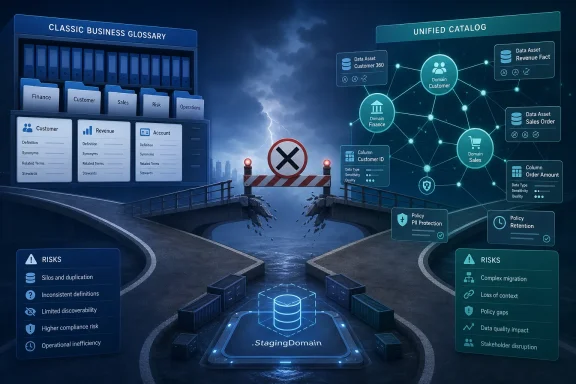
The important operational point is simple: do not treat the currently published Unified Catalog migration documentation as a green light to begin a production move. Microsoft’s roadmap entry now says it has decided not to proceed, while the related Learn documentation still describes a consequential, one-time workflow that can make the classic glossary and its APIs read-only.
The Roadmap does not explain why the change was cancelled, whether any tenants received the feature during the preview period, or what Microsoft intends to offer instead. It also does not state what customers should do if they had already begun a sample or full migration before the decision.
A July pause became an August cancellation
The cancellation is the second public status change in less than a month. Microsoft’s Message Center notice, MC1280564, originally described a built-in Purview tool that Data Governance Admins and Data Stewards could use to transfer classic glossary terms, associated term templates, and relationships to assets and columns. A July 9 update paused the rollout, saying Microsoft would communicate again when it was ready to proceed.
That wording suggested a delay. The Roadmap update on August 7 is more definitive: Microsoft says it has decided not to move forward with the change. Roadmap ID 558683 is now marked Cancelled, replacing its earlier preview and general-availability targets.
For Purview administrators, this is more than a missed convenience feature. The classic business glossary and Unified Catalog organize governance differently. The old experience centers on traditional glossary objects, while Unified Catalog puts glossary terms under governance domains and connects them to business concepts, data products, assets, columns, critical data elements, and potentially policies. A migration utility was supposed to bridge that design shift while preserving the relationships that make a glossary useful beyond a list of definitions.
Microsoft has not announced a new launch date, a revised migration design, or a replacement export-and-import process. No other outlet has reported a timeline for a successor tool.
Microsoft’s remaining documentation describes an irreversible move
Microsoft Learn still hosts a page titled Migrate classic glossary terms and enable asset curation (preview), last updated June 23, 2026. It details a workflow through Unified Catalog’s Catalog management > Classic types area, including a choice to migrate existing classic terms or switch directly to Unified Catalog terms.
That documentation carries warnings administrators should take seriously, especially now that the underlying roadmap feature has been cancelled. It describes migration as a one-time, non-reversible action. On completion, classic terms become read-only; users cannot create new terms in the classic experience; classic terms cease to appear in Data Map asset searches; and classic term APIs become read-only.
The intended migration was not a simple metadata copy. Microsoft says it would have moved classic glossaries and terms, their standard metadata such as acronyms and parent information, and their existing asset and column relationships in Microsoft Purview Data Map. Classic term templates would have been converted into Unified Catalog business-concept attributes.
That conversion has an additional permanence problem: Microsoft’s documentation says the resulting attributes cannot be edited or deleted. The pre-migration guidance therefore tells customers to remove unwanted term templates first. If a tenant did use an early version of the tool, that limitation matters more than the roadmap’s cancellation notice: a rollback may not be technically available simply because the future rollout is no longer proceeding.
The documents do not resolve whether a tenant that already completed a migration remains in a supported configuration, whether the tool is still visible to preview users, or whether Microsoft will preserve existing .StagingDomain objects. Microsoft needs to answer those questions directly rather than leave customers to infer product support from an older preview guide.
.StagingDomain made the migration a governance project
The proposed utility would have placed imported terms in a system-created governance domain named .StagingDomain, rather than automatically assigning them to their permanent owners. Data stewards would then have had to review and move migrated terms into the appropriate governance domains.
That architecture was defensible from a governance perspective. A classic glossary often reflects years of accumulated definitions, overlapping ownership, abandoned templates, duplicated names, and relationships that were valid when they were created but no longer map cleanly to a modern data-domain structure. Landing everything in staging would have prevented the tool from silently deciding which business unit owns “Customer,” “Revenue,” or “Sensitive Data.”
It also meant the promised feature required a prepared operating model, not merely a click-through migration. The person initiating the move needed both Governance Domain Creator and Data Curator roles, according to Microsoft’s guide. The data stewards responsible for redistribution needed access to both their destination domains and .StagingDomain.
Microsoft recommended a sample migration of up to five glossaries before a full migration, which is precisely the kind of safety valve this type of change needs. Yet the practical effort did not end with a successful sample. Term hierarchies would move together, so a selected parent term brings its children. Duplicate term names would not automatically move into a destination governance domain. And a Unified Catalog term can have no more than 100 relationships, requiring organizations to audit and potentially clean up heavily connected terms before starting.
Those constraints explain why cancellation creates uncertainty beyond a delayed interface. Purview customers may already have performed inventory work, redesigned governance-domain ownership, assigned roles, pruned templates, and planned a controlled cutover around a capability Microsoft now says it will not release.
Asset curation is caught in the middle
The most consequential detail in Microsoft’s documentation is that the migration-and-enablement process was also described as necessary to curate data assets with glossary terms. In the Unified Catalog model, a term is intended to be an active governance object: it can attach business context to assets and columns, and Microsoft says terms can carry policies governing how data is managed, discovered, and used.
Organizations with no classic glossary terms were not necessarily exempt from the broader enablement workflow. Microsoft’s documentation said that even new Unified Catalog users needed to confirm use of current Unified Catalog terms to enable asset curation. Existing classic-glossary users could choose to migrate, while organizations willing to abandon their old terms could choose to switch directly to Unified Catalog terms.
The current cancellation notice does not say whether that enablement path is also withdrawn. Its wording specifically cancels the “migration tool,” while Microsoft’s live Learn page continues to frame migration and asset-curation enablement as one connected process. That leaves a material ambiguity for administrators: can a tenant safely enable Unified Catalog asset curation without using the cancelled migration capability, and what happens to classic terms if it does?
Until Microsoft clarifies the status, the conservative interpretation is to separate planning from irreversible action. Teams can inventory classic glossaries, identify template debt, document current asset and column relationships, assign prospective domain owners, and decide how terms should map into Unified Catalog. They should not deactivate classic terms, select a direct switch away from them, or assume a preview UI remains supported merely because a documentation page still describes it.
What Purview administrators should preserve now
The cancellation does not mean an organization should freeze its data-governance work. It means the planned automated bridge cannot be assumed to exist. Administrators should preserve the information that a future Microsoft migration tool—or a carefully designed manual process—would need.
- Export and retain a dated inventory of classic glossaries, terms, parent-child relationships, acronyms, custom template fields, and linked Data Map assets and columns.
- Review terms with large numbers of relationships, particularly any that may approach Unified Catalog’s 100-relationship limit, before a later migration design turns cleanup into an emergency task.
- Map ownership in advance, including the governance domains each term should enter and the Data Stewards who will own approval and maintenance after the move.
- Avoid deleting classic templates solely to prepare for the cancelled tool unless the cleanup is independently approved as sound governance work.
- Record whether anyone ran a preview sample or full migration, and capture the current state of
.StagingDomain, migrated terms, and classic API behavior before making further changes.
Microsoft’s June documentation made clear that Unified Catalog is where the company wants glossary management and asset curation to converge. The August 7 cancellation does not reverse that product direction, but it does remove the transition mechanism Microsoft had publicly planned for classic customers. For now, the classic glossary remains the system of record for organizations that have not already moved, and any production cutover should wait for Microsoft to publish a replacement path and explicit guidance for tenants touched by the preview.