
The cancellation matters because the roadmap item described a particular meeting-era agent experience, rather than merely another way to chat with a Copilot Studio bot. Microsoft’s stated plan was to make agents available during calls and meetings for private or group use, with suggested zero-state prompts and session memory for agents built on Copilot. Organizations preparing meeting workflows around that promised surface should treat it as unavailable, not delayed.
Microsoft’s own roadmap record is the primary notice here. But its presentation also exposes a problem familiar to Teams administrators: the entry retains its old feature description and, in some views, still appears under “in development” even while the description says the rollout has been stopped. The operative change is the cancellation notice, not the stale categorization or the long-expired September target.
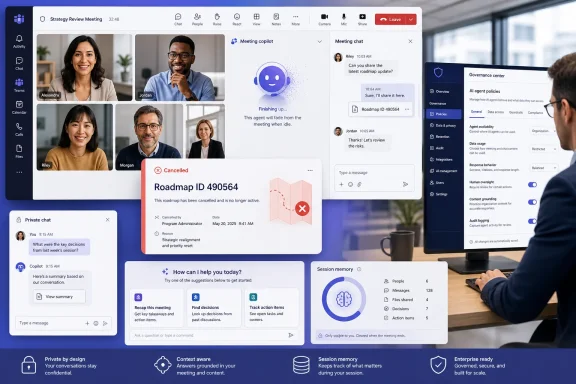 The cancelled feature was more specific than Teams agents generally
The original proposal was built around agents that could be called into the context of a Teams meeting or 1:1 call. Microsoft said users could engage an agent with other participants or privately, and that private interactions would avoid appearing as a conventional participant-facing exchange. The product pitch also centered on agents offering useful interactions before a user had composed a request, a behavior Microsoft describes as zero-state prompting.
Microsoft’s May 2025 What’s New in Microsoft Teams post had already described interactive agents for meetings and calls as a public-preview capability. That announcement said an agent could join group or private conversations, suggest prompts, answer questions, and track action items. It also said private agent conversations would not show the agent in the meeting roster.
Roadmap 490564 was therefore not the beginning of Teams extensibility in meetings, nor a declaration that all existing meeting bots would disappear. Teams has long supported meeting apps and calling or meeting bots through Microsoft Graph-based capabilities. Microsoft Learn continues to document agents, meeting apps, and bots that can respond in meeting contexts, access relevant meeting information, and support workflows such as summaries, agenda updates, and task capture.
What Microsoft has cancelled is the planned broadly released interactive-agent rollout described by this roadmap record. That distinction is important for anyone reading “cancelled” as a blanket withdrawal of all Teams agents. The public record does not support that broader conclusion.
Session memory was an unfinished dividing line
The planned feature also contained a limitation that matters for builders. Microsoft said only Copilot-built agents would support sessions, allowing them to remember context from earlier in the same interaction. Custom agents would not have session support.
That is not a cosmetic distinction. A meeting assistant that cannot retain session context has to regain the user’s intent through the current prompt, connected data, or whatever conversation history the platform deliberately provides. An agent with session support can respond with continuity during a discussion, but it also creates more complicated questions around retention, user expectations, access boundaries, and what happens when the meeting’s attendees or content change.
Microsoft’s Copilot Studio documentation makes clear that agents added to a group or meeting chat can receive that conversation history, helping them produce context-aware responses. It also says administrators must approve the capability changes that allow users to add an agent to teams, group chats, or meeting chats. That remains a separate, documented model from the cancelled roadmap item’s promise of session-aware interactive agents in calls and meetings.
The practical result is that developers should not infer session behavior from an agent merely because it can appear in Teams. They should validate its actual data access, memory behavior, chat scope, and consent path in the exact Teams and Copilot Studio configuration they deploy. The cancelled rollout would have made a particular interaction model more visible; it did not erase the existing need to define those controls per agent.
Microsoft has not explained why the rollout stopped
The cancellation notice is unusually sparse: Microsoft says only that, after further review, it cannot continue the rollout and apologizes for the inconvenience. It names no privacy defect, security issue, reliability failure, licensing change, customer-feedback threshold, or replacement product.
That absence matters more than the apology. Teams meeting agents sit where spoken discussion, meeting chat, files, identities, external attendees, transcription, and potentially sensitive business decisions can meet. Microsoft’s current Teams policy guidance for agents treats external access, guest access, meeting policies, messaging policies, and content access as settings that need active administrative review. It says administrators can control, among other things, whether agents join meetings hosted by other organizations and whether anonymous or external users can interact with apps in meetings organized by an agent.
None of that proves that governance or privacy concerns caused the cancellation. Microsoft has not said so, and there is no public evidence in the roadmap notice that establishes a cause. But it does show why a feature that combines private conversations, meeting context, and agent memory is more operationally sensitive than a normal chat bot.
The timing also deserves careful treatment. Independent tracking of Microsoft’s roadmap changes, including SharePoint Stuff’s October 2025 roundup, recorded the same “not able to continue” wording well before the submitted August 17, 2026 timestamp. Microsoft’s live roadmap listing has also displayed conflicting signals: the cancellation language remains in the description while some indexed views continue to label the item as in development and retain the September 2026 rollout date.
In other words, the public record supports the cancellation, but it does not cleanly support August 17, 2026 as the first date Microsoft decided to stop the feature. The newer timestamp may represent a metadata update, a later republication, or a roadmap-record refresh. Microsoft has not published an explanation resolving that history.
What Teams administrators should change now
For IT teams, this is primarily a planning and communication issue rather than an emergency remediation event. The roadmap listed Worldwide standard multi-tenant environments and desktop clients, with both Targeted Release and General Availability rings. Since it is cancelled, there is no supported rollout to wait for, no feature flag identified for cleanup, and no published migration path.
Administrators should take three immediate steps:
- Remove Roadmap ID 490564 from deployment plans, executive roadmaps, pilot commitments, and user-training material that describe interactive agents arriving in Teams meetings or 1:1 calls.
- Review whether a proof of concept was relying on the cancelled session-memory behavior, private in-meeting interaction model, or agent availability assumptions rather than capabilities already documented and enabled in the tenant.
- Verify the configuration and governance of agents that are already available through Teams, Microsoft 365 Copilot, or Copilot Studio, especially their meeting-chat scope, knowledge sources, external access, data-loss-prevention policies, and approval state.
Teams administrators should also avoid telling users that all meeting-related agents have been withdrawn. Existing Teams platform capabilities are still documented, and Copilot Studio still supports publishing agents to Teams and Microsoft 365 Copilot under its own configuration, approval, and policy rules. The cancelled item does not repeal those mechanisms.
A roadmap card is not a deployment contract
Microsoft’s roadmap itself warns that release dates are estimates and that items can be changed, postponed, or cancelled. This case is a sharper example of why organizations should not build a production dependency around a roadmap promise—particularly for an AI feature whose final governance, memory model, and meeting behavior have not yet reached general availability.
The better threshold for commitment is a combination of an available product feature, administrator documentation, a defined licensing model, and test results in the organization’s own tenant. A public-preview announcement can justify exploration; a roadmap date can inform capacity planning; neither is a guarantee that a capability will ship in the described form.
For Roadmap ID 490564, the concrete consequence is simple: the September 2026 Teams rollout should be considered dead. Microsoft has not named a successor, has not offered an implementation alternative for the cancelled experience, and has not said whether its session-aware meeting-agent concept will return under another product or roadmap entry.
