

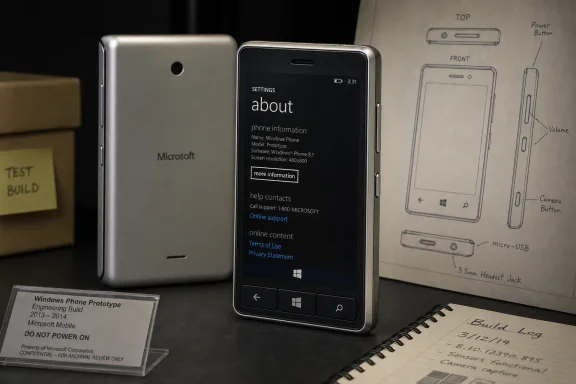
The important qualification is that the photos do not prove Microsoft had a finished “Surface Phone” ready for sale, nor do they authenticate a codename. Windows Central says the device may have been called Raven and describes it as an internal prototype, but the images themselves do not expose a readable product name, model number, regulatory label, or hardware identifier. No second outlet has independently reported its provenance, specifications, or internal project name.
What the pictures do establish is more useful than another decade-old rumor: Microsoft was at least testing a distinctive in-house handset design while Windows Phone 8.1 was still under development. The timing puts this device at a pivotal point in the company’s mobile strategy, when it was simultaneously promoting Surface as its premium hardware brand and preparing to close the Nokia Devices and Services deal.
The evidence supports a prototype, not a confirmed Surface product
The photographed handset looks unlike the retail Lumia designs Microsoft ultimately sold after acquiring Nokia’s phone division. It has a plain Microsoft wordmark rather than Nokia or Lumia branding, a silver-colored frame reminiscent of the Surface 2 era, and three separate capacitive hardware navigation keys beneath the display. Windows Central reports a 720p screen, an unidentified Qualcomm processor, separate volume buttons and camera key on the right side, top-mounted power button, left-side SIM tray, and micro-USB plus headphone jack at the bottom.
Those details fit a Windows Phone reference or engineering device from the period. Dedicated Back, Start, and Search keys were still an expected part of the Windows Phone hardware experience, while a physical shutter button was common on Lumia hardware and important to Microsoft’s imaging ambitions. A 720p panel and Qualcomm silicon would also have been conventional for a midrange-to-upper-midrange Windows Phone in late 2013, rather than evidence of a flagship intended to compete head-on with the largest Android devices of 2014.
But “conventional” cuts both ways. Nothing visible in the photographs proves that this was a Surface-branded retail candidate rather than one of many internal test designs. Hardware teams produce devices to validate radio stacks, displays, buttons, camera modules, manufacturing processes, and pre-release operating-system builds; most are never intended to reach a store shelf. The Microsoft logo is significant, but it is not a product roadmap.
The apparent September 2013 Windows Phone build is similarly consistent with the timeframe, not conclusive by itself. Microsoft publicly unveiled Windows Phone 8.1 at Build on April 2, 2014, and later brought it to Lumia devices through the Lumia Cyan release. A device running an earlier internal branch months before that announcement would be expected inside Microsoft or a close hardware partner. It does not demonstrate that the phone was destined to ship alongside the OS.
The strongest conclusion the record supports is narrower: Microsoft was testing its own Windows Phone hardware before the Nokia deal closed, and this device may be one surviving example. Claims that it was definitively the canceled Surface Phone, or that Raven was its settled codename, remain unverified.
The Nokia acquisition changed the value of a separate Microsoft phone
The prototype’s likely 2013–2014 window explains why it vanished. Microsoft completed its acquisition of substantially all of Nokia’s Devices and Services business on April 25, 2014. That transaction delivered the company Lumia phone engineering, supply-chain operations, manufacturing capacity, camera expertise, carrier relationships, and an established portfolio already built specifically for Windows Phone.
A separate Microsoft-developed Surface phone could have made strategic sense before the deal. Surface had launched in 2012 partly as a first-party expression of Microsoft’s view of Windows hardware: a device meant to demonstrate industrial design, touch computing, accessories, and premium integration when OEMs were moving slowly or in divergent directions. A phone built to the same logic would have given Microsoft a direct way to set a Windows Phone benchmark.
After April 2014, however, Microsoft no longer needed to create a smartphone organization from scratch to do that. It owned the one OEM most deeply invested in Windows Phone. Microsoft publicly said it would continue producing, selling, and supporting Lumia and Asha devices after the transaction. By October, the company was formally transitioning Lumia into the Microsoft family.
That made a parallel Surface handset difficult to justify internally. It would have required Microsoft to maintain two first-party phone identities—one inherited but widely recognized, one newly created—and decide which would receive the best cameras, flagship components, carrier launches, marketing budget, and software differentiation. It also risked signaling that Microsoft considered Lumia inadequate immediately after spending billions to acquire Nokia’s handset operations.
Microsoft did go on to release Lumia 535, Lumia 640, Lumia 650, Lumia 550, Lumia 950, and Lumia 950 XL under Microsoft branding. Those were phones from the Nokia pipeline and its successor organization, not Surface devices. The product decision was practical: consolidate around Lumia, use its existing engineering and distribution apparatus, and try to build momentum around Windows Phone 8.1 and then Windows 10 Mobile.
The newly surfaced prototype looks like collateral damage from that consolidation. It may have been paused because of Nokia, as Windows Central suggests, but no Microsoft document seen publicly confirms a cancellation decision, a project date, or a reason. The acquisition offers a compelling explanation; it is not the same as a disclosed postmortem.
Microsoft had publicly rejected Surface Phone rumors before these photos
The existence of a Microsoft-branded test handset also adds context to a public denial that is easy to misread in hindsight. In April 2013, Windows Phone chief Terry Myerson said Microsoft had no plans to make a Surface Phone, according to reporting at the time by TechRadar. That statement was about product plans, not necessarily every piece of exploratory hardware in a Microsoft lab.
Large device companies regularly test form factors and product directions they never commercialize. In Microsoft’s case, Surface itself began as an unusual move because it put the company into more direct competition with hardware partners that licensed Windows. A phone would have been politically and commercially more sensitive still: HTC, Samsung, Huawei, and especially Nokia all sold Windows Phone handsets, even as the platform struggled to gain share against Android and iPhone.
The apparent prototype therefore does not automatically mean Myerson’s 2013 statement was false. It may mean Microsoft’s hardware group was doing exactly what a platform owner should do—evaluating possibilities and developing internal reference designs—without a committed, approved Surface Phone launch plan. The absence of a retail announcement, certification record, carrier leak, marketing materials, or a broader chain of independently documented hardware samples makes the distinction important.
It also exposes how quickly Microsoft’s mobile plans were being reshaped. In September 2013, Microsoft announced its agreement to acquire Nokia’s Devices and Services business. By April 2014, Windows Phone 8.1 was being introduced as the platform’s major consumer update, with Action Center, Cortana in the United States, Word Flow keyboard, Wi‑Fi Sense, Storage Sense, and enterprise improvements. Nokia’s Lumia 630 became the first phone sold with Windows Phone 8.1 preinstalled in May 2014.
A standalone Surface handset would have entered a market where Microsoft was already betting on Lumia hardware to carry Windows Phone 8.1. The prototype’s likely fate was decided less by its metal frame or its screen resolution than by that corporate reality.
The “Skype Phone” theory is a rumor layered on a rumor
Windows Central also revisits an old claim that Microsoft had explored a “Skype Phone” concept: a Windows Phone device using Skype for calls and messaging over mobile data rather than relying on traditional carrier voice networks. It is an intriguing idea, particularly because Microsoft had acquired Skype in 2011 and was trying to make its services central to Windows Phone.
There is no visible evidence in these photographs tying the device to Skype, however. The physical design described by Windows Central—standard buttons, SIM support, micro-USB, headphone jack, and a Windows Phone 8.1 development build—does not distinguish a Skype-focused phone from any other prototype. The reported SIM tray in fact underscores that the device was designed to work with cellular connectivity, though it says nothing about how voice service would have been provisioned.
Treating the handset as a Skype Phone would go beyond the available record. A credible connection would require software screens, diagnostic menus, internal presentation material, a radio configuration, prototype documentation, or independently sourced testimony that identifies the project. None has surfaced publicly with these images.
This is a recurring problem in the history of Microsoft’s mobile hardware: surviving prototypes are compelling because the commercial products never arrived, and that vacuum invites every abandoned internal device to become the Surface Phone. The photos are historically valuable without being forced into that narrative.
A relic of the phone strategy Microsoft never completed
Microsoft eventually used the Surface brand on a phone-sized device, but only after Windows Phone was gone. Surface Duo launched in 2020 with Android, two displays, and a very different purpose from a conventional slab handset. Windows Central has also documented later canceled dual-screen projects, including the Windows-based Andromeda effort. Those programs show Microsoft continued to experiment with mobile form factors long after the Lumia era, but they should not be retroactively treated as evidence that this 2013–2014 device was on a direct path to Surface Duo.
The more revealing comparison is with what Microsoft actually shipped after this prototype’s likely cancellation. Lumia remained the company’s Windows Phone vehicle; Microsoft then ended Windows Phone 8.1 support on July 11, 2017. By the time Surface Duo arrived three years later, Microsoft had abandoned its own mobile OS and accepted Android as the platform required to sell a modern phone.
That is why these images matter. They are not proof of a lost flagship that would have saved Windows Phone. They are evidence of a moment when Microsoft was still considering whether it could build the phone itself, before Nokia’s acquisition gave it a different answer and before the app and market realities made Windows Phone untenable. Unless the device’s owner publishes its labels, firmware details, or a provenance trail, Raven and “Surface Phone” should remain working theories—not established product history.