
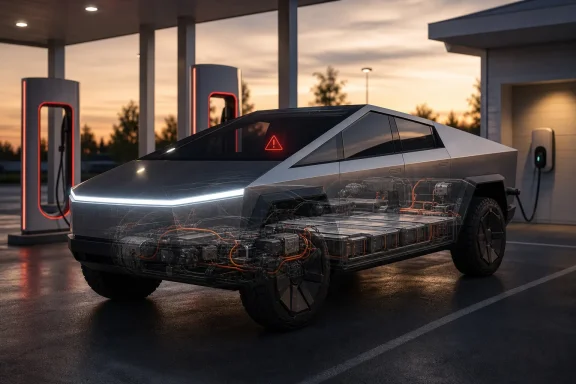
 Overview: What Cybertruck Owners Are Reporting
The latest reports center on forum posts from Cybertruck drivers who encountered high-voltage system alerts, charging failures, or service diagnoses calling for a replacement battery pack. In the most detailed account, a Maryland owner said his Cybertruck required a new high-voltage battery after roughly 12,000 miles and eight months of use, following a period in which he says he charged exclusively through Tesla’s Supercharger network. Torque News
That owner reportedly took delivery in September 2025 and received one year of complimentary Supercharging. Instead of treating free public charging as a road-trip convenience, he says he used it as his primary—and apparently only—source of energy. The financial logic is understandable: if a buyer is offered free fast charging, maximizing its value can feel like an obvious benefit.
A Chicago owner described an almost identical charging strategy. He reported exclusive Supercharger use for approximately nine months under a free-charging offer, fewer than 5,000 miles on the odometer, and a subsequent high-voltage battery error. In his account, the warning temporarily cleared, but he opened a service request and elected not to continue driving the truck until Tesla could inspect it. Torque News
The most important counterpoint comes from a Pennsylvania owner of a 2026 Cybertruck Premium. This driver reported voltage-sense-harness warnings, limp-mode behavior, and a potential no-restart alert after about 3,000 miles—yet specifically said the truck had never been Supercharged. The owner instead used Tesla’s Mobile Connector at 28 amps at home. Torque News
That third report is critical. It prevents a responsible analysis from collapsing into the simple claim that “Supercharging killed the batteries.” If a Cybertruck that has never used DC fast charging displays high-voltage battery warnings requiring service, other explanations must remain on the table.
Battery Degradation Is Not the Same as Battery Failure
A major source of confusion in EV reliability discussions is the tendency to use the word battery as though it describes one simple, single component. It does not.
A modern EV high-voltage battery system includes far more than cells and stored energy. It encompasses modules, cooling hardware, contactors, sensors, battery-management electronics, harnesses, connectors, isolation-monitoring components, and control software. A fault in any of these areas can trigger a high-voltage system warning or make the vehicle unable to charge—even if its individual battery cells have not suffered unusual capacity loss.
That distinction matters because the reports concern high-voltage battery errors and replacements, not merely a driver noticing a few fewer miles of estimated range. Tesla’s own Cybertruck manual recognizes that battery capacity naturally declines with time and energy use, while also making a separate point about the possible effects of extensive DC fast charging on charging behavior. Tesla says that the battery’s peak charging rate “may decrease slightly” after a large number of Supercharger sessions, reflecting changing battery conditions over use and age. Tesla Cybertruck Owner’s Manual
In other words, Tesla itself does not present Supercharging as consequence-free. But a reduced peak charging rate over time is very different from an outright pack failure, a locked charge port, a voltage-sense warning, or a vehicle that enters limp mode.
The distinction owners should make
When a Cybertruck presents a battery-related warning, the practical questions are:
- Is the vehicle reporting reduced battery capacity?
- Is it restricting power because of a thermal or voltage condition?
- Is it unable to accept a charge?
- Is it reporting a harness, sensor, isolation, contactor, or battery-management fault?
- Has Tesla diagnosed the issue as a cell or pack defect, or as an ancillary component problem?
- Is the battery replacement a repair for a confirmed pack failure, a preventive service action, or a consequence of an underlying diagnostic code?
Those answers determine whether Supercharger frequency is even a plausible primary factor. A damaged or improperly routed sensing harness, for example, would be a very different problem from electrochemical cell degradation caused by high-rate charging.
Tesla’s Own Guidance Is Clear: Use Level 1 or Level 2 Charging When Possible
While the available owner reports do not establish causation, Tesla’s own published Cybertruck battery-care advice leaves little ambiguity about the preferred routine. The company says owners should charge using Level 1 or Level 2 equipment whenever possible and “save the Supercharging for road trips or long drives.” Tesla Cybertruck Owner’s Manual
Tesla also advises Cybertruck owners to charge regularly rather than waiting for the pack to become very low, avoid leaving the battery close to 0% or 100% for extended periods, and keep the vehicle plugged in when it will not be used for weeks. Tesla Cybertruck Owner’s Manual
That guidance frames the real issue with the free-Supercharging cases. The concern is not that an owner used a Supercharger now and then. Tesla built the Cybertruck for long-distance travel and currently advertises up to 325 kW of Supercharging capability, with up to 137 miles added in 15 minutes on the Cybertruck Premium All-Wheel Drive. Tesla Cybertruck product page
The concern is exclusive dependence on high-power DC charging for months.
A free-charging incentive can inadvertently encourage precisely the behavior Tesla’s owner guidance treats as the less desirable daily habit. A buyer who has paid for home charging equipment and household electricity may naturally use Level 2 charging overnight. A buyer presented with free Supercharger access may instead make regular charging trips, potentially arriving at chargers with lower states of charge and using repeated high-rate charging sessions as a routine.
That does not make the owner irresponsible. It does, however, highlight an incentive mismatch:
- Tesla’s promotion encourages use of its charging network.
- Tesla’s battery-care guidance favors slower charging at home when practical.
- Owners may understandably treat “free” Supercharging as a benefit to maximize.
- The battery system experiences a different long-term usage profile as a result.
Why Frequent DC Fast Charging Can Matter
At a basic level, fast charging requires a battery to accept energy at substantially higher power than home AC charging. The Cybertruck’s thermal-management system, battery-management software, and charging curve exist to keep that process within defined operating limits. Under normal conditions, this is exactly what an EV is engineered to do.
Yet battery science has long recognized that fast charging creates more demanding conditions than slower charging. Research supported by the U.S. Department of Energy has identified high-current charging as a contributor to degradation mechanisms including lithium deposition, active-material damage, and rising internal resistance. Argonne National Laboratory research via OSTI
The important qualifier is conditions. Charging rate is not the only variable. Temperature, state of charge, battery chemistry, charge curve, pack cooling, cell age, depth of discharge, preconditioning, and the software’s limits all affect the outcome.
What happens inside a lithium-ion battery
When a lithium-ion battery is charged, lithium ions move into the anode material. At very high charging rates, especially in unfavorable temperature or state-of-charge conditions, the system can become less able to move and store those ions uniformly. One risk is lithium plating, in which metallic lithium accumulates on the anode rather than becoming properly intercalated in the battery material.
Laboratory research has found that high-rate fast charging can accelerate mechanisms such as lithium plating and impedance growth, though the exact result depends on the cell design and operating conditions. Argonne and NREL research via OSTI Research into extreme fast charging has also identified multiple degradation pathways, including lithium plating, formation of electrically inactive lithium, and loss of active electrode material. Lawrence Berkeley, Argonne, Idaho National Laboratory and collaborators via OSTI
But laboratory findings cannot be casually mapped onto a specific Cybertruck diagnosis. A production truck does not charge at a fixed laboratory C-rate from empty to full. Tesla dynamically regulates power as the pack warms, the state of charge rises, and battery conditions change. That is one reason a broad “fast charging is bad” conclusion is as misleading as an equally broad “fast charging can never matter” claim.
The real-world evidence is more complicated
One earlier collection of Cybertruck owner-reported battery-health figures suggested that trucks frequently charged at Superchargers displayed more apparent degradation than several trucks charged primarily at home. However, the dataset was self-reported, small, uncontrolled, and heavily exposed to confounding factors such as mileage, climate, driving speed, towing, charging limits, and differences in software-based battery estimates. Torque News
Those figures are useful as a reason to investigate—not as proof of a failure rate or a scientific verdict on Cybertruck battery durability. An app’s estimate of usable capacity can change after calibration, temperature shifts, software changes, or a battery-management-system recalibration. It is not equivalent to a controlled diagnostic measurement of cell health.
The Voltage Sense Harness Report Changes the Story
The Pennsylvania report deserves special attention because it names a possible fault domain: the Voltage Sense Harness. This is not a casual detail. A voltage-sensing circuit is part of the system used to monitor battery conditions and safely manage a high-voltage pack.
Tesla has previously issued a Cybertruck service bulletin concerning an HV battery ancillary harness that could have been improperly routed, potentially straining harness branches or connectors between the High Voltage Controller and Battery Management Boards. The bulletin applies to certain 2024 Cybertruck vehicles and is not proof that it applies to any particular 2026 truck, but it demonstrates that harness routing and high-voltage monitoring hardware have already been identified as legitimate Cybertruck service concerns. Tesla service bulletin filed with NHTSA
That context is crucial for interpreting the new accounts.
A high-voltage battery warning could arise from:
- Cell-level degradation or a defective battery module.
- A battery-management-system sensor reading outside expected limits.
- A damaged or strained ancillary harness.
- A connector or communication fault.
- A cooling-system or temperature-sensing issue.
- A contactor, fuse, or isolation-monitoring problem.
- A software diagnostic threshold that correctly detects an abnormal condition before a larger failure occurs.
The reported home-charging case makes these possibilities more than theoretical. If that truck genuinely has never used Supercharging, then charging frequency alone cannot explain the event. The most defensible conclusion is that exclusive fast charging is a possible stress factor worth examining, not a confirmed root cause of the reported high-voltage battery replacements.
Why This Is a Bigger Issue Than a Routine Service Visit
A high-voltage warning has consequences beyond inconvenience. In the accounts reported so far, one owner said the truck would not charge and that the charge port would not open; another described alerts that could lead to limp mode and warned that the vehicle might not restart. Torque News
For an electric pickup expected to serve as transportation, work vehicle, towing platform, and mobile-power source, the difference between “charging more slowly than before” and “may not restart” is enormous. The latter can interrupt trips, leave an owner arranging a tow, complicate job-site use, and erode confidence in a vehicle’s central propulsion system.
There is also an ownership-experience issue. The Pennsylvania owner said parts had been ordered and the truck remained at the service center for weeks. That report is anecdotal, but it illustrates the practical impact when a specialized battery or high-voltage component is unavailable: even a warranty-covered repair can become a prolonged loss-of-use event. Torque News
Tesla’s published warranty provides Cybertruck battery and drive-unit coverage for eight years or 150,000 miles, whichever comes first, with a minimum 70% battery-capacity retention threshold during the warranty period. Tesla Vehicle Warranty That is important protection for owners, especially at the low mileage figures cited in these reports.
Still, warranty coverage does not eliminate the disruption of a vehicle being unavailable, nor does it answer the reliability question. Replacing a battery pack under warranty is an appropriate remedy for a covered defect. It is not, by itself, an explanation for why the defect occurred.
What Cybertruck Owners Should Do Now
There is no sound reason for owners to panic or to avoid Supercharging altogether. Tesla explicitly designed the Cybertruck to use the Supercharger network, and DC fast charging remains essential for long-distance EV travel.
However, the current reports reinforce the value of following the manufacturer’s own battery-care guidance rather than treating complimentary fast charging as a daily default.
A sensible charging routine
For Cybertruck owners who have access to home or workplace charging, the practical approach is straightforward:
- Use Level 2 charging as the normal routine. Tesla explicitly recommends Level 1 or Level 2 charging whenever possible and reserves Supercharging for longer travel needs. Tesla Cybertruck Owner’s Manual
- Set an appropriate daily charge limit. Tesla advises keeping the daily limit near 80% on vehicles for which that limit is recommended, saving 100% for occasions where the additional range is needed. Tesla Cybertruck Owner’s Manual
- Do not repeatedly run the battery near empty before charging. Tesla says regular charging is better than waiting until the battery is very low, and warns against leaving the pack at or near 0% for long periods. Tesla Cybertruck Owner’s Manual
- Use Trip Planner when traveling to a Supercharger. Tesla says battery preconditioning can reduce charging time by warming the battery en route. Tesla Cybertruck Owner’s Manual
- Treat high-voltage alerts as service events, not dashboard noise. If the truck reports charging inability, reduced power, a potential no-restart condition, or persistent high-voltage warnings, use the Tesla app to schedule service and avoid assuming that a cleared warning means the underlying issue has disappeared.
- Document the details. Owners should retain screenshots of warnings, service messages, charging history, mileage, ambient conditions, and the exact behavior before and after the alert. This information can help Tesla diagnose whether a case involves cell health, charging hardware, a sensing harness, or a software issue.
What not to assume
It would be premature to assume that every Cybertruck battery alert stems from repeated Supercharging. The home-charging report directly contradicts that theory as a universal explanation.
It would also be a mistake to assume that all battery-pack replacements mean the cells themselves have worn out. Modern high-voltage systems are replaced or serviced for many reasons, and a pack-level repair may be the most efficient service procedure even where the original fault is in monitoring hardware or a related subsystem.
Tesla Needs to Make the Diagnosis More Transparent
The largest gap exposed by these reports is not merely a potential hardware issue. It is the shortage of public diagnostic clarity.
Owners can see a message such as “high-voltage battery error,” but that phrase is broad. It can describe a spectrum ranging from an isolated voltage-sense signal problem to an actual battery-pack defect. When a service center recommends a pack replacement, customers understandably want to know whether the replacement addresses capacity, safety isolation, a harness issue, an internal module fault, cooling performance, or a software-driven engineering action.
Greater transparency would benefit both Tesla and owners. It would help distinguish:
- Normal battery aging from a sudden high-voltage fault.
- A charging-habit correlation from a manufacturing or component problem.
- A pack replacement driven by cell health from one driven by monitoring hardware.
- An isolated repair from a pattern requiring a broader service campaign.
Tesla has already acknowledged through its own Cybertruck manual that extensive DC fast charging can slightly reduce peak charge rate over time, and it explicitly recommends slower AC charging whenever practical. Tesla Cybertruck Owner’s Manual The company can strengthen owner confidence by pairing that guidance with more specific service communication when high-voltage faults occur.
The Bottom Line
The Cybertruck high-voltage battery failure reports are significant because the affected vehicles are relatively new, the failures can leave owners unable to charge or potentially unable to restart, and some drivers associate the problem with months of exclusive Supercharger use. Torque News
Yet the available evidence does not establish that frequent Supercharging caused the failures. The reported case involving home-only charging, along with the known importance of voltage sensing, harness routing, battery management, and thermal control, shows why a single-cause narrative would be technically unsound.
The prudent takeaway is less dramatic but more useful: Supercharging is a capability, not the ideal everyday default when slower charging is available. Tesla’s own Cybertruck guidance supports that position. Owners should use Level 1 or Level 2 charging for routine replenishment, reserve high-power Supercharging for travel and time-sensitive needs, monitor any high-voltage warnings carefully, and insist on clear diagnostic explanations when a service center recommends replacing one of the vehicle’s most important and expensive components.
