
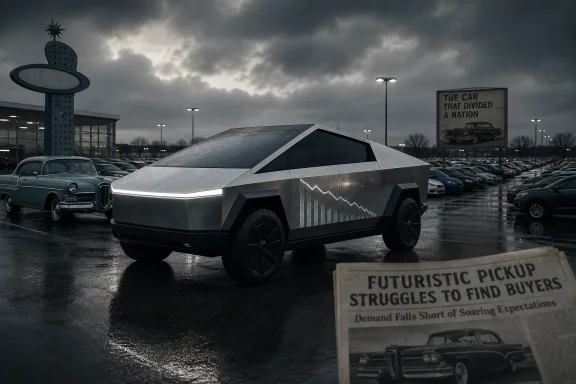
That headline is deliberately dramatic, but the underlying question is substantive: has Tesla’s Cybertruck become a failed mass-market product, or merely a niche EV that was marketed with impossible expectations? The answer matters not only to Tesla shareholders and pickup buyers, but to the wider technology industry. The Cybertruck was meant to demonstrate how a software-first company could overturn one of Detroit’s most conservative, profitable product categories. Instead, it has exposed the limits of product hype, unconventional design, and engineering ambition when they collide with real-world pricing, reliability concerns, and buyer expectations.
For Windows and PC enthusiasts, the story also lands close to home. Tesla has often been treated as the automotive equivalent of a disruptive tech platform: vertically integrated, aggressively updated, hardware-led, and willing to replace familiar conventions with a radically different user experience. The Cybertruck shows that innovation can be compelling without necessarily being commercially scalable.
 The Cybertruck’s Commercial Problem Is Bigger Than a Slow Quarter
The immediate concern is not simply that Cybertruck sales have softened. It is that the sales trajectory appears to have deteriorated rapidly after the launch-period excitement faded.
According to figures cited by 24/7 Wall St., Tesla sold approximately 38,965 Cybertrucks in 2024, followed by 20,237 in 2025—a decline of 48.1%. The same report says Cybertruck volume reached just 3,519 deliveries in the first quarter of 2026, while S&P Global Mobility registration data cited by Bloomberg showed 7,133 U.S. registrations through May 2026.
Those numbers matter because the Cybertruck was never introduced as a limited-edition collector vehicle. It was presented as Tesla’s breakthrough entry into the full-size pickup market, one of the most valuable segments in the United States. Tesla chief executive Elon Musk had projected production of 250,000 Cybertrucks annually by 2025, according to the Los Angeles Times.
There is an important discrepancy in the public record over the highest stated sales goal. APA’s report references an ambition of 500,000 units annually, while other reporting points to the more frequently cited 250,000-per-year target. Either figure creates an enormous gap between aspiration and reality. Even using the lower 250,000-unit benchmark, sales have landed far below what Tesla’s leadership once suggested was achievable.
That distinction is crucial. A specialist vehicle selling 20,000 units a year is not automatically a failure. Many expensive, niche performance cars and luxury SUVs sell in lower quantities. The Cybertruck’s issue is that its actual market scale is nowhere close to the scale Tesla used to justify the project’s hype, production investment, and cultural positioning.
A target-versus-reality failure
The Ford Edsel comparison has traction because it is based on expectations as much as total volume. Ford projected 200,000 first-year Edsel sales but sold less than a third of that amount, according to 24/7 Wall St.. The Cybertruck, by comparison, may be suffering an even larger proportional miss against its expected production run.
That does not mean the two vehicles are identical. The Edsel was a conventional car born from traditional corporate planning, while the Cybertruck is an all-electric, heavily software-defined pickup built around a polarizing stainless-steel body and a radically different manufacturing concept. But both demonstrate how an automaker can become trapped by its own expectations.
Once a vehicle has been framed as revolutionary, merely being competent is not enough. It has to reshape the market.
The Cybertruck has not done that.
Background: A Pickup Designed to Reject the Pickup Rulebook
From its reveal in 2019, the Tesla Cybertruck was never designed to blend in. The wedge-shaped electric pickup rejected the visual language of Ford, Chevrolet, Ram, Toyota, and every other mainstream truckmaker. Tesla replaced familiar curves, painted steel body panels, and traditional truck proportions with flat stainless-steel surfaces, sharp angles, and a silhouette closer to a science-fiction prop than a work vehicle.
That was a strength at launch. It made the Cybertruck impossible to ignore.
Tesla’s pitch combined several ideas that were tailor-made for a technology audience:
- A stainless-steel exterior positioned as exceptionally durable.
- A battery-electric powertrain promising strong acceleration and modern EV convenience.
- Tesla software and over-the-air updates that could theoretically improve features over time.
- An unconventional user experience intended to distinguish the truck from legacy automotive design.
- A futuristic brand identity that invited buyers to see the vehicle as a statement about technology, not merely transportation.
APA’s report noted that Musk promoted the Cybertruck as a “tank built to survive the apocalypse,” while also acknowledging that the vehicle has faced criticism related to its reliability and divisive styling since launch. APA framed those issues as central to the argument that the pickup could become a major commercial disappointment.
The problem is that the mainstream pickup market does not reward novelty for novelty’s sake. Truck buyers often care about dependability, payload and towing capability, bed access, repairability, dealer support, resale confidence, fleet suitability, and the ability to use a vehicle without attracting unwanted attention. A bold design can create demand, but it can also sharply limit the addressable market.
The original price promise did not survive production reality
The Cybertruck’s commercial case became still more difficult when the launch vehicle cost far more than the early promise attached to it. The Los Angeles Times reported that initial Cybertruck versions sold for more than $100,000, substantially above the under-$40,000 starting price Tesla promoted in 2019.
That is a major shift in buyer psychology.
At under $40,000, a radical Tesla electric pickup could be framed as an attainable alternative to a well-equipped conventional truck. At $100,000 or more, it becomes a luxury product competing for buyers who have many alternatives: premium gasoline pickups, high-performance SUVs, established luxury EVs, and even specialized off-road vehicles.
The Cybertruck’s unusual design may be easier to accept as a $40,000 disruption than as a six-figure experiment.
The Demand Curve Appears to Have Broken
New models often see a surge of early demand. Reservation holders, loyal customers, collectors, influencers, and brand enthusiasts tend to buy first. The true commercial test comes later, when a vehicle must appeal beyond the launch audience.
Cybertruck sales suggest that Tesla may have exhausted much of that early adopter pool faster than expected.
The Los Angeles Times reported that, without sales to Musk-controlled companies including SpaceX, xAI, Boring Co., and Neuralink, Cybertruck registrations would have fallen 51% in the fourth quarter cited by the newspaper. Automotive forecasting executive Sam Fiorani told the paper that Tesla was “running out of buyers for the Cybertruck.”
Tesla has not announced that it intends to discontinue the vehicle. It also remains the leading battery-electric pickup by unit sales in a difficult category, according to data cited by the Los Angeles Times. Yet leading a weak segment is not equivalent to meeting the product’s intended business case.
Fleet purchases may keep production moving, but they do not solve retail demand
The reported affiliated-company purchases create a particularly uncomfortable optic. The Los Angeles Times said Musk-linked companies had bought Cybertrucks and that the financial terms were not publicly disclosed. It also quoted S&P Global Mobility analyst Tom Libby, who described affiliated purchases as a means of keeping a plant operating when retail demand does not match production. The report noted that Tesla had provided no indication the Cybertruck would be discontinued.
Corporate fleet sales are not inherently suspicious. Automakers sell vehicles to fleets every day, and EV pickups can make sense in security, maintenance, local delivery, utility, and site-operations roles. A low-mileage, centrally charged commercial fleet could even be a reasonable deployment environment for a vehicle with unconventional hardware.
But fleet demand is not the same as consumer demand. If affiliated organizations become a meaningful outlet for excess production, the sales data become harder to interpret as evidence of broad public enthusiasm.
Tesla’s potential long-term commercial opportunity may therefore depend on whether the Cybertruck can become a functional work vehicle rather than a lifestyle symbol. Musk has suggested autonomous cargo movement as a possible future use case, telling investors in January that an autonomous Cybertruck could be useful for moving cargo locally within cities, according to the Los Angeles Times.
That is a strategically interesting idea. It is also a very different market from the consumer pickup revolution originally imagined.
Reliability, Service Experience, and the Cost of Being Unconventional
The Cybertruck’s sales problem cannot be explained by design alone. A vehicle that looks radically different can still win if it establishes a reputation for toughness, reliability, and usefulness. The original Jeep, the Hummer, and various generations of off-road-focused trucks prove that buyers will accept unusual proportions and specialized compromises when the product delivers something they value.
The Cybertruck, however, has faced a persistent narrative of quality, reliability, and usability concerns.
APA’s report specifically highlighted criticism over reliability and the unconventional design. Its coverage does not provide a detailed defect-rate analysis, so it would be irresponsible to treat every online complaint as statistically representative. Yet for a high-profile product, the perception of quality can be commercially damaging even before it is reflected in formal reliability surveys.
This is especially true for a pickup.
A consumer buying a sports sedan may tolerate an occasional software quirk. A truck buyer generally expects the vehicle to operate as a dependable tool. It must function in heat, cold, mud, construction sites, parking lots, work crews, suburban driveways, and long-distance travel. It cannot become a source of anxiety every time a driver hauls equipment, tows a trailer, or parks in a tight public space.
Software-defined does not mean software can fix everything
Tesla’s greatest strength is its ability to treat the car as an evolving computer platform. Over-the-air updates, centralized interfaces, and integrated vehicle software have helped redefine consumer expectations for EVs. That remains an advantage.
But software cannot fully resolve hardware-led objections.
An update can refine infotainment, user-interface behavior, charging logic, and driver-assistance features. It cannot make an unusually shaped vehicle easier to park in every environment. It cannot instantly change a buyer’s opinion about stainless-steel panel fit, visibility, body repair complexity, or the truck’s public image. It cannot make a high purchase price feel low.
The broader lesson is familiar to PC users: a firmware patch can improve a device, but it cannot turn an awkward industrial design into a universally desirable product. Hardware decisions establish the boundaries within which software must operate.
Tesla’s Bigger Business Is Doing Better Than the Cybertruck
The Cybertruck’s decline should not be confused with a company-wide collapse. Tesla reported deliveries of 480,216 vehicles in the second quarter of 2026, up 25% year over year, according to the Associated Press. The vast majority of those deliveries were Model Y and Model 3 vehicles, the AP said.
Tesla’s second-quarter revenue rose 26% to $28.24 billion, while net income was $1.11 billion, or 32 cents per share. However, adjusted earnings of 33 cents per share fell below the 53 cents anticipated by Wall Street analysts surveyed by FactSet, as Tesla’s spending on research and development climbed about 49% to $2.37 billion. The AP reported that the company expects full-year capital expenditures to exceed $25 billion as it invests in robotaxis, AI infrastructure, Optimus robotics, and manufacturing capacity.
That context matters because Tesla may have the financial and operational capacity to keep the Cybertruck alive even if the model never becomes a major volume generator. A company with a single-product portfolio might be forced to cancel an underperforming vehicle quickly. Tesla has stronger-performing products, an energy-storage operation, a vast charging network, and an investor story centered increasingly on autonomy and AI.
Still, the Cybertruck is strategically awkward for Tesla.
It is the company’s most visible new vehicle launch in years, yet it is not a meaningful contributor to the delivery gains that investors are watching. The Atlantic observed that Tesla had not released another all-new passenger vehicle since 2020 apart from the Cybertruck, while the company’s core U.S. EV presence remains heavily dependent on the Model Y and Model 3.
That creates an uncomfortable contrast:
- Tesla’s mainstream vehicles still drive the company’s automotive volume.
- Tesla’s future strategy is increasingly centered on robotaxis, AI, and robotics.
- Tesla’s most radical conventional vehicle launch has struggled to establish a durable market.
Why the Electric Pickup Segment Has Been So Difficult
The Cybertruck’s poor performance does not exist in isolation. The wider electric pickup market has struggled to justify the optimism that surrounded it earlier in the decade.
The Los Angeles Times reported that electric pickups have been a disappointment within a broader U.S. EV slowdown, and that Ford had decided to convert the F-150 Lightning into an extended-range hybrid vehicle. This suggests a market problem as well as a Tesla problem.
Pickup buyers have distinctive needs:
- They may tow long distances, where EV range can decline substantially.
- They may work in places without dependable charging.
- They may prioritize fast refueling over home charging convenience.
- They often value proven service networks and readily available parts.
- They may be less willing to pay a premium for technology that adds complexity without clearly improving the job at hand.
An electric pickup can be excellent for the right owner. Someone who drives locally, charges overnight, occasionally hauls cargo, and values quiet performance may find it ideal. But the transition is harder for buyers who view a truck as a long-distance, high-load, all-weather tool.
The Cybertruck adds another challenge: it does not merely ask buyers to adopt an EV. It asks them to adopt a very specific Tesla vision of what a pickup should be.
That is a narrower proposition.
What Tesla Can Still Do With the Cybertruck
Calling the Cybertruck a commercial failure today may be premature if Tesla can materially reposition the model. The evidence does suggest that the original mass-market story is in trouble, but a vehicle’s strategic value can evolve.
Tesla has several potential paths.
1. Reprice it for the market it actually has
The simplest option is a more aggressive pricing strategy. If the Cybertruck is fundamentally a premium lifestyle EV, Tesla may need to price it more competitively against conventional luxury pickups and performance SUVs.
Price cuts, low-rate financing, subsidized leasing, and fleet incentives can move inventory. But there is a risk: dramatic reductions may hurt resale values and reinforce the idea that Tesla overestimated demand.
2. Make the work case stronger
The truck needs a clearer answer to a straightforward question: What job does it do better than an established pickup?
Tesla could emphasize practical commercial applications such as local fleet use, mobile power supply, security operations, construction-site support, and short-route deliveries. This strategy would require durable service support, transparent operational-cost data, and a more mature ecosystem of accessories and upfitting options.
3. Reduce the visual and ownership friction
Tesla’s most loyal Cybertruck customers may love the distinctive form. But a broader audience might respond better to a more practical, less polarizing derivative—possibly with more conventional dimensions, easier repair characteristics, and a lower cost structure.
The Atlantic argued that a smaller, less polarizing Tesla pickup could perform substantially better than the Cybertruck. That is an opinion, but it aligns with a basic market reality: the more specialized a product looks and feels, the smaller its likely buyer pool.
4. Treat it as a halo product rather than a volume product
Tesla could simply accept that the Cybertruck is a halo vehicle. It could become a showcase for engineering ideas, software features, battery technology, and brand identity rather than a truck expected to compete with the Ford F-Series on volume.
That approach could preserve the product without pretending it is the next Model Y.
The downside is financial discipline. Halo products make sense when their development costs are controlled and their brand value is clear. They make less sense when they consume capital and factory capacity that could support more affordable, higher-demand vehicles.
The Tech Industry Lesson: Attention Is Not Adoption
The Cybertruck story should be studied well beyond the auto industry. It is a case study in the gap between virality and market fit.
The product succeeded brilliantly at attracting attention. Its launch became a global cultural event. Its design generated endless videos, memes, debates, and publicity. It became instantly recognizable in a way few modern vehicles can match.
But attention is not adoption, and adoption is not retention.
A successful technology product needs more than a passionate core audience. It needs a practical reason for large numbers of people to choose it over familiar alternatives. In consumer electronics, that can mean compatibility, price, reliability, repairability, and ecosystem support. In vehicles, it also includes usability, safety confidence, service access, and long-term ownership economics.
The Cybertruck’s importance lies in the fact that Tesla did not fail because it lacked engineering ambition. It may have failed because it pushed ambition too far ahead of customer reality.
Conclusion: A Warning, Not the End of Tesla
The Tesla Cybertruck has not yet been formally declared dead, and Tesla has not said it plans to end production. The company remains capable of selling large volumes of its mainstream vehicles, funding large technology investments, and influencing the EV market through charging infrastructure, battery storage, software, and manufacturing scale.
Yet the latest Cybertruck sales evidence makes one conclusion difficult to avoid: Tesla’s futuristic pickup has not become the high-volume commercial breakthrough it was presented as.
The reported decline from nearly 39,000 sales in 2024 to just over 20,000 in 2025, coupled with low 2026 registration figures, makes the Edsel comparison understandable even if it remains rhetorically loaded. The sales data summarized by 24/7 Wall St. point to a model whose demand has weakened quickly rather than matured into a stable long-term franchise.
Tesla can still reposition the Cybertruck as a fleet vehicle, a lower-volume halo product, or the basis for a more practical future pickup. But the original promise—that an aggressively unconventional electric truck would transform America’s biggest vehicle segment—has not materialized.
That is the Cybertruck’s real commercial failure: not that it was too strange to exist, but that it was sold as though strange alone would be enough to win.
