
Tesla has filed an emergency federal lawsuit seeking access to Cybertruck tooling inside an Angstrom Automotive Group plant in Troy, Texas, warning that its remaining supply of affected parts could be exhausted within days and disrupt vehicles already assigned to customers.
The case, Tesla, Inc. v. Angstrom Automotive Group, LLC, was filed July 23 in the U.S. District Court for the Western District of Texas. As reported by Bloomberg Law and detailed this week by Teslarati, Road & Track, and Electrek, Tesla is asking for the return of physical production equipment rather than damages or a ruling on the broader commercial dispute.
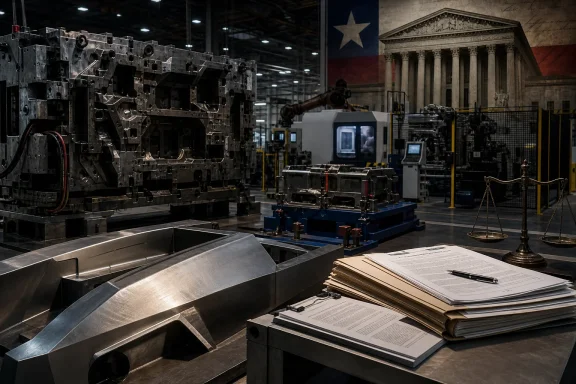
Tesla alleges Angstrom notified it on July 13 that it intended to close the Troy facility, then did not cooperate with a plan to release Tesla-owned equipment. The automaker says the site holds specialized die-cast tools, trim dies, fixtures, cutting tools, gauges, and X-ray equipment used to make Cybertruck components.
According to Tesla’s complaint, a shipment of 700 finished parts scheduled for July 17 did not leave the plant. Tesla representatives reportedly arrived on July 21 with law-enforcement accompaniment but were denied access.
The company says rebuilding the equipment would take five to six months, making a rapid supplier change unrealistic. Tesla is seeking expedited court action because it says the tooling supports several thousand Cybertrucks in or planned for production.
Tesla’s immediate argument is narrow: it says the tools are its property and should be released. Angstrom has not publicly responded to the allegations. Until a court rules or the companies reach an agreement, the filing presents Tesla’s account rather than an adjudicated finding.
Reports differ on the payment demand Tesla attributes to Angstrom. Bloomberg Law’s coverage contains conflicting descriptions of whether the additional amount was $250,000 per day or per week, while Teslarati and other follow-up reports describe $250,000 per week. The underlying court record should settle that distinction.
Tesla’s Cybertruck line at Giga Texas may have installed annual capacity far above its present output, but capacity figures offer little protection when a single-source component set cannot reach the assembly line. The next meaningful milestone is an expedited hearing in Texas federal court—and whether Tesla can recover the equipment before its on-hand inventory runs out.
The case, Tesla, Inc. v. Angstrom Automotive Group, LLC, was filed July 23 in the U.S. District Court for the Western District of Texas. As reported by Bloomberg Law and detailed this week by Teslarati, Road & Track, and Electrek, Tesla is asking for the return of physical production equipment rather than damages or a ruling on the broader commercial dispute.
A Plant Closure Becomes a Production Risk
Tesla alleges Angstrom notified it on July 13 that it intended to close the Troy facility, then did not cooperate with a plan to release Tesla-owned equipment. The automaker says the site holds specialized die-cast tools, trim dies, fixtures, cutting tools, gauges, and X-ray equipment used to make Cybertruck components.According to Tesla’s complaint, a shipment of 700 finished parts scheduled for July 17 did not leave the plant. Tesla representatives reportedly arrived on July 21 with law-enforcement accompaniment but were denied access.
The company says rebuilding the equipment would take five to six months, making a rapid supplier change unrealistic. Tesla is seeking expedited court action because it says the tooling supports several thousand Cybertrucks in or planned for production.
The Critical Detail Is Ownership of the Tooling
For manufacturing and IT operations teams, the dispute is a reminder that tooling ownership is not an administrative footnote. A vehicle maker can own dies, inspection systems, fixtures, and production data while a supplier retains physical control of the plant and equipment.Tesla’s immediate argument is narrow: it says the tools are its property and should be released. Angstrom has not publicly responded to the allegations. Until a court rules or the companies reach an agreement, the filing presents Tesla’s account rather than an adjudicated finding.
Reports differ on the payment demand Tesla attributes to Angstrom. Bloomberg Law’s coverage contains conflicting descriptions of whether the additional amount was $250,000 per day or per week, while Teslarati and other follow-up reports describe $250,000 per week. The underlying court record should settle that distinction.
A Supply-Chain Failure With No Software Fix
This is not a typical factory outage that can be mitigated with scheduling changes or an over-the-air update. The alleged bottleneck is physical: unique machinery, finished components, and access to a supplier site.Tesla’s Cybertruck line at Giga Texas may have installed annual capacity far above its present output, but capacity figures offer little protection when a single-source component set cannot reach the assembly line. The next meaningful milestone is an expedited hearing in Texas federal court—and whether Tesla can recover the equipment before its on-hand inventory runs out.
References
- Primary source: Road & Track
Published: 2026-07-28T22:44:19.832622+00:00
Loading…
www.roadandtrack.com - Independent coverage: Teslarati
Published: 2026-07-28T07:12:44+00:00
Loading…
www.teslarati.com - Independent coverage: Electrek
Published: 2026-07-28T13:00:05+00:00
Loading…
electrek.co - Related coverage: news.bloomberglaw.com
Loading…
news.bloomberglaw.com - Related coverage: basenor.com
Loading…
www.basenor.com - Related coverage: secnews.gr
Loading…
www.secnews.gr