
The video has become easy ammunition for Cybertruck critics, especially because its visual punchline is so clear. What initially resembles a demonstration of electric torque and all-wheel-drive capability turns into a recovery operation. Yet the more useful takeaway for WindowsForum readers—and for anyone following the increasingly software-defined world of EVs—is not simply “electric trucks cannot tow.” It is that the Cybertruck’s hardware, traction strategy, vehicle settings, trailer setup, and the terrain beneath its tires all matter at once.
That distinction is important. Tesla still publishes a maximum towing capacity of 11,000 pounds for the all-wheel-drive Cybertruck equipped with its specified 20-inch wheels, alongside a maximum tongue weight of 1,100 pounds. But Tesla’s own towing documentation also makes clear that this figure is conditional: passengers and cargo in the truck can reduce permissible tongue weight, the trailer must be properly loaded, and towing places substantially greater demands on the motors, brakes, tires, suspension, and battery. Tesla’s Cybertruck towing guidance offers a more nuanced picture than a single headline rating can convey.
 The Eight-Second Viral Test Nobody Planned
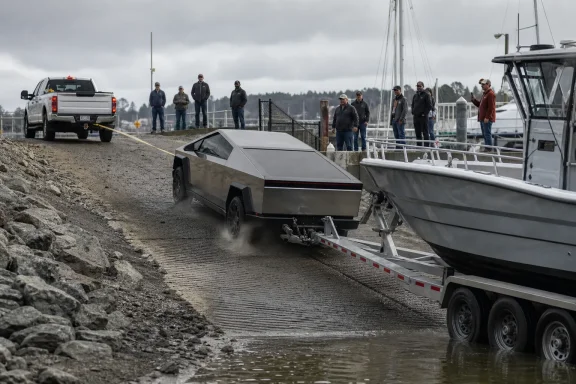
The TikTok footage described in the reports shows a Cybertruck attached to a sizable gray boat trailer on an uneven, concrete-and-gravel incline. For the first several seconds, the truck appears to make measured progress. It pulls the trailer forward slowly while onlookers watch from the boat and surrounding area.
Then momentum disappears.
The reporting says the Cybertruck stops moving forward roughly eight seconds into the attempt. After an edit, it is visibly moving again—but the conclusion is not a heroic recovery by the EV’s traction control. A second conventional pickup is connected ahead of the Cybertruck and pulls the disabled combination uphill. The original AOL report describes that assisting vehicle as a Ram, while the AOL Canada version identifies it as a Ford F-150. That discrepancy is worth flagging, because the clip’s central fact is clear while the precise make and model of the recovery truck is less consistently reported.
The important visual is not the badge of the rescue vehicle. It is the recovery configuration: the second truck appears to be doing the work of pulling both the boat and the Cybertruck up the incline.
For social media, this is devastatingly simple. The Cybertruck, a product designed around unconventional styling and bold utility claims, is presented as the trailer’s middleman rather than its tow vehicle. The accompanying comment culture practically writes itself, and the video’s popularity reflects how closely the scene collides with popular expectations about what a pickup truck should do.
But viral video is not an instrumented test. It does not identify the boat-and-trailer’s true gross weight, whether the trailer brakes were working or adjusted correctly, which Cybertruck configuration was involved, the exact grade of the ramp, tire pressures, tire condition, payload in the truck bed, battery state of charge, traction-control behavior, or whether Trailer Mode had been enabled. Those missing variables prevent a credible engineering verdict on the model from a single incident.
They do not, however, erase the incident’s consumer relevance. A truck that is bought for boat launching, construction access, farm use, or towing on loose surfaces must be evaluated in precisely these less-than-laboratory conditions.
Why an 11,000-Pound Rating Does Not Solve a Boat-Ramp Problem
The Cybertruck’s advertised towing capacity is substantial. Tesla lists 11,000 pounds as the maximum trailer weight for the applicable all-wheel-drive configuration, a figure that puts it squarely in full-size-pickup territory on paper. Tesla’s owner documentation also specifies that a trailer’s tongue weight should be about 10% of total trailer weight without exceeding the vehicle’s limits.
That is a capacity figure, though—not a promise that the truck will climb every ramp with every legal trailer load.
Towing capacity versus available traction
A truck can have enough power and enough rated towing capacity yet still fail to move a trailer uphill. This happens when the tires cannot transmit sufficient force to the ground. Loose gravel, algae-covered concrete, damp stone, sand, ruts, and uneven paving all reduce the amount of grip available at the contact patch.
Boat ramps are especially punishing environments because the surface can transition quickly from dry, rough pavement to damp material contaminated by water, silt, moss, or marine residue. Even a shallow-looking incline may become a difficult launch or retrieval site when a heavy trailer places the entire combination near the limits of available tire grip.
The TikTok reports describe a concrete-and-gravel or stone-slab approach rather than a clean, dry test strip. AOL Canada’s account specifically notes the rough surface and wheelspin. That matters more than online debates about whether EV motors make instant torque. Torque is useful only when the tires can use it.
Weight transfer can work against a tow vehicle
As a truck pulls uphill, the load on the trailer and the incline can alter how weight is distributed across the tow vehicle’s axles. Improper trailer loading can make matters worse. Too little tongue weight risks instability; too much can overload the rear of the tow vehicle and affect steering response or suspension posture.
Tesla warns owners to load a trailer evenly, observe tongue-weight limits, confirm that the Cybertruck sits level when coupled, and avoid exceeding either vehicle or trailer limits. Tesla’s towing instructions also state that passengers, cargo, and equipment carried in the Cybertruck can reduce the tongue weight it can support.
The boat in the viral footage appears large, but appearance is a poor substitute for a scale ticket. Hull construction, engine configuration, fuel level, stored equipment, trailer type, and whether the boat was loaded with people can change total mass dramatically. The video reportedly shows people on or around the boat, but the precise total load remains unverified. That means it would be irresponsible to declare the trailer was within or beyond Tesla’s stated rating.
Tires may be the overlooked variable
Tires are one of the least glamorous parts of an EV towing discussion, yet they are the point where every claim about horsepower, battery power, and drive-motor torque meets reality. A tire optimized for highway efficiency, quietness, or range may behave very differently from one intended for wet ramps, loose gravel, mud, or off-road recovery.
Tesla’s manual requires adjusted tire pressures for towing and warns against towing with a faulty or temporarily repaired tire. The Cybertruck owner’s manual makes clear that towing changes vehicle demands and that owners must account for the additional load. The viral clip does not reveal whether the Cybertruck’s tires were set up appropriately for the task.
That uncertainty does not excuse poor performance. Instead, it shows why a prospective owner should not treat the maximum tow rating as the only specification that matters. The right tire, correct pressure, surface awareness, and a recovery plan may matter more on a ramp than an extra thousand pounds of paper capacity.
Trailer Mode Is Not a Magic Button
Modern EVs bring software into towing in a way that traditional trucks historically did not. The Cybertruck offers trailer profiles and Trailer Mode, which can support towing-related functions and help the vehicle estimate energy consumption based on a stored trailer’s mass, dimensions, and auxiliary settings. Tesla explains Trailer Profiles and Trailer Mode in its official documentation.
Tesla says Trailer Mode should always be active when towing and indicates that the vehicle can engage it automatically when a trailer’s electrical connection is detected. The system is designed to recognize towing conditions, but it cannot turn a low-traction surface into high-friction pavement, reduce an overloaded trailer’s mass, or correct a poorly balanced boat trailer.
Software helps, but physics remains in charge
This is the broader lesson for EV buyers who are accustomed to sophisticated software features. A modern electric truck can coordinate motors with immense precision, react quickly to wheel slip, estimate energy use, and alter vehicle behavior based on towing settings. That is a meaningful strength.
However, the truck still has to satisfy the same basic requirements as any other tow vehicle:
- Enough traction at the driven wheels
- Sufficient weight distribution
- Correctly inflated, appropriate tires
- A trailer within rated limits
- Proper tongue weight
- Working trailer brakes where required
- A safe approach angle and ramp condition
- Enough room to stop, maneuver, and recover
No user interface can bypass those constraints.
Tesla itself emphasizes the risk. Its owner material warns that towing affects steering, stability, braking, turning radius, stopping distance, and braking performance. It advises drivers to reduce speed, avoid sudden maneuvers, increase following distance, and take care with turns. Tesla’s official towing guidelines are considerably more sober than the bravado typically found in short promotional clips.
Off-road mode and Trailer Mode have a limitation
One small but consequential technical detail is that Tesla states Off-Road Modes and Trailer Mode cannot be enabled simultaneously. Tesla’s service documentation presents that limitation directly.
For a boat-ramp scenario involving loose material, this raises a practical question—not about whether the truck has software, but about which vehicle behavior is prioritized. A driver may want towing-related settings active while also wishing for maximum assistance on an uneven or slippery approach. The video does not show the touchscreen, so there is no basis to say which mode was selected. Still, the limitation underscores a wider point: software modes involve trade-offs, and owners need to understand them before they arrive at a ramp with several tons attached.
The Tow-Hitch Debate Is Separate—but It Will Not Go Away
The viral ramp failure did not show the Cybertruck’s hitch breaking away. It is essential to keep those subjects separate.
A traction failure on an incline is not proof of a structural defect. Conversely, a structural stress test is not proof that every normal towing trip will end in failure. Online discussions often collapse these separate questions into one sweeping judgment, which is not useful for owners or prospective buyers.
Still, the towing conversation around the Cybertruck already carried baggage before this video emerged.
In 2025, YouTuber Zack Nelson of JerryRigEverything published a high-force tow-hitch stress test in which the rear structure of a Cybertruck failed under an extreme loading setup. Reporting on the test noted that the experiment applied a largely vertical load and that the force involved was far beyond the Cybertruck’s rated tongue weight—important context when evaluating how directly the test maps to ordinary towing. The Drive’s analysis emphasized both the concern over the cast-aluminum structure and the fact that the test’s loading case differed from conventional trailer towing.
Other coverage similarly stressed that the test measured a severe hitch-load scenario rather than a straightforward verification of the truck’s 11,000-pound tow rating. Carscoops noted that the experiment was about tongue-weight-style force rather than total towing capacity. This distinction is not pedantic. Tow ratings, tongue-weight ratings, recovery loads, shock loads, and vertical hitch loads are different forces with different consequences.
Yet the perception problem is real. The Cybertruck has been positioned as a radically tough, utility-first product. When a widely viewed ramp video shows it being pulled by another truck, it revives every earlier argument about hitch design, real-world towing, and whether the vehicle’s futuristic construction inspires confidence among traditional truck buyers.
For Tesla, this is the reputational risk. A single clip does not establish a universal defect, but it can become a memorable symbol when it reinforces an existing narrative.
Recall History Adds to the Optics Problem
The towing video arrives against a backdrop of Cybertruck recalls that has made scrutiny of the vehicle unusually intense. In March 2025, Tesla announced a voluntary recall covering certain 2024 and 2025 Cybertrucks to replace the cantrail assembly after determining that a stainless-steel panel could delaminate at its adhesive joint and separate from the vehicle. Tesla’s recall support page says the affected production period ran from November 13, 2023, through February 27, 2025.
Tesla stated that a detached panel could create a road hazard and increase the risk of injury or collision, while the remedy was a replacement assembly designed to meet durability-testing requirements. Tesla’s official notice also said the replacement would be performed without charge.
That recall has nothing to do with the boat-ramp footage’s apparent traction issue. It should not be presented as evidence that the Cybertruck failed to tow the boat. But it does explain why a relatively ordinary scenario—one truck losing traction while towing on a difficult surface—can receive outsized attention.
A product with a long-established reputation for rugged work use may be granted more benefit of the doubt in a viral clip. A newer, polarizing product that has already faced high-profile service campaigns is less likely to receive that grace.
This is a classic example of how product reliability narratives compound. Each episode may have separate technical causes. Public perception rarely keeps those causes separate.
What the Video Does—and Does Not—Prove
The most defensible reading of the footage is narrower than both the Cybertruck’s loudest critics and its most determined defenders may prefer.
What it does show
The incident shows that this particular Cybertruck, with this particular boat trailer, on this particular uneven incline, did not complete the ascent unaided. It also shows another pickup being used to help move the Cybertruck-and-boat combination uphill, according to both supplied reports. AOL and AOL Canada agree on the essential sequence.
It further shows why towing capability must be judged in context. Buyers who tow boats do not operate only on level, dry, grippy pavement. They encounter wet ramps, uneven marina access roads, gravel, changing loads, and traction problems that cannot be captured by a single brochure statistic.
What it does not show
The clip does not establish the boat’s verified weight. It does not establish whether the trailer was within the Cybertruck’s rating, whether the load met tongue-weight guidance, whether the truck was operating in Trailer Mode, whether the trailer brakes were configured correctly, or whether tire choice and pressure were appropriate.
It also does not establish that the Cybertruck lacks enough motor power to tow the boat. The visible issue appears more consistent with a loss of effective traction or an inability to sustain forward motion under the combined load and surface conditions. Those are serious practical limitations in their own right, but they are not synonymous with “not enough horsepower.”
Finally, the video does not demonstrate a hitch or frame failure. The separate controversy surrounding high-load hitch stress tests should be evaluated on its own evidence and with attention to the difference between vertical loading, shock loading, rated tongue weight, and rated trailer mass.
The Practical Checklist for Cybertruck Towing
For Cybertruck owners, the lesson is not to avoid towing altogether. Tesla expressly supports towing within its specifications and supplies dedicated towing features. The lesson is to treat a heavy trailer and an uncertain surface as a full systems problem.
Before towing a boat or other substantial trailer, owners should consider the following:
- Verify actual trailer weight. Do not estimate based on the boat’s dry weight alone. Include trailer, fuel, batteries, water, equipment, spare tires, accessories, and cargo.
- Confirm tongue weight and balance. Tesla advises approximately 10% tongue weight while staying under the vehicle’s limit. Poor balance can undermine both traction and control. Tesla’s towing guidance
- Use Trailer Mode and create an accurate trailer profile. Tesla says Trailer Mode should be active while towing, and its trailer-profile tools rely on correct trailer information. Tesla’s documentation
- Inspect tires and set towing pressures. Tire condition, design, and inflation are fundamental to heavy-load traction and safety. Tesla specifically provides towing-related tire guidance in the owner manual. Tesla’s owner manual
- Assess the ramp before committing. Look for loose gravel, standing water, algae, mud, ruts, abrupt transitions, and limited turnaround space. A safe retreat may be better than forcing repeated attempts.
- Avoid sudden throttle inputs. When traction is marginal, aggressive acceleration can turn manageable wheel slip into a complete loss of forward progress.
- Have a recovery plan. A recovery strap, appropriate attachment points, a capable second vehicle, and people who understand safe recovery procedures are far better than improvising after a combination has stalled on an incline.
Tesla’s transport guidance is also unusually explicit about moving a disabled Cybertruck: it says not to use the trailer hitch to tow or transport the vehicle in normal towing fashion, and describes Tow Mode as intended for short repositioning or winching onto a flatbed. Tesla’s transportation instructions should be consulted carefully if a Cybertruck itself requires recovery.
A Viral Failure, a More Useful Warning
The Cybertruck boat-ramp video will remain memorable because it transforms a high-concept electric pickup into the thing it was supposed to replace: cargo being pulled by a more conventional truck. That contrast is sharp, funny, and tailor-made for social media.
But the strongest conclusion is also the least sensational. The clip does not settle the Cybertruck’s entire towing story, and it does not invalidate Tesla’s rated capability by itself. It does demonstrate that rated capacity is only one part of towing competence—and perhaps not the part that matters most when the surface is loose, the grade rises, and a loaded boat trailer has to move now.
For Cybertruck owners, the warning is practical. For Tesla, it is strategic. A truck marketed around toughness cannot depend on specifications alone; it must build confidence at marinas, job sites, gravel paths, boat ramps, and recovery situations where consumers judge utility with their eyes.
