
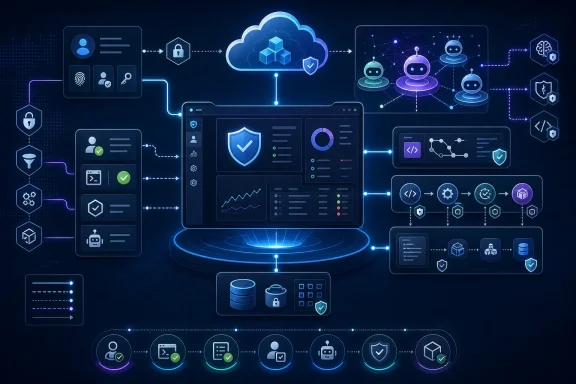
Microsoft has added an AI assessment pillar and a DevSecOps planning pillar to its Zero Trust tooling, giving Microsoft 365 and Azure security teams a more structured way to examine where AI agents, coding assistants, CI/CD pipelines, and machine identities can exceed their intended authority. The practical news is less a new enforcement product than a new operating model: run a tenant assessment, turn the findings into a phased workshop roadmap, and use that roadmap to assign work across security, platform, and engineering teams.
Microsoft detailed the August 4 update in its Security Blog, expanding the Zero Trust Assessment with AI, Security Operations, and Infrastructure coverage, while adding DevSecOps to the browser-based Zero Trust Workshop. The company says the new DevSecOps pillar contains 15 control groups and 91 tasks spanning source repositories, dependencies, artifacts, infrastructure as code, developer platforms, and continuous integration and delivery pipelines.
For Windows and Microsoft 365 administrators, the important boundary is clear: the Assessment is an inspection and prioritization tool, not a control plane for AI agents. It can identify configuration gaps in a Microsoft tenant and propose remediations, but it does not turn an over-permissioned agent into a least-privileged one, review generated code, or stop a malicious prompt by itself. Those controls still have to be designed into the agent, its identity, its tools, its pipeline, and its approval path.
Microsoft’s Zero Trust Assessment is a PowerShell-based tenant review that connects to Microsoft Graph and Microsoft cloud services, evaluates configuration and activity signals, and writes a local HTML report. Its newly updated project site says the tool now assesses seven pillars: Identity, Devices, Network, Data, Infrastructure, Security Operations, and AI.
That is a meaningful expansion from the four core areas most administrators associate with the tool. AI agents can inherit a tenant’s existing weaknesses at high speed: permissive app registrations, excessive SharePoint access, unmanaged devices, weak conditional access, broad service-principal privileges, or poorly monitored administrative workflows. Adding AI as a dedicated pillar should help make those inherited exposures visible in the same conversation as the agent deployment.
But there is a limit buried in the tool’s architecture. The Assessment connects to an organization’s Microsoft Entra tenant and services including Microsoft Graph, Azure, Exchange, SharePoint, and Azure Information Protection. It is therefore strongest at examining Microsoft configuration, identities, telemetry availability, and related controls. It cannot independently prove that an agent using a non-Microsoft model provider, an external Model Context Protocol server, an on-premises build runner, or a third-party SaaS integration has sound runtime authorization.
That limitation is not a defect unique to Microsoft’s tool; it is the distinction between posture assessment and agent security engineering. NIST’s 2026 work on AI-agent identity and authorization identifies the hard problems as agent identification, delegated authority, task-scoped least privilege, action logging, provenance, and controls that reduce the impact of direct and indirect prompt injection. Those are implementation questions that extend beyond whether a tenant setting is enabled.
Microsoft’s own agentic AI guidance reaches the same conclusion in different language. It says the decisive controls sit at the application layer: which tools an agent can invoke, which data it can read, which actions it can perform, where approvals are mandatory, and how failures are contained. An assessment can surface an unprotected doorway. It cannot decide whether the agent should have been given the key.
The August release shifts the emphasis from architecture diagrams to program execution. Microsoft is now trying to give organizations a sequence: establish a baseline, select the relevant pillars, use the Workshop’s First, Then, Next task ordering, and build a 12- to 24-month remediation plan.
That approach has a sensible use inside a large Microsoft environment. An AI-security program often gets stranded between teams: security owns risk; identity teams own Entra; endpoint teams own devices; platform teams own Azure; developers own repositories and build pipelines; data teams own sensitivity labels and retention. A shared assessment and planning system can at least produce a common list of work rather than another isolated AI governance document.
Microsoft also says it has updated the Workshop’s AI guidance around its AI Memory framework. The idea is to treat an agent’s memory as a security boundary with defined intent, provenance, lifecycle visibility, and user control. That is a better framing than treating memory as harmless personalization. Stored context can include sensitive data, prior instructions, retrieved content, or assumptions that affect later tool calls; if it is persistent, it requires the same lifecycle discipline as other sensitive application state.
What Microsoft does not publish in this announcement is a definitive list of the new AI assessment checks, their severity scoring, the specific products or agent architectures they cover, or which checks are available in the currently published PowerShell module. Those details matter. A team assessing Microsoft 365 Copilot configurations, custom Azure-hosted agents, GitHub Copilot workflows, and agents connected through external MCP services will want to know exactly where the assessment’s visibility stops before treating a green report as a security sign-off.
Microsoft applies its familiar Zero Trust principles to that chain: verify explicitly, use least privilege, and assume breach. In practical terms, those principles should lead teams to question whether a coding agent needs write access to production repositories; whether a build agent can reach every subscription; whether dependency updates are reviewed and signed; whether generated infrastructure changes require policy validation; and whether a pipeline token remains valid longer than the task that needed it.
The Workshop reportedly includes four tasks focused directly on AI-assisted development: code governance, tool allowlisting, data protection, and AI and machine-learning pipeline supply-chain security. These are appropriately specific starting points, though their value will depend on whether organizations make the work enforceable.
A tool allowlist, for example, needs to be paired with separate agent identities, narrowly scoped credentials, environment segmentation, and explicit action limits. Code governance needs branch protection, review policy, secret scanning, dependency controls, artifact provenance, and a clear decision about whether AI-generated pull requests are subject to the same—or stricter—review rules as human-written code. A checklist that merely says “secure AI code generation” will accomplish little.
Microsoft’s May guidance on autonomous agents is unusually direct on this point: an agent should begin with zero access, and each tool call, data access request, or external integration should result from an explicit authorization decision. It also recommends enforcing high-impact human approval in the application or orchestrator rather than relying on the model to decide whether it needs oversight.
That principle should be the operational test for the new DevSecOps pillar. If an AI assistant can read a sensitive repository, open a pull request, modify a pipeline, approve its own generated change, and deploy to a production subscription using one durable identity, the organization has automated a privileged administrator—not built a Zero Trust workflow.
That discrepancy does not show that the new coverage is unavailable; the project landing page says it is. It does show that the operational documentation remains incomplete on the day of announcement. Administrators should expect that the report layout, module version, prerequisites, outputs, or remediation guidance may differ from the screenshots and instructions in the older Learn article.
The legacy runbook also exposes a deployment detail that deserves more attention than Microsoft’s launch post gives it. The initial connection requires Global Administrator consent, and the assessment requests a broad set of read permissions across directory, audit, device management, risk, policy, entitlement management, reports, role management, and authentication methods. Subsequent use can be delegated to less privileged reader roles, but the first consent should be handled as a standard privileged-app review—not casually run by an engineer from an admin workstation.
Microsoft states that the assessment is read-only and stores the report locally. That reduces the risk of the tool changing tenant configuration, but it creates another handling requirement: the report and export folder contain sensitive tenant information and should be treated accordingly. For large tenants, Microsoft warns that an assessment can take more than 24 hours, which makes it unsuitable as an on-demand incident-response diagnostic.
There is also no support for Windows on ARM64 in the current Assessment documentation. That will matter to organizations standardizing security administration on ARM-based Windows devices, even if the report ultimately runs from a shared x64 administrative workstation.
Still, the release should be read as guidance and assessment tooling, not as evidence that an organization’s agents are secure. NIST’s recent review of input from industry and researchers found broad agreement that traditional security principles remain relevant for AI agents but need adaptation for their new autonomy, access patterns, and attack paths.
The immediate action for Microsoft shops is to run the updated assessment in a controlled administrative context, inventory every agent’s identity, tools, data sources, and deployment privileges, then use the DevSecOps workshop to eliminate standing access and self-approval paths from the build-to-production chain. The report may identify where the tenant is exposed; the real security outcome depends on whether each agent is left with only the authority it needs for the task in front of it.
For Windows and Microsoft 365 administrators, the important boundary is clear: the Assessment is an inspection and prioritization tool, not a control plane for AI agents. It can identify configuration gaps in a Microsoft tenant and propose remediations, but it does not turn an over-permissioned agent into a least-privileged one, review generated code, or stop a malicious prompt by itself. Those controls still have to be designed into the agent, its identity, its tools, its pipeline, and its approval path.
The assessment now reaches AI, but only where Microsoft can observe it
Microsoft’s Zero Trust Assessment is a PowerShell-based tenant review that connects to Microsoft Graph and Microsoft cloud services, evaluates configuration and activity signals, and writes a local HTML report. Its newly updated project site says the tool now assesses seven pillars: Identity, Devices, Network, Data, Infrastructure, Security Operations, and AI.That is a meaningful expansion from the four core areas most administrators associate with the tool. AI agents can inherit a tenant’s existing weaknesses at high speed: permissive app registrations, excessive SharePoint access, unmanaged devices, weak conditional access, broad service-principal privileges, or poorly monitored administrative workflows. Adding AI as a dedicated pillar should help make those inherited exposures visible in the same conversation as the agent deployment.
But there is a limit buried in the tool’s architecture. The Assessment connects to an organization’s Microsoft Entra tenant and services including Microsoft Graph, Azure, Exchange, SharePoint, and Azure Information Protection. It is therefore strongest at examining Microsoft configuration, identities, telemetry availability, and related controls. It cannot independently prove that an agent using a non-Microsoft model provider, an external Model Context Protocol server, an on-premises build runner, or a third-party SaaS integration has sound runtime authorization.
That limitation is not a defect unique to Microsoft’s tool; it is the distinction between posture assessment and agent security engineering. NIST’s 2026 work on AI-agent identity and authorization identifies the hard problems as agent identification, delegated authority, task-scoped least privilege, action logging, provenance, and controls that reduce the impact of direct and indirect prompt injection. Those are implementation questions that extend beyond whether a tenant setting is enabled.
Microsoft’s own agentic AI guidance reaches the same conclusion in different language. It says the decisive controls sit at the application layer: which tools an agent can invoke, which data it can read, which actions it can perform, where approvals are mandatory, and how failures are contained. An assessment can surface an unprotected doorway. It cannot decide whether the agent should have been given the key.
The AI pillar arrives after Microsoft’s March promise
This update fulfills a specific commitment Microsoft made on March 19, when it introduced its broader Zero Trust for AI strategy and said an AI pillar for the Assessment was under development for release in summer 2026. The earlier rollout concentrated on a Zero Trust for AI reference architecture, patterns for agentic systems, observability, AI threat modeling, prompt-injection defenses, and an AI-focused Workshop pillar.The August release shifts the emphasis from architecture diagrams to program execution. Microsoft is now trying to give organizations a sequence: establish a baseline, select the relevant pillars, use the Workshop’s First, Then, Next task ordering, and build a 12- to 24-month remediation plan.
That approach has a sensible use inside a large Microsoft environment. An AI-security program often gets stranded between teams: security owns risk; identity teams own Entra; endpoint teams own devices; platform teams own Azure; developers own repositories and build pipelines; data teams own sensitivity labels and retention. A shared assessment and planning system can at least produce a common list of work rather than another isolated AI governance document.
Microsoft also says it has updated the Workshop’s AI guidance around its AI Memory framework. The idea is to treat an agent’s memory as a security boundary with defined intent, provenance, lifecycle visibility, and user control. That is a better framing than treating memory as harmless personalization. Stored context can include sensitive data, prior instructions, retrieved content, or assumptions that affect later tool calls; if it is persistent, it requires the same lifecycle discipline as other sensitive application state.
What Microsoft does not publish in this announcement is a definitive list of the new AI assessment checks, their severity scoring, the specific products or agent architectures they cover, or which checks are available in the currently published PowerShell module. Those details matter. A team assessing Microsoft 365 Copilot configurations, custom Azure-hosted agents, GitHub Copilot workflows, and agents connected through external MCP services will want to know exactly where the assessment’s visibility stops before treating a green report as a security sign-off.
The DevSecOps addition addresses the authorization problem upstream
The new DevSecOps pillar is the more consequential part of this release for engineering organizations. AI-assisted development changes the volume and velocity of software changes, but it also changes who—or what—can propose code, alter infrastructure definitions, recommend packages, access secrets, or trigger a deployment.Microsoft applies its familiar Zero Trust principles to that chain: verify explicitly, use least privilege, and assume breach. In practical terms, those principles should lead teams to question whether a coding agent needs write access to production repositories; whether a build agent can reach every subscription; whether dependency updates are reviewed and signed; whether generated infrastructure changes require policy validation; and whether a pipeline token remains valid longer than the task that needed it.
The Workshop reportedly includes four tasks focused directly on AI-assisted development: code governance, tool allowlisting, data protection, and AI and machine-learning pipeline supply-chain security. These are appropriately specific starting points, though their value will depend on whether organizations make the work enforceable.
A tool allowlist, for example, needs to be paired with separate agent identities, narrowly scoped credentials, environment segmentation, and explicit action limits. Code governance needs branch protection, review policy, secret scanning, dependency controls, artifact provenance, and a clear decision about whether AI-generated pull requests are subject to the same—or stricter—review rules as human-written code. A checklist that merely says “secure AI code generation” will accomplish little.
Microsoft’s May guidance on autonomous agents is unusually direct on this point: an agent should begin with zero access, and each tool call, data access request, or external integration should result from an explicit authorization decision. It also recommends enforcing high-impact human approval in the application or orchestrator rather than relying on the model to decide whether it needs oversight.
That principle should be the operational test for the new DevSecOps pillar. If an AI assistant can read a sensitive repository, open a pull request, modify a pipeline, approve its own generated change, and deploy to a production subscription using one durable identity, the organization has automated a privileged administrator—not built a Zero Trust workflow.
The documentation has not caught up with the release
Microsoft’s public project site has been updated to describe seven Assessment pillars, including AI, Infrastructure, and Security Operations. Yet the existing Microsoft Learn runbook for installing and running the Assessment, last updated March 16, still describes report tabs only for Identity, Devices, Network, and Data.That discrepancy does not show that the new coverage is unavailable; the project landing page says it is. It does show that the operational documentation remains incomplete on the day of announcement. Administrators should expect that the report layout, module version, prerequisites, outputs, or remediation guidance may differ from the screenshots and instructions in the older Learn article.
The legacy runbook also exposes a deployment detail that deserves more attention than Microsoft’s launch post gives it. The initial connection requires Global Administrator consent, and the assessment requests a broad set of read permissions across directory, audit, device management, risk, policy, entitlement management, reports, role management, and authentication methods. Subsequent use can be delegated to less privileged reader roles, but the first consent should be handled as a standard privileged-app review—not casually run by an engineer from an admin workstation.
Microsoft states that the assessment is read-only and stores the report locally. That reduces the risk of the tool changing tenant configuration, but it creates another handling requirement: the report and export folder contain sensitive tenant information and should be treated accordingly. For large tenants, Microsoft warns that an assessment can take more than 24 hours, which makes it unsuitable as an on-demand incident-response diagnostic.
There is also no support for Windows on ARM64 in the current Assessment documentation. That will matter to organizations standardizing security administration on ARM-based Windows devices, even if the report ultimately runs from a shared x64 administrative workstation.
A roadmap is useful only if it produces enforceable boundaries
Microsoft’s update is a credible improvement to its Zero Trust adoption materials because it puts AI and software delivery into the same planning structure as identity, devices, data, networks, and infrastructure. KuppingerCole’s 2026 Zero Trust Platforms report also lists Microsoft as an Overall, Product, Innovation, and Market Leader, lending weight to Microsoft’s position in the broader Zero Trust market.Still, the release should be read as guidance and assessment tooling, not as evidence that an organization’s agents are secure. NIST’s recent review of input from industry and researchers found broad agreement that traditional security principles remain relevant for AI agents but need adaptation for their new autonomy, access patterns, and attack paths.
The immediate action for Microsoft shops is to run the updated assessment in a controlled administrative context, inventory every agent’s identity, tools, data sources, and deployment privileges, then use the DevSecOps workshop to eliminate standing access and self-approval paths from the build-to-production chain. The report may identify where the tenant is exposed; the real security outcome depends on whether each agent is left with only the authority it needs for the task in front of it.
References
- Primary source: Microsoft
Published: 2026-08-04T18:30:00+00:00
Loading…
www.microsoft.com - Related coverage: microsoft.com
Loading…
www.microsoft.com - Related coverage: learn.microsoft.com
Secure autonomous agentic AI systems | Microsoft Learn
Learn about securing autonomous agaentic AI systemslearn.microsoft.com - Related coverage: learn.microsoft.com
Reduce autonomous agentic AI risk | Microsoft Learn
Learn about automnomous agentic AI system risk, and how to reduce it.learn.microsoft.com - Related coverage: devblogs.microsoft.com
Build agents you can trust across any framework with open evals and a control standard | Microsoft Foundry Blog
Learn how Microsoft helps developers build trustworthy AI agents with open evaluations, portable runtime controls, production observability, and security workflows that work across frameworks.devblogs.microsoft.com - Related coverage: techcommunity.microsoft.com
Loading…
techcommunity.microsoft.com - Related coverage: blogs.windows.com
Windows platform security for AI agents
Making Windows the trustworthy OS for agents AI agents are no longer just answering questions, they are taking actions across systems with increasing autonomy. As they become persistent participants in how software runs, they introduce new rblogs.windows.com - Related coverage: download.microsoft.com
Loading…
download.microsoft.com - Related coverage: cdn-dynmedia-1.microsoft.com
Loading…
cdn-dynmedia-1.microsoft.com - Related coverage: download.microsoft.com
Loading…
download.microsoft.com - Related coverage: techradar.com
Loading…
www.techradar.com - Related coverage: axios.com
Microsoft Project Perception launches AI agents, specialized model for cybersecurity
The new tools come as cybersecurity and AI companies race to help defenders keep pace with attackers.www.axios.com
- Related coverage: techradar.com
Loading…
www.techradar.com - Related coverage: kuppingercole.com
Loading…
www.kuppingercole.com - Related coverage: nist.gov
Loading…
www.nist.gov - Related coverage: csrc.nist.gov
- Related coverage: nccoe.nist.gov
Loading…
www.nccoe.nist.gov - Related coverage: nist.gov
Loading…
www.nist.gov - Related coverage: goteleport.com
Loading…
goteleport.com - Related coverage: cornucopia.owasp.org
Loading…
cornucopia.owasp.org - Related coverage: nvd.nist.gov
Loading…
nvd.nist.gov - Related coverage: csrc.nist.gov
Loading…
csrc.nist.gov - Related coverage: nvlpubs.nist.gov
Adversarial Machine Learning: A Taxonomy and Terminology of Attacks and Mitigations
This NIST Trustworthy and Responsible AI report provides a taxonomy of concepts and defines terminology in the field of adversarial machine learning (AML). The taxonomy is arranged in a conceptual hierarchy that includes key types of ML methods, life cycle stages of attack, and attacker goals...nvlpubs.nist.gov
- Related coverage: xonasystems.com
Loading…
www.xonasystems.com