
The deadline is not a new NVIDIA policy. It was set out by the company on July 31, 2025, and reported at the time by PC Gamer and Tom’s Hardware alongside NVIDIA’s separate retirement plan for Maxwell-, Pascal-, and Volta-based GeForce cards. What has changed is the calendar: on August 27, 2026, Windows 10 users have roughly two months to decide whether their current driver is a stable endpoint or whether the PC needs an operating-system migration.
NVIDIA’s support notice is unusually direct. October 2026 is the last month for full Windows 10 coverage; November 2026 is the first month without it. The company will still issue quarterly Windows 10 security-driver updates through October 2029, but those releases are a narrow maintenance channel, not a continuation of Game Ready support.
For gamers and PC administrators, the important distinction is simple: a GeForce card will keep working after October, and the October driver will not suddenly stop loading games. What ends is NVIDIA’s commitment to tune subsequent driver releases for new games, repair ordinary display-driver faults, and validate ongoing compatibility on Windows 10.
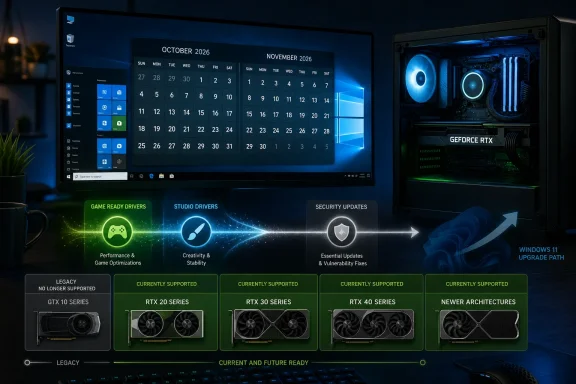 The October driver becomes the functional baseline
Game Ready Drivers are NVIDIA’s consumer releases for new-game support, performance tuning, fixes, and features. NVIDIA Studio Drivers follow a different cadence and validation focus for creative applications, but Windows 10 loses regular support from both channels at the same point.
That means the final Windows 10-capable driver may be a sensible long-term deployment image for machines that cannot yet move. It does not mean it will remain an ideal one. A game released in December 2026, for example, may still run on the October driver, but NVIDIA will no longer be promising launch-day optimization or a prompt driver-side correction if the game exposes a Windows 10-specific fault.
The same constraint applies to the NVIDIA App and the wider driver package only where future releases require newer driver components or operating-system support. NVIDIA’s Windows 10 plan says nothing about which individual control-panel functions, overlay features, DLSS overrides, or application integrations may cease to be available over time. The safe assumption for managed fleets is that the installed October package is the last validated Windows 10 configuration, while later features should be tested only on supported operating systems.
NVIDIA has also not published a final driver version number, exact release date, or a special long-term-support designation for the October package. Administrators should not build plans around an assumed “final” branch until the release notes and download page identify it.
Security updates continue, but on a different clock
NVIDIA says Windows 10 will receive quarterly security updates containing critical bug fixes through October 2029. That is materially better than a clean cutoff, particularly for systems attached to the internet, gaming PCs used for years without hardware refreshes, and specialist workstations where an application or peripheral blocks a Windows 11 migration.
But the wording sets a firm boundary. NVIDIA promises quarterly updates for critical security items; it does not promise monthly releases, Game Ready profiles, ordinary bug fixes, new capabilities, or broader certification against current games and applications. A security driver may address a serious vulnerability without resolving a monitor wake issue, a game crash, a VR problem, or instability introduced by a new application.
The cadence also makes patch management less forgiving. Organizations accustomed to evaluating each Game Ready or Studio release will need a separate process for tracking NVIDIA security bulletins, confirming whether a quarterly package applies to deployed GPU families, and testing the update before broad rollout. A “do not update graphics drivers unless something breaks” policy is particularly risky once the regular stream ends; the remaining releases will be the only path for remediating security defects in the Windows display-driver stack.
There is a subtle but important mismatch with Microsoft’s own Windows 10 servicing timeline. Microsoft ended normal support for Windows 10 on October 14, 2025. Its commercial Extended Security Updates program can provide Critical and Important Windows 10 patches through October 10, 2028 for eligible Enterprise, Education, and commercial Pro installations. Consumer Windows 10 ESU coverage is shorter, ending October 13, 2026.
NVIDIA’s promised security-driver coverage therefore extends beyond Microsoft’s Windows 10 ESU program: about one year beyond the final commercial ESU period and three years beyond the consumer program. That extra NVIDIA coverage can reduce one category of risk, but it cannot make an unpatched Windows 10 installation supported or secure as a whole. An operating system with no current OS security updates remains exposed through components NVIDIA does not control.
GPU age and Windows version are separate support problems
The Windows 10 cutoff is easy to confuse with NVIDIA’s GPU architecture retirement policy, announced on the same day in 2025. They are overlapping deadlines, but they are not the same deadline.
NVIDIA ended regular Game Ready support for Maxwell, Pascal, and Volta GeForce GPUs after October 2025. That group includes many GeForce GTX 900-series cards, GTX 10-series cards, and the Titan V. Those products already receive only quarterly critical security updates, scheduled through October 2028, regardless of whether the PC runs Windows 10 or Windows 11.
Turing, Ampere, Ada, and Blackwell GeForce hardware remained on NVIDIA’s regular Game Ready path under that architecture policy. For a Turing-or-newer GPU still running Windows 10, the operating system becomes the limiting factor in November 2026: the hardware may remain current enough for feature releases, but the installed OS prevents access to them.
This creates two distinct scenarios that IT staff should inventory rather than lump together as “old NVIDIA PCs”:
- A Windows 10 PC with an RTX 20-, RTX 30-, RTX 40-, or newer GeForce GPU will reach its Windows support cutoff in November 2026, then move to NVIDIA’s quarterly security-only track through October 2029.
- A GTX 900- or GTX 10-series PC was already removed from regular Game Ready support in late 2025 because of its GPU architecture, and its NVIDIA security-update window ends in October 2028 even if Windows itself is upgraded.
The difference affects budgets and remediation. Upgrading a Windows 10 RTX 3060 system to Windows 11 may restore access to regular driver releases without replacing the GPU. Upgrading Windows on a GTX 1080 system can improve OS support, but it does not reinstate Game Ready support for the Pascal card.
Windows 10 LTSC does not change NVIDIA’s deadline
Windows 10 is not a single servicing population. Microsoft’s LTSC and IoT editions have lifecycle dates that differ from consumer Windows 10 22H2. Windows 10 Enterprise LTSC 2021, for example, remains in service until January 2027, while some IoT Enterprise LTSC editions have longer support periods.
NVIDIA has not published a separate Game Ready schedule for those editions. Its notice describes Windows 10 generally and specifies the same October 2026 transition to quarterly security updates. A machine can therefore be running a Microsoft-supported Windows 10 LTSC release after NVIDIA has stopped regular Game Ready and Studio validation for Windows 10.
That matters most in engineering, media, laboratory, point-of-sale, and control-room environments where an LTSC build is deliberately retained. Those teams should avoid treating Microsoft lifecycle coverage as proof that every hardware vendor will keep delivering normal feature and compatibility releases. The OS, GPU driver, application suite, and device firmware each have their own support clock.
What Windows 10 users should do before November
The practical action is to identify what would actually be lost on each system. A machine used for older games, offline rendering, or a fixed production workload may be able to stay on the October driver for a long time with careful security controls. A PC used for newly released multiplayer games, VR titles, current creative software, or frequent application updates is much more likely to encounter the cost of being off the ordinary driver track.
For individual users, that means checking whether the device can make a supported move to Windows 11 before assuming a graphics-card replacement is necessary. For organizations, it means tying GPU inventory to Windows edition, Windows version, GPU architecture, and the installed NVIDIA driver branch—not merely recording “NVIDIA graphics.”
The last full Windows 10 driver is likely to become a common freeze point in November. It should be archived, tested, and documented like any other end-of-support baseline. From then on, Windows 10 GeForce systems will receive security maintenance only, while current game and creator-driver support moves decisively to Windows 11.