
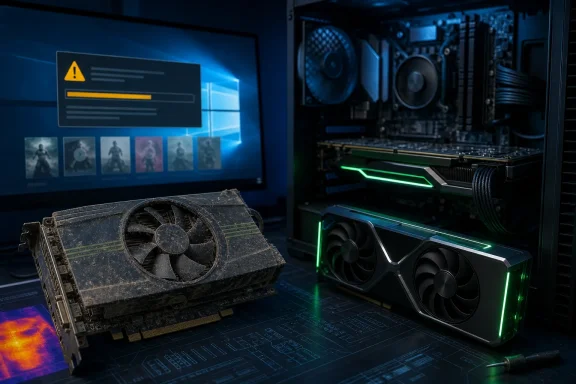
BGR’s conclusion that an Nvidia graphics card can “easily” last 10 years is plausible for a well-kept desktop card, but its evidence is owner anecdotes rather than a durability study—and its GTX 700-series example misses the more immediate limit for Windows users: software support and usable performance usually expire long before the silicon does.
The distinction is important while GPU prices make a longer ownership cycle attractive. A GeForce card that still boots, renders a desktop, and passes a stress test at age 10 has achieved hardware survival. That does not mean it remains a sensible card for a current Windows gaming PC, a CUDA workstation, or a machine exposed to the internet without current driver security fixes.
BGR bases its August 4 report on Reddit owners still running GeForce GTX 700-series hardware and on the common observation that fans can be replaced. Those reports establish that old cards can survive; they do not establish a statistically meaningful expected lifespan for Nvidia cards as a category. There is no published Nvidia consumer-card fleet dataset in the report, no breakdown by board maker, no comparison between lightly used and 24/7 systems, and no separation of desktop cards from the much hotter, less-serviceable laptop designs.
The practical answer for buyers is therefore less satisfying but more useful: plan a modern GeForce purchase around five to eight years of satisfactory primary use, while treating 10 years of physical operation as a bonus rather than a durability guarantee. The card’s actual useful life will be determined by its memory capacity, feature support, driver status, cooling hardware, and the type of work it is asked to do.
A decade-old GTX 700 card that remains in service is real evidence that a GPU does not have an inherent five-year expiration date. Desktop graphics cards have no moving parts inside the GPU package itself, and a system that stays within safe temperatures, has a stable power supply, and avoids physical damage can keep functioning for a very long time.
But the stories most likely to be posted and repeated are success stories. Owners whose GTX 770, GTX 780 Ti, or GTX Titan died years ago are far less likely to be reporting a quiet failure in a current Reddit thread. That is survivorship bias, and it makes a collection of “my card still works” posts a poor substitute for failure-rate data.
Puget Systems, which publishes reliability figures from the workstations it builds and services, has at least provided a more structured snapshot: its 2024 report put the overall GPU failure rate for the hardware it handled that year at 0.68%. Its 2025 reliability reporting also singled out Nvidia Founders Edition GeForce RTX cards as particularly reliable among the consumer models it sold. Those figures are useful evidence that modern GPUs are not routinely failing under normal professional deployment, but they still cannot answer a 10-year question. They cover a particular system integrator’s inventory, workloads, customer base, and much younger products.
There is also no single thing called “an Nvidia GPU” once it reaches a PC. Nvidia supplies the GPU silicon and, for Founders Edition models, the entire board. Most GeForce cards, however, are assembled by companies such as ASUS, MSI, Gigabyte, PNY, and Zotac. The cooler, fan design, VRM, memory modules, PCB layout, factory overclock, warranty terms, and repairability can differ substantially between cards using the same Nvidia chip.
That means a GeForce RTX 5070 from one vendor and another card based on the same GPU can have different aging risks. It also means a claim about Nvidia GPU durability must be read as a broad claim about an ecosystem of board partners, not a verified conclusion about Nvidia silicon alone.
The statement that even the most powerful GTX 700-series model had only 6GB of VRAM is incorrect. Nvidia’s GeForce GTX Titan Z, launched in 2014, carried 12GB of GDDR5 memory across two GPUs. The single-GPU GTX Titan Black had 6GB, while the GTX 780 Ti had 3GB. Titan Z is an unusually expensive dual-GPU outlier, and its 12GB was not equivalent to a modern unified 12GB framebuffer for every game, but it remains a direct contradiction of the article’s “most powerful version” claim.
The GTX 700 badge also concealed two architecture generations. Most of the performance-focused 700 series used Nvidia’s Kepler architecture. However, the GTX 750 and GTX 750 Ti were early Maxwell products, despite retaining the 700-series name. This matters because their software support has diverged.
Nvidia ended Game Ready driver support for desktop Kepler GeForce cards in August 2021 and said critical security updates would continue through September 2024. By August 2026, the Kepler-based GTX 700 cards cited as proof of long life are beyond Nvidia’s stated security-update period. A card can still work in Windows 11 with its last compatible driver, but it no longer receives the normal stream of security fixes, game profiles, game-specific bug fixes, or performance tuning.
The Maxwell-based GTX 750 and GTX 750 Ti took a different path. Nvidia ended their Game Ready support alongside Maxwell, Pascal, and Volta GPUs after the final October 2025 release, but it has committed those architectures to quarterly security updates through October 2028. Nvidia issued a Maxwell/Pascal/Volta security driver in January 2026 and listed the same legacy architectures in its May 2026 display-driver security bulletin.
So “GTX 700 has no driver support” is too broad. For a Kepler GTX 780, it is effectively true in 2026. For a Maxwell GTX 750 Ti, the answer is more limited: it still receives security maintenance, but no new-game optimization. The model number alone is not enough; Windows users should identify the architecture and check Nvidia’s driver page before deciding whether an old card is safe to retain.
Still, “the fan is easily replaceable” is only true for cards with available parts, accessible screws, compatible connectors, and a user comfortable dismantling a heatsink. A replacement fan for a 10-year-old board may be inexpensive and straightforward. It may also be unavailable, proprietary, or require replacing the entire cooler. Mishandling the assembly can damage fan headers, thermal pads, or the GPU package.
Fans are merely the visible failure point. Other age-sensitive components include:
A card used as a secondary display adapter, a retro-gaming device, a basic media PC, or a lab machine disconnected from sensitive work can remain useful long after it stops being a modern gaming GPU. In that setting, an old GTX 700-series card may have years of life left if temperatures are controlled and the system’s security posture is appropriate.
A primary gaming or work machine is different. VRAM limits arrive early, especially for newer AAA games, creator workloads, local AI tools, and high-resolution multi-monitor configurations. Newer Nvidia features such as RTX ray tracing, Tensor cores, modern DLSS implementations, improved video encoding and decoding, and current driver optimizations may be absent even if raw frame rates remain tolerable at low settings.
The five-year rule of thumb cited by some owners in BGR’s reporting is better understood as a performance and feature horizon, not a mechanical one. A high-end card bought today can often outlast a lower-tier card bought at the same time because it begins with more compute headroom and VRAM. But no amount of careful cleaning can add memory capacity, restore discontinued Game Ready support, or enable hardware blocks that the card never had.
The sensible maintenance routine is simple: monitor temperatures and fan behavior, clean the heatsink and case filters, use a reputable power supply, avoid blindly increasing voltage for overclocks, and investigate new artifacts, driver resets, black screens, or grinding fans before they become repeated thermal events. Back up work that depends on a single aging GPU, particularly in a workstation where a failure can halt rendering or compute jobs.
The evidence supports a calmer conclusion than the usual upgrade-cycle anxiety: Nvidia desktop cards can physically last a decade, and many do. But buyers should not confuse that durability with a 10-year promise of modern Windows compatibility, current security maintenance, or acceptable performance. By the time an old GeForce card finally fails electrically, its driver branch and VRAM budget may already have made the replacement decision for you.
BGR bases its August 4 report on Reddit owners still running GeForce GTX 700-series hardware and on the common observation that fans can be replaced. Those reports establish that old cards can survive; they do not establish a statistically meaningful expected lifespan for Nvidia cards as a category. There is no published Nvidia consumer-card fleet dataset in the report, no breakdown by board maker, no comparison between lightly used and 24/7 systems, and no separation of desktop cards from the much hotter, less-serviceable laptop designs.
The practical answer for buyers is therefore less satisfying but more useful: plan a modern GeForce purchase around five to eight years of satisfactory primary use, while treating 10 years of physical operation as a bonus rather than a durability guarantee. The card’s actual useful life will be determined by its memory capacity, feature support, driver status, cooling hardware, and the type of work it is asked to do.
Owner anecdotes show survivorship, not an average lifespan
A decade-old GTX 700 card that remains in service is real evidence that a GPU does not have an inherent five-year expiration date. Desktop graphics cards have no moving parts inside the GPU package itself, and a system that stays within safe temperatures, has a stable power supply, and avoids physical damage can keep functioning for a very long time.But the stories most likely to be posted and repeated are success stories. Owners whose GTX 770, GTX 780 Ti, or GTX Titan died years ago are far less likely to be reporting a quiet failure in a current Reddit thread. That is survivorship bias, and it makes a collection of “my card still works” posts a poor substitute for failure-rate data.
Puget Systems, which publishes reliability figures from the workstations it builds and services, has at least provided a more structured snapshot: its 2024 report put the overall GPU failure rate for the hardware it handled that year at 0.68%. Its 2025 reliability reporting also singled out Nvidia Founders Edition GeForce RTX cards as particularly reliable among the consumer models it sold. Those figures are useful evidence that modern GPUs are not routinely failing under normal professional deployment, but they still cannot answer a 10-year question. They cover a particular system integrator’s inventory, workloads, customer base, and much younger products.
There is also no single thing called “an Nvidia GPU” once it reaches a PC. Nvidia supplies the GPU silicon and, for Founders Edition models, the entire board. Most GeForce cards, however, are assembled by companies such as ASUS, MSI, Gigabyte, PNY, and Zotac. The cooler, fan design, VRM, memory modules, PCB layout, factory overclock, warranty terms, and repairability can differ substantially between cards using the same Nvidia chip.
That means a GeForce RTX 5070 from one vendor and another card based on the same GPU can have different aging risks. It also means a claim about Nvidia GPU durability must be read as a broad claim about an ecosystem of board partners, not a verified conclusion about Nvidia silicon alone.
The GTX 700 example is older—and less uniform—than it sounds
BGR is right that many GTX 700-series cards are old enough to demonstrate long physical service. The family launched from 2013 into 2014, placing the earliest cards well beyond a decade old in August 2026. But the report’s wording flattens major differences within that product line.The statement that even the most powerful GTX 700-series model had only 6GB of VRAM is incorrect. Nvidia’s GeForce GTX Titan Z, launched in 2014, carried 12GB of GDDR5 memory across two GPUs. The single-GPU GTX Titan Black had 6GB, while the GTX 780 Ti had 3GB. Titan Z is an unusually expensive dual-GPU outlier, and its 12GB was not equivalent to a modern unified 12GB framebuffer for every game, but it remains a direct contradiction of the article’s “most powerful version” claim.
The GTX 700 badge also concealed two architecture generations. Most of the performance-focused 700 series used Nvidia’s Kepler architecture. However, the GTX 750 and GTX 750 Ti were early Maxwell products, despite retaining the 700-series name. This matters because their software support has diverged.
Nvidia ended Game Ready driver support for desktop Kepler GeForce cards in August 2021 and said critical security updates would continue through September 2024. By August 2026, the Kepler-based GTX 700 cards cited as proof of long life are beyond Nvidia’s stated security-update period. A card can still work in Windows 11 with its last compatible driver, but it no longer receives the normal stream of security fixes, game profiles, game-specific bug fixes, or performance tuning.
The Maxwell-based GTX 750 and GTX 750 Ti took a different path. Nvidia ended their Game Ready support alongside Maxwell, Pascal, and Volta GPUs after the final October 2025 release, but it has committed those architectures to quarterly security updates through October 2028. Nvidia issued a Maxwell/Pascal/Volta security driver in January 2026 and listed the same legacy architectures in its May 2026 display-driver security bulletin.
So “GTX 700 has no driver support” is too broad. For a Kepler GTX 780, it is effectively true in 2026. For a Maxwell GTX 750 Ti, the answer is more limited: it still receives security maintenance, but no new-game optimization. The model number alone is not enough; Windows users should identify the architecture and check Nvidia’s driver page before deciding whether an old card is safe to retain.
Cooling and power delivery often decide what fails first
BGR’s observation about fans is directionally right. A graphics-card fan is a serviceable mechanical component on many desktop models, and Nvidia itself directs owners of failed fans toward the card maker while a card remains under warranty. It also acknowledges that third-party replacement coolers exist for some cards.Still, “the fan is easily replaceable” is only true for cards with available parts, accessible screws, compatible connectors, and a user comfortable dismantling a heatsink. A replacement fan for a 10-year-old board may be inexpensive and straightforward. It may also be unavailable, proprietary, or require replacing the entire cooler. Mishandling the assembly can damage fan headers, thermal pads, or the GPU package.
Fans are merely the visible failure point. Other age-sensitive components include:
- Thermal paste and thermal pads can dry or lose conformity, raising temperatures even when fans still spin normally.
- Dust accumulation and poor case airflow can force the cooler to run harder for years, increasing noise and heat stress.
- Board-level power components and capacitors can fail, and unlike a fan, they are not a routine home repair.
- A weak or failing power supply can damage a graphics card or mimic a GPU failure through crashes, black screens, and instability.
- Heavily used cards from rendering, compute, or mining workloads may have accumulated far more thermal and fan hours than a lightly played gaming card of the same age.
“Still works” is no longer the right retirement test
For Windows enthusiasts and IT administrators, a GPU’s retirement date should be based on function, support, and risk—not whether it produces an image.A card used as a secondary display adapter, a retro-gaming device, a basic media PC, or a lab machine disconnected from sensitive work can remain useful long after it stops being a modern gaming GPU. In that setting, an old GTX 700-series card may have years of life left if temperatures are controlled and the system’s security posture is appropriate.
A primary gaming or work machine is different. VRAM limits arrive early, especially for newer AAA games, creator workloads, local AI tools, and high-resolution multi-monitor configurations. Newer Nvidia features such as RTX ray tracing, Tensor cores, modern DLSS implementations, improved video encoding and decoding, and current driver optimizations may be absent even if raw frame rates remain tolerable at low settings.
The five-year rule of thumb cited by some owners in BGR’s reporting is better understood as a performance and feature horizon, not a mechanical one. A high-end card bought today can often outlast a lower-tier card bought at the same time because it begins with more compute headroom and VRAM. But no amount of careful cleaning can add memory capacity, restore discontinued Game Ready support, or enable hardware blocks that the card never had.
The sensible maintenance routine is simple: monitor temperatures and fan behavior, clean the heatsink and case filters, use a reputable power supply, avoid blindly increasing voltage for overclocks, and investigate new artifacts, driver resets, black screens, or grinding fans before they become repeated thermal events. Back up work that depends on a single aging GPU, particularly in a workstation where a failure can halt rendering or compute jobs.
The evidence supports a calmer conclusion than the usual upgrade-cycle anxiety: Nvidia desktop cards can physically last a decade, and many do. But buyers should not confuse that durability with a 10-year promise of modern Windows compatibility, current security maintenance, or acceptable performance. By the time an old GeForce card finally fails electrically, its driver branch and VRAM budget may already have made the replacement decision for you.
References
- Primary source: bgr.com
Published: 2026-08-04T20:17:00+00:00
Loading…
www.bgr.com - Related coverage: nvidia.custhelp.com
Loading…
nvidia.custhelp.com - Related coverage: pcworld.com
Loading…
www.pcworld.com - Related coverage: pcworld.com
Nvidia confirms end of drivers for GTX 700, 900, and 10-series cards | PCWorld
Game Ready drivers will go out one final time in October for these storied cards, then switch to quarterly security-only updates.www.pcworld.com
- Related coverage: forums.tomshardware.com
- Related coverage: docs.nvidia.com
NVIDIA Data Center GPU Driver version 470.161.03 (Linux) / 474.04 (Windows)
Release Notesdocs.nvidia.com
- Related coverage: tomshardware.com
Nvidia’s Melting 16-Pin Connectors on RTX 4090: All We Know | Tom's Hardware
There are still more questions than answers, but reports of power problems with Nvidia’s new flagship card keep popping up.www.tomshardware.com - Related coverage: uk.pforce.nvidia.com
- Related coverage: developer.download.nvidia.com
- Related coverage: download.nvidia.com
- Related coverage: investor.nvidia.com
- Related coverage: nvidia.com
Driver Details | NVIDIA
Download the <dd~LanguageName> <dd~Name> for <dd~OSName> systems. Released <dd~ReleaseDateTime>www.nvidia.com - Related coverage: nvidianews.nvidia.com
NVIDIA Leads Performance Per Watt Revolution With "Maxwell" Graphics Architecture | NVIDIA Newsroom
SANTA CLARA, CA--(Marketwired - Feb 18, 2014) - NVIDIA today introduced the first GPUs based on its new Maxwell™ graphics architecture, which deliver amazing gaming performance in extremely...nvidianews.nvidia.com - Related coverage: nvidia.custhelp.com
- Related coverage: nvidia.co.jp
GeForce GTX TITAN Z 究極のゲーミング・グラフィックスカード | NVIDIA
GeForce® GTX TITAN Z は、ゲーム界のベストセラー商品であり、地上で最も最先端なPCゲーミングを作動させるために我々が作った最速のグラフィックスカードです。5760 のコアと 12 GB のメモリを備えたこのデュアルGPU は、最強のマルチモニター・ディスプレイや4K のハイパーPC を駆動する力を与えます。www.nvidia.co.jp - Related coverage: nvidia.co.uk
GeForce GTX Titan Z Extreme Gaming Graphics Card | NVIDIA
The TITAN Z extreme PC gaming graphics card is a monster of a card, with dual GPUs, 5760 CUDA cores, 12 GB of memory, and 4K monitor support.www.nvidia.co.uk - Related coverage: windowscentral.com
NVIDIA releases driver update for Maxwell and Pascal GPUs — it focuses only on security fixes, but it's still crucial for the older cards | Windows Central
NVIDIA's older GPUs are still in service in plenty of PCs despite them no longer receiving Game Ready Driver updates.www.windowscentral.com - Related coverage: nvidia.com
- Related coverage: techspot.com
Nvidia GeForce GTX 750 Ti Specs | TechSpot
Nvidia GeForce GTX 750 Ti is an entry-level GPU based on the Maxwell architecture with 2 GB GDDR5, 640 shader cores, 128-bit bus, and 86.4 GB/s bandwidth.www.techspot.com - Related coverage: blogs.nvidia.com.tw
兩顆 GPU、一張瘋狂的繪圖卡:GeForce GTX TITAN Z 隆重登場 - NVIDIA 台灣官方部落格
延續 TITAN 固有啟發自超級電腦的效能,NVIDIA 執行長黃仁勳今日在我們的年度 GPU 技術大會上宣布blogs.nvidia.com.tw - Related coverage: docs.nvidia.com
- Related coverage: forums.tomshardware.com
- Related coverage: tomshardware.com