
Open source matters in AI not only because it gives developers code to inspect or modify, but because it determines which platforms developers choose to build on. As InfoWorld argues, the companies that earn developers’ trust early can turn that goodwill into a durable advantage across tools, infrastructure, and hardware.
That lesson predates generative AI. Stephen O’Grady’s The New Kingmakers framed developers as the people who ultimately decide which technologies win: they select the frameworks, libraries, runtimes, and deployment patterns that become an organization’s default. Free tools and permissive projects can therefore be a commercial strategy, not simply an act of software altruism.
In the AI era, the stakes are larger because the chosen stack reaches from a developer workstation to a cloud GPU cluster.
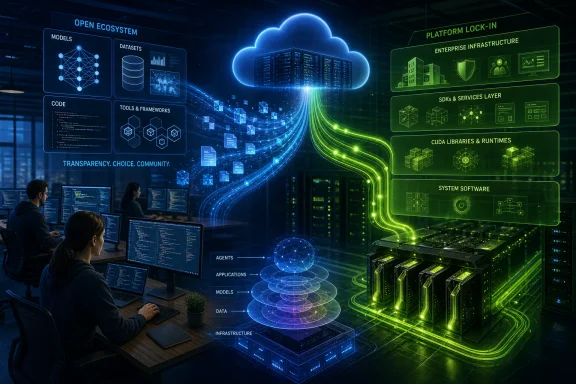
InfoWorld uses Nvidia as the clearest current example. Nvidia’s CUDA platform made GPU programming substantially more practical than working directly against lower-level hardware interfaces, and that developer experience helped turn CUDA into a powerful dependency. Code, skills, documentation, and optimized libraries accumulated around Nvidia GPUs.
Nvidia’s Nemotron family extends that approach into agentic AI. The company offers model weights, datasets, and training recipes that developers can inspect and adapt for specialized agents, retrieval systems, coding assistants, and other workloads. That openness lowers the barrier to evaluation and fine-tuning, while Nvidia’s tooling positions CUDA, NeMo, NIM, and Nvidia GPUs as the fast path to production.
The commercial logic is straightforward: make the model accessible, then make the surrounding platform indispensable. Open resources create the developer relationship; optimized proprietary infrastructure captures much of the long-term spend.
That distinction matters for enterprises evaluating self-hosted AI. A model may be transparent enough for security review and local deployment while still tying an organization to a particular GPU ecosystem, hosted runtime, or support contract. Openness can improve control without eliminating lock-in.
For administrators, the practical value remains substantial:
That is why open source and open models remain strategically important even when the company giving them away is not trying to be “open” in every layer of its business. The immediate benefit is developer adoption. The longer-term prize is becoming the default platform beneath the applications those developers create.
That lesson predates generative AI. Stephen O’Grady’s The New Kingmakers framed developers as the people who ultimately decide which technologies win: they select the frameworks, libraries, runtimes, and deployment patterns that become an organization’s default. Free tools and permissive projects can therefore be a commercial strategy, not simply an act of software altruism.
In the AI era, the stakes are larger because the chosen stack reaches from a developer workstation to a cloud GPU cluster.
Nvidia’s Open Models Still Point Back to Nvidia Hardware
InfoWorld uses Nvidia as the clearest current example. Nvidia’s CUDA platform made GPU programming substantially more practical than working directly against lower-level hardware interfaces, and that developer experience helped turn CUDA into a powerful dependency. Code, skills, documentation, and optimized libraries accumulated around Nvidia GPUs.Nvidia’s Nemotron family extends that approach into agentic AI. The company offers model weights, datasets, and training recipes that developers can inspect and adapt for specialized agents, retrieval systems, coding assistants, and other workloads. That openness lowers the barrier to evaluation and fine-tuning, while Nvidia’s tooling positions CUDA, NeMo, NIM, and Nvidia GPUs as the fast path to production.
The commercial logic is straightforward: make the model accessible, then make the surrounding platform indispensable. Open resources create the developer relationship; optimized proprietary infrastructure captures much of the long-term spend.
“Open Weight” Is Useful, but It Is Not the Same as Open Source
Windows developers and IT teams should be precise about the terminology. An open-weight model can let an organization download, run, inspect, and sometimes fine-tune its parameters, but those permissions depend on the license and may not extend equally to training data, source code, redistribution, or commercial use.That distinction matters for enterprises evaluating self-hosted AI. A model may be transparent enough for security review and local deployment while still tying an organization to a particular GPU ecosystem, hosted runtime, or support contract. Openness can improve control without eliminating lock-in.
For administrators, the practical value remains substantial:
- Open models can be evaluated on internal data without sending every prompt to a public AI service.
- Fine-tuning and retrieval pipelines can be aligned with company terminology, documents, and access controls.
- Teams can retain fallback options if a single API provider changes pricing, availability, or product direction.
The Developer Is Still the Distribution Channel
The AI market has made one change to the old open-source playbook: developers now choose models and agent frameworks alongside programming languages and operating systems. A useful open model, a strong SDK, and a few deployable examples can establish habits that later influence GPU purchases, cloud architecture, and enterprise standards.That is why open source and open models remain strategically important even when the company giving them away is not trying to be “open” in every layer of its business. The immediate benefit is developer adoption. The longer-term prize is becoming the default platform beneath the applications those developers create.
References
- Primary source: InfoWorld
Published: 2026-07-28T21:50:00+00:00
Why open source software matters in an AI world | InfoWorld
Even hardware companies like Nvidia know they can sell more products to more people if they give software developers what they want.www.infoworld.com
- Related coverage: forums.developer.nvidia.com
Introducing Nemotron 3: Open Models for Agentic AI - NVIDIA Nemotron - NVIDIA Developer Forums
Nemotron 3 is NVIDIA’s new open model family for agentic AI systems where multiple cooperating agents plan, retrieve, verify, and use tools over long contexts and long-running workflows. Built for agentic workflows: D…
forums.developer.nvidia.com
- Related coverage: developer.nvidia.com
Advancing Agentic AI with NVIDIA Nemotron Open Reasoning Models | NVIDIA Technical Blog
As AI progresses toward greater autonomy, the emergence of AI agents capable of independent decision-making marks a significant milestone.developer.nvidia.com