
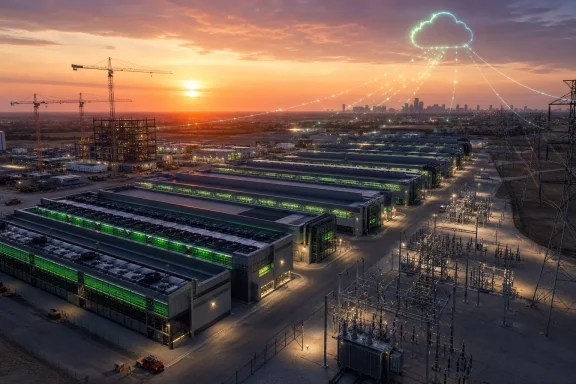
Adam Tooze’s Chartbook, citing Financial Times reporting, says Nvidia has committed to lease the full Texas facility as it is built, potentially subleasing capacity to “neocloud” providers that operate Nvidia GPU infrastructure for customers. Hut 8 had previously announced a 15-year lease for the first 352MW phase, carrying $9.8 billion in base-term contract value, without naming the tenant.
 Hut 8’s bond sale shows why the tenant matters
Hut 8 closed a $4.25 billion offering of 6.129% senior secured notes in June to finance the first Beacon Point phase, including six data halls and a substation. The company said the facility would be leased to a tenant rated AA− or higher, a description that narrowed the field considerably even before the Financial Times identified Nvidia.
The implication is straightforward: Nvidia’s credit strength can lower the cost of raising construction finance for facilities dedicated to Nvidia systems. That turns an accelerator supplier into a key enabler of the entire deployment chain—power interconnection, construction debt, data halls, servers and ultimately cloud capacity.
For IT buyers, this could make Nvidia-backed capacity easier to obtain from specialized cloud providers. It may also make the market more concentrated: a smaller set of operators with Nvidia relationships, financing and reserved grid power could have an advantage over independent GPU clouds and enterprises attempting private builds.
The Ohio talks raise the stakes further
The Texas lease is not an isolated move. Reuters and other outlets reported this week that Nvidia is in talks to provide a roughly $250 billion financing backstop enabling OpenAI to lease a planned 10GW data-center project in southern Ohio being developed by SoftBank’s energy subsidiary.
Those talks remain unconfirmed and should be treated as negotiations rather than a completed deal. But paired with the Hut 8 arrangement, they reinforce a pattern in which Nvidia is using its balance sheet to help customers finance the infrastructure required to buy and operate its GPUs.
Critics call this circular financing: a vendor supports the financing of customers whose spending becomes the vendor’s own revenue. Nvidia’s case is more complex than a simple vendor loan, since data centers require real assets, long construction schedules, grid commitments and creditworthy tenants. Still, the risk is clear if AI demand or utilization disappoints: the same company could be exposed to weaker customers, surplus GPU capacity and facilities built around its platform.
Power Is Becoming the First Constraint
The most important asset in the Hut 8 deal may be the 1GW power position, not the building itself. Hut 8 says Beacon Point has a 1GW interconnection agreement, while the initial data-center build represents 352MW of critical IT load. In an environment where utility queues and transmission availability can delay projects for years, a secured site with financeable expansion capacity is a major competitive advantage.
That changes the procurement conversation for Windows-based AI estates. Organizations considering Azure Stack HCI, Windows Server GPU clusters, on-premises inference, or GPU cloud rentals will increasingly be choosing among capacity models shaped by power contracts and vendor-backed financing—not merely comparing GPU generations, VM prices or CUDA compatibility.
Nvidia’s role is therefore expanding from chipmaker to infrastructure guarantor. Whether that keeps AI capacity flowing or creates a more fragile, tightly coupled supply chain will depend on whether the workloads filling these campuses generate enough durable demand to justify the power already being reserved.
