

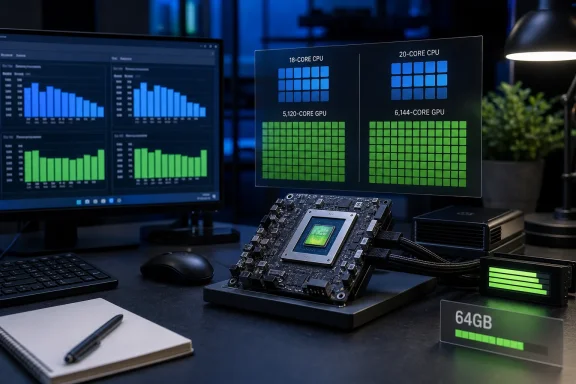
The important new detail is the CPU bin. Nvidia’s May 31 RTX Spark announcement, published with Microsoft, advertised a platform with up to 20 Arm CPU cores, up to 6,144 Blackwell RTX cores, and up to 128GB of unified memory. Nvidia’s July developer driver had already revealed that a 5,120-core graphics configuration existed. The new Geekbench data is the first public record tying that reduced GPU to an 18-core processor rather than simply showing a graphics-device identifier.
For Windows enthusiasts and IT buyers, this moves RTX Spark from a single flagship specification toward what it was always likely to become: a product family whose actual performance, memory capacity, cooling, and price will depend heavily on the OEM machine.
The benchmark records show two hardware bins
According to Notebookcheck, the higher-clocked system reports a 20-core CPU arranged in two 10-core clusters at 4.00GHz, alongside 6,144 GPU cores. It recorded 2,570 points in Geekbench 7 single-core and 23,126 in multi-core testing while running Windows 11 Pro with 64GB of RAM.
The second entry identifies an 18-core layout, with a 10-core cluster and an eight-core cluster clocked at 3.90GHz, plus the 5,120-core GPU. It scored 2,541 single-core and 21,776 multi-core points under Windows 11 Enterprise, also with 64GB of RAM. Both listings identify the processor as ARMv8 Family 8 Model D87 Revision 1.
Those figures show a modest 1.1% single-core difference and a 5.8% multi-core deficit for the cut-down model. That relationship is broadly credible: the CPU loses 10% of its total cores, but benchmark scaling is never perfectly linear because it also reflects clocks, power limits, memory behavior, scheduling, and the workload’s ability to keep every core busy.
What the benchmarks do not establish is GPU performance. Geekbench’s CPU result cannot validate how much gaming, CUDA, AI-inference, rendering, video, or ray-tracing performance the 5,120-core part gives up. A 16.7% reduction in listed GPU cores is a meaningful hardware cut, but realized graphics performance will depend on operating clocks, memory bandwidth, thermal design power, software maturity, and whether an application is native Arm64 or passes through Windows emulation.
Nvidia’s own disclosures left room for this exact split
The public evidence is consistent with Nvidia’s phrasing, but it also illustrates why “up to” deserves attention in a launch announcement. Microsoft’s Windows Experience Blog and Nvidia’s May announcement specified maximums for RTX Spark rather than declaring that every notebook and small desktop would receive the 20-core CPU, 6,144-core GPU, and 128GB memory configuration.
Nvidia’s native Windows 11 Arm64 developer driver made the GPU split less speculative in July. Windows Latest first reported that the driver’s device strings named RTX Spark N1X entries for both a 6,144-core and a 5,120-core Blackwell RTX GPU; Hardware Busters independently reported the same pair in the package. That was solid evidence of two graphics configurations, though it could not reveal whether Nvidia would pair the smaller GPU with a different CPU, memory ceiling, or power envelope.
The Geekbench entries now answer one part of that question: at least one lower-tier RTX Spark implementation combines the 5,120-core graphics silicon with 18 CPU cores. That is a fuller binning strategy than the driver strings alone could show.
There is a practical lesson in the shared 64GB figure, too. The Microsoft and Nvidia launch materials promote up to 128GB of unified memory, while both benchmark systems report 64GB. It would be premature to call 64GB the standard configuration — these systems are identified as engineering samples, and benchmark databases frequently reflect early validation hardware rather than retail SKUs. But 64GB is now the only capacity publicly associated with both tested configurations, whereas 128GB remains a stated platform maximum rather than a confirmed shipping laptop configuration.
Geekbench does not settle the Windows on Arm question
RTX Spark’s commercial pitch rests on more than a CPU score. Nvidia and Microsoft are positioning the Arm-based platform for local AI workloads, GPU-accelerated creative software, RTX graphics, and conventional Windows applications through native code or Prism emulation. Nvidia has also opened a developer preview with a dedicated RTX Spark driver and CUDA Toolkit 13.4 materials, signaling that the software stack is still being prepared alongside the first devices.
That makes these early Geekbench results useful but narrow. They establish that the lower CPU/GPU combination is alive in Windows 11 hardware, and they provide a baseline for the processor’s general-purpose performance. They say little about the most consequential questions for real buyers:
- Whether the 5,120-core model will receive the same media engines, AI features, display capabilities, and software support as the 6,144-core version.
- Whether 64GB is the likely ceiling for lower-priced systems or simply the capacity used in these particular engineering samples.
- Which OEMs will sell each configuration, and whether the lower bin will appear in laptops, compact desktops, or both.
- How either model performs in native Arm64 creative apps, x64 Windows applications under Prism, games, CUDA workloads, and local AI inference.
- Whether OEM cooling and power settings produce large performance differences between machines using the same chip.
The last point may prove especially important. A tightly integrated chip with CPU, GPU, and unified memory has a shared thermal and power budget. Two laptops can carry nominally identical core counts and still behave quite differently under sustained mixed CPU-and-GPU work if one vendor allows higher sustained power, uses faster memory, or provides a larger cooling solution. That is familiar territory for laptop buyers, but it is more consequential here because RTX Spark is being sold as a single platform spanning AI, graphics, and general computing.
The lower-end part could define the real entry price
The 18-core configuration also complicates comparisons built around Nvidia’s headline 6,144-core claim. The full GPU count is visually comparable to the 6,144 CUDA cores Nvidia uses in its GeForce RTX 5070 desktop-class specification, but neither the shared-memory design nor the power envelope makes that a direct performance equivalence. With the smaller 5,120-core configuration now independently visible, prospective buyers should expect RTX Spark branding to cover systems with materially different graphics resources.
Nvidia has not announced retail pricing, device availability dates, or final per-model specifications for either configuration. It has said RTX Spark PCs will arrive from major OEM partners, while the developer materials are already available. The absence of a retail SKU list means there is no basis yet for declaring which version will be the mainstream model, how much the 18-core part will cost, or whether its savings will reach buyers rather than remain an OEM margin and thermals tool.
Notebookcheck describes both Geekbench systems as engineering samples, which is the appropriate warning label. Clock speeds can change, firmware can alter boost behavior, memory configurations can expand, and product names can shift before retail launch. Yet the central finding is sturdier than the performance numbers: Nvidia’s RTX Spark hardware lineup includes at least two silicon configurations, and the less powerful one is reduced on both the CPU and GPU sides.
That leaves Windows buyers with a straightforward rule when RTX Spark systems arrive: do not buy from the platform name alone. Check the exact CPU core count, Blackwell GPU core count, unified-memory capacity, and chassis power profile. Nvidia’s maximum specification is now demonstrably not the only specification headed for Windows 11 on Arm.