
New Electronics first reported the MCX A5 launch on August 18, describing samples as available and positioning the chips for industrial and IoT edge deployments. NXP had telegraphed this direction six months earlier when it released the TJF1410, saying forthcoming members of its MCX A line would integrate 10BASE-T1S ports. NXP’s current MCUXpresso SDK documentation now identifies the FRDM-MCXA577 board as having an internal 10BASE-T1S digital PHY, independently confirming that the promised MCU-side interface has arrived.
For Windows-based embedded development teams, the near-term value is less about a new processor benchmark than about fewer components and fewer software boundaries to validate. A developer can build and provision firmware from a PC using MCUXpresso tooling and Visual Studio Code integrations, while the target MCU handles the low-level interface to a shared single-pair Ethernet segment. That is a meaningful simplification for distributed I/O, compact controllers, smart circuit breakers, and other products where a traditional four-pair Ethernet port is physically or economically excessive.
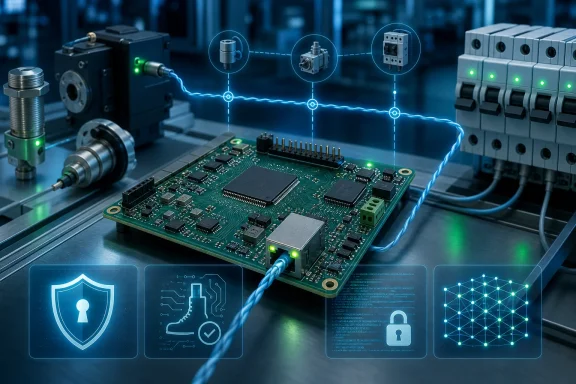 The integrated PHY still needs an analogue companion
The most important detail omitted by the broad “integrated Ethernet” framing is the split between the MCX A5’s digital PHY and the external analogue front end. NXP’s TJF1410 is a 10 Mbps 10BASE-T1S PMD transceiver designed for industrial use. It interfaces with the MCU through the Open Alliance TC14 three-pin PMD interface, then drives the actual single-pair cable.
That division is normal for this class of design, but it sets the real bill of materials. An MCX A5-based endpoint still needs the TJF1410, passive components, connector and cabling decisions, protection appropriate to the installation, plus power design. The gain is not that NXP has eliminated the external Ethernet layer; it has eliminated the need for a separate digital PHY or equivalent interface logic between the MCU’s Ethernet controller and the PMD transceiver.
NXP has already described the TJF1410 as a production-released part, while the MCX A5 launch is explicitly at the sampling stage. That makes the controller, rather than the cable transceiver, the gating component for a production design. Neither New Electronics nor NXP’s currently indexed material specifies a production-release date, distributor pricing, or a complete SKU-by-SKU availability schedule for MCX A5. Engineering groups planning a 2026 deployment should therefore treat samples and board support packages as evaluation material, not as confirmation of a supply commitment.
10BASE-T1S targets the awkward last stretch of industrial Ethernet
10BASE-T1S is not a replacement for 100 Mbps or gigabit Ethernet uplinks. It is a 10 Mbps single-pair Ethernet technology intended for short, multi-drop edge networks, where adding a switch port and conventional Ethernet cabling to every device can be costly and bulky. The appeal is especially clear in a cabinet or building subsystem packed with modest-bandwidth devices: sensors, valve controllers, remote I/O modules, lighting equipment, circuit breakers, and local environmental monitors.
The MCX A5’s topology-discovery feature is more than a headline feature if a design uses a shared bus rather than point-to-point wiring. It can help identify which endpoints are present and where they sit in the network arrangement, reducing manual commissioning work and making replacement or fault diagnosis easier. The OPEN Alliance has maintained a 10BASE-T1S topology-discovery specification since 2023, so the notable part of NXP’s announcement is the capability appearing in a wired industrial MCU with the digital PHY integrated, rather than the invention of a new discovery standard.
There are limits. Shared-media 10BASE-T1S networks must be designed around their traffic patterns, endpoint count, cable layout, and scheduling behavior. NXP’s own FRDM-MCXA577 SDK example instructs developers to enable Physical Layer Collision Avoidance, or PLCA, and configure a coordinator and node count for a test network. In other words, the network is deterministic only when the installer and firmware team configure it as one; plugging devices together does not remove the need for network engineering.
The SDK documentation also shows the early software path is still developing. A Zephyr issue filed this summer reported multicast ICMP reply collisions when two FRDM-MCXA577 boards operated on a 10BASE-T1S network in PLCA mode. That does not establish a silicon flaw, but it is a useful warning against equating integrated hardware with a finished protocol stack. Teams evaluating the part should exercise multicast, broadcast, recovery after node loss, and mixed-vendor interoperability in the exact RTOS and middleware combination they intend to ship.
PQC support is useful, but NXP has not published the details buyers need
NXP says the MCX A5 combines a hardware root of trust, secure boot, secure firmware update, secure attestation, secure debug authentication, and post-quantum cryptography capabilities. For industrial equipment expected to remain installed for a decade or longer, securing the firmware-update chain matters more immediately than adding another network interface. A controller that can be patched securely is a substantially better starting point than one whose installed firmware is effectively permanent.
The post-quantum language needs careful reading. NXP’s wider PQC strategy, published in late 2025, says it intends to add PQC support to nearly all new product releases, including higher-end MCX devices, particularly for long-lived products. But the launch reporting does not identify the specific PQC algorithms available on MCX A5, whether they are accelerated in hardware, which are supported in the boot ROM, how hybrid classical-and-PQC verification works, or the performance and memory costs involved.
Those omissions matter. “PQC-capable” does not by itself tell an OEM whether the device can verify a selected post-quantum firmware signature within its boot-time budget, whether it can use a required algorithm in a TLS stack, or whether the capability is available only through a future software release. Until NXP publishes the datasheet, security reference manual, and software documentation that answer those questions, buyers should describe the family as PQC-ready by vendor claim, rather than assume a drop-in quantum-safe deployment.
The same caution applies to the PSA Certified Level 3 wording. PSA Certified explains that Level 3 is intended to demonstrate substantial resistance to both software and hardware attacks through independent evaluation of a platform root of trust. That is a valuable assurance target. However, a Level 3 statement is not a substitute for checking the certificate, exact hardware revision, security firmware version, and configuration covered by the evaluation. NXP’s product documentation will need to establish whether the MCX A5 is already certified at launch, which variants are covered, and whether customers must preserve a specified secure-enclave software version to remain within the certified configuration.
Rust and Zephyr lower one barrier, not the validation burden
NXP says selected MCX A5 variants support Rust, alongside its MCUXpresso SDK, middleware, security utilities and long-term-support releases. It also lists Zephyr RTOS compatibility. Those are meaningful options for teams that want to move some application code away from memory-unsafe C and C++, particularly in connected products exposed to remote update paths.
But Rust support in an MCU family should be evaluated at the board-support level. A language toolchain can make new application modules safer while critical work still depends on C HALs, interrupt handlers, network drivers, linker scripts, startup code and vendor-supplied binary components. The real question for an engineering manager is whether the exact MCX A5 board, Ethernet driver, cryptographic service and RTOS configuration are supported and tested in the chosen toolchain—not whether the chip name appears in a Rust-compatible product list.
The same is true of Zephyr. Its availability gives developers an open-source RTOS path, but it does not transfer responsibility for lifecycle management. Industrial vendors will need a process for tracking Zephyr releases, NXP SDK updates, cryptographic-library changes, CVEs, signed update keys, and the settings that lock debug access before devices leave production. The MCX A5 can make that procedure technically feasible; it cannot make it optional.
The first evaluation should focus on deployment, not the headline specifications
A 240 MHz Cortex-M33 with up to 2 MB of flash and 640 KB of RAM is enough headroom for many edge control jobs, particularly when paired with CAN FD, USB, UART, I²C, I3C, SPI and FlexIO. Yet the strongest reason to evaluate MCX A5 is its attempt to bring networking and device trust into the same small controller family, rather than its clock speed or peripheral count.
A sensible proof-of-concept should pair an MCX A5 development board with the TJF1410, then test the complete chain: initial provisioning, signed firmware boot, debug lockout, authenticated field update, endpoint discovery, PLCA behavior, loss and replacement of a node, and coexistence with the intended gateway. It should also measure whether 10 Mbps shared-media Ethernet is sufficient for the actual telemetry, diagnostics, and update payloads—not merely for a ping demonstration.
NXP’s new MCU may reduce the cost of connecting previously isolated industrial endpoints, but the immediate consequence is more exacting: device makers now have a compact route to build Ethernet-connected products whose networking, update security, and lifecycle controls must be designed together from the first prototype.
