
A new guide on Habr, written by Chiang Mai-based Codex Ambassador Vladislav Guzey, describes the program as a bridge between OpenAI’s Codex team and local developer communities. That characterization is consistent with OpenAI’s own program page, which assigns ambassadors four broad tasks: run hands-on events, create reusable learning resources, help grow builder communities, and send real-world feedback to the Codex team.
The important distinction is that this is not an ordinary influencer or referral initiative. OpenAI is recruiting people to create a local support layer around an AI coding agent: people who can put Codex in front of developers with actual repositories, surface failure modes, and turn recurring questions into documentation or workshops. For a developer tool that may touch source code, terminal sessions, credentials, and deployment workflows, that peer-learning function is more consequential than a polished launch demo.
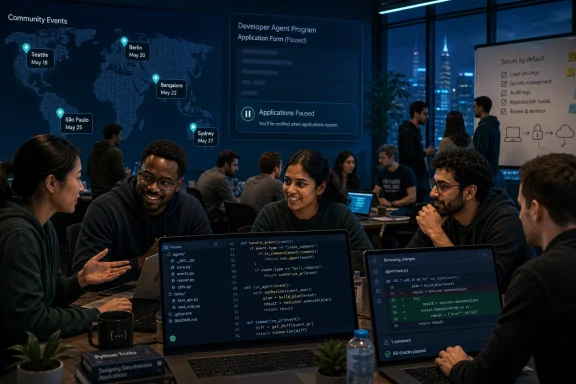 The program is paused, and OpenAI has not set a return date
OpenAI’s Codex Ambassadors page says applications are paused while it supports the current cohort and that a future cohort will open later. It does not provide a target month, application deadline, selection criteria with scoring, cohort size for the next intake, or a review-time promise.
That makes some of the practical advice in the Habr guide more valuable than its application-focused framing. Guzey advises prospective candidates to document three real workflows, publish one narrowly scoped resource, run one small session, and define a measurable contribution. None of that is an official checklist, but it matches the evidence OpenAI says it will consider when applications return: prior community experience, interest in Codex, and the local developer activity an applicant wants to support.
OpenAI also says existing event-hosting experience is helpful but not mandatory. Multiple people can be selected in the same city. This tells applicants not to treat the program as a geographic franchise, where one ambassador “owns” a territory. The selection logic appears to be capacity and relevance: whether someone can convene or help a builder group, and whether that person can contribute something more durable than a single presentation.
The current public directory lists 149 ambassadors, including Guzey in Chiang Mai. That confirms the program is operating despite the application pause; it is not a shelved announcement or a form collecting interest without an active cohort behind it.
OpenAI’s current terms contain a material detail the Habr guide left out
The Habr article says ambassadors can receive Codex and API credits, starter kits, collaboration with the Codex team, invitations to selected events, and swag. OpenAI’s current program page lists those items, but adds one notable benefit: an honorarium for ambassadors’ time and contributions.
That omission changes how the program should be read. A two-to-four-hour weekly expectation and at least one contribution each month are not merely casual volunteer activity, although OpenAI has not published the honorarium amount, payment structure, country eligibility, tax treatment, or whether every contribution receives the same compensation. Developers should not infer a salary, a fixed contract, or reimbursement for an event venue from the word “honorarium.”
OpenAI also describes credits as support for ambassador work and local events, but does not state quantities, whether credits are individual or event-specific, whether unused balances expire, or whether API credits can cover a workshop’s full usage. Those gaps matter to organizers planning a hands-on lab. A session where every participant uses a coding agent can create costs, account prerequisites, rate limits, and support work that a generic “credits available” label does not resolve.
The Habr guide gets the workload right in another respect: one event can consume far more time than its on-stage duration. A 90-minute workshop may require an environment check, access instructions, a fallback plan for account or network failures, a test repository, safety boundaries for terminal access, post-event support, and a way to collect useful feedback. OpenAI’s stated minimum contribution rule does not make those operational tasks disappear.
The deliverable is a reproducible workflow, not a Codex sales pitch
The strongest element in Guzey’s account is its emphasis on repository-based learning. A developer does not learn much from a broad session called “Using coding agents.” A workshop becomes useful when it gives participants a bounded job: understand an unfamiliar TypeScript project, locate a defect, ask Codex to propose a patch, inspect the diff, run tests, and explain what verification did or did not prove.
That is also the practical test OpenAI’s program structure implies. Its official page asks ambassadors to create reusable learning assets and give candid feedback from the field. Neither outcome follows reliably from a product demonstration. Reusability needs enough context for someone who was not in the room: prerequisites, setup steps, expected outputs, known limitations, and a verification path. Candid feedback needs the surrounding conditions—operating system, tool surface, repository type, developer experience level, attempted task, and observed failure.
For Windows developers and IT teams, that should translate into an explicit workshop rule: do not equate an agent-produced patch with an approved change. If Codex is demonstrated against a real project, the session should show the full engineering loop: review the modified files, check dependency changes, run the relevant test suite, inspect generated configuration, and prevent secrets or proprietary code from being pasted into public follow-up material.
The feedback OpenAI says it wants is most actionable when it reaches beyond “the model was good” or “the setup was confusing.” A useful report can identify a reproducible onboarding break—for example, where a Windows shell, IDE integration, permission prompt, proxy configuration, or repository bootstrap step causes a participant to stall. It can also distinguish a model limitation from poor workshop design. If ten new users misunderstand the same instruction, that is a documentation and onboarding signal; if the same task fails across separate repositories after clear prompts and tests, that may be a product-quality signal.
The meetup directory proves the program is active, but its status labels need scrutiny
OpenAI’s Codex Meetups directory currently shows community events in Dhaka on August 6, Perth and San Francisco on August 13, Sydney on August 19, and Bengaluru on September 3. Those listings support OpenAI’s claim that the ambassador network is being used for activity beyond a single region or launch market.
But the directory also labels an OpenAI Builder Lounge in Seattle on July 30, 2026 as “Upcoming” even though August 2, 2026 has already passed. This is a small but revealing operational discrepancy: the calendar may contain valid event records, but its status labels are not being updated reliably enough to be treated as a definitive real-time attendance tool.
That matters to prospective attendees and organizers. A central directory is useful for discovery, yet it should not be the final confirmation of whether a particular event is open, rescheduled, full, or already completed. The Habr article treats the directory as the place where current events are listed; it is, but the stale Seattle status shows that “current” needs verification at the event-registration level.
The program’s public materials give no attendance targets, retention metrics, number of events per ambassador, or published feedback outcomes. OpenAI reports a network of 149 ambassadors and more than 300 community events across its wider developer community page, but it does not break out how many of those events belong specifically to Codex Ambassadors or show what product changes resulted from their feedback. The program therefore has visible activity, but not yet a public accountability trail connecting field reports to documentation fixes, product changes, or better-supported workflows.
What prospective ambassadors should build before applications reopen
The safest preparation is to treat the future application as an evidence review rather than a résumé contest. Organizers should be able to show that they identified a developer problem, created an activity or resource around it, observed where it worked or failed, and improved the next version.
A small, repeatable workshop can be stronger evidence than a large event with no technical follow-through. An open-source maintainer who documents how Codex helped triage issues—while showing review and testing steps—has a clearer case than someone promising to “grow the community” without a defined audience or format. A student leader can make the same case with a focused beginner lab that records setup failures and incorporates them into the next session.
The Habr guide’s July 18 OpenAI Build Week meetup in Chiang Mai is a reasonable example of the program’s intended format: developers, founders, students, and creators used different Codex surfaces and compared approaches in person. Its limitation is also the broader challenge for ambassadors: mixed audiences make a single session harder to design. A beginner needs safe setup and terminology; an experienced engineer needs a repository task that has enough technical substance to be worth their time.
OpenAI has made the role, support model, minimum contribution level, and current cohort visible. It has not said when applicants can join it next, how much an honorarium is worth, or how local events will be funded at the operational level. Until those details change, the concrete consequence is that prospective ambassadors cannot apply—but they can build the verified workshop, resource, and feedback record that OpenAI’s own program description says it is looking for.
