
For Windows developers, research IT teams, and administrators supporting reproducible computing environments, the useful takeaway is straightforward: agentic coding can reduce the maintenance burden of scientific software, but it does not remove the need for strong tests, controlled environments, or accountable maintainers.
OpenAI’s report describes a familiar problem in research computing. Important tools often begin as paper-adjacent code maintained by small teams, then accumulate difficult installation paths, aging dependencies, undocumented conventions, and fragile release processes. That is especially visible on Windows, where a project built around Linux-first assumptions can turn setup, compilers, native extensions, and package resolution into a barrier for researchers.
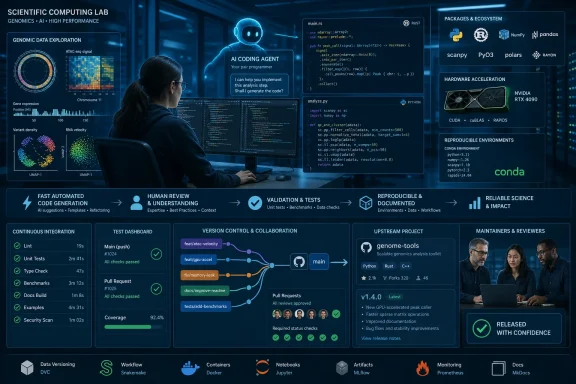 Agents Move Researchers Toward Review and Verification
The case studies suggest that agents are particularly useful when a team can define a narrow task and a concrete pass condition. That might mean matching an existing tool’s output exactly, reproducing known statistical behavior, passing simulated-data checks, or retaining compatibility with an established test suite.
OpenAI cites work on cyvcf2, a Python library for genomic variant files, where GPT-5.5 reportedly replaced legacy build and packaging processes with a unified modern workflow intended to improve installation, testing, and releases. That sort of work may sound mundane, but it is the difference between a library that can be installed reliably in a fresh environment and one that consumes a lab’s afternoon in dependency troubleshooting.
The report’s central caution is equally important: agents may produce plausible-looking code and confidently miss scientific or numerical requirements. The human role therefore shifts from writing every line to designing acceptance tests, reviewing results, identifying edge cases, and deciding whether the implementation is ready for real users.
The Last Mile Still Belongs to the Maintainer
OpenAI found that successful projects did not proceed as single prompts followed by a release. Teams divided larger goals into small, feedback-driven changes, then used benchmarks and intermediate validation to correct errors. Initial implementations often arrived quickly; matching edge cases and subtle numerical behavior took substantially longer.
That pattern should resonate with Windows IT professionals already managing developer workstations, CI systems, Python environments, containers, and GPU stacks. Coding agents can accelerate a rewrite, but they do not automatically establish a dependable build matrix across Windows 11, Windows Server, WSL, CUDA versions, compiler toolchains, or package channels.
For organizations considering agent-assisted modernization, the safest adoption model is to treat generated code as a fast-moving contributor rather than a trusted release engineer:
- Use version control, code review, reproducible environments, and CI before expanding agent use.
- Define measurable regression tests before asking an agent to optimize or port a scientific workflow.
- Preserve upstream compatibility where possible instead of creating another isolated fork.
- Assign an owner for releases, security fixes, documentation, and user support.
Lower Engineering Costs Can Also Multiply Abandoned Forks
The report does not frame cheaper implementation as an unqualified win. If agents make it easy to produce multiple rewrites of the same tool, they can also divide contributors and dilute the limited expert attention needed to maintain software over years.
OpenAI points to different stewardship outcomes in its examples: changes to MHCflurry and cyvcf2 went back into their upstream projects, while rustar-aligner moved into new community stewardship after its original project was abandoned. The distinction matters more than the programming language or the model used to generate code.
Scientific software gains value from user trust, compatibility knowledge, and long-term responsibility—not merely from a newer codebase. Agentic AI may make modernization cheaper, but it makes governance, validation, and upstream coordination more important, not less.
Update: Additional details (August 1, 2026)
The Decoder reports that RustQC reduced a large quality-control workload from 15 hours 34 minutes to 14 minutes 54 seconds by consolidating 15 tools, while GPU-native HelixForge completed a genomic-data pipeline 59.6 times faster than BamSurgeon; its main compute stage was 98.6 times faster. The report also says rustar-aligner matched STAR’s results on 99.815 percent of 10,000 single-end yeast reads and 99.883 percent of paired-end reads.
Additional validation examples underline the article’s caution: an early Rust rewrite of bayesm reportedly contained a reversed control parameter and calculation errors despite plausible outputs, which were caught only through calibration against thousands of synthetic datasets. The Decoder also reports that hifiasm optimization cut runtime on real human-genome data by nearly 15 percent, while HI.SIM optimizations reduced runtime by about 31 percent without changing output.
