
Kurdistan24, citing Reuters reporting published August 14, says Washington is preparing to warn countries in its AI partnerships against joining Chinese-backed initiatives. That warning would raise the stakes for governments signing AI cooperation agreements, particularly where those agreements affect semiconductor sourcing, data-center investment, cloud capacity and national AI programs. Yet the clearest practical conclusion for IT decision-makers is narrower than the article’s “pick a side” framing: this contest is about who controls the supply chain and standards around AI deployment, not a new rule requiring organizations to replace their existing cloud, model or hardware stacks overnight.
The distinction matters because enterprises already buy from a mixed market. A company may run Azure-hosted workloads, use Nvidia accelerators manufactured through globally distributed supply chains, procure network equipment from another country, and deploy an open-weight model trained or maintained outside the United States. Government diplomacy can make those combinations more costly, less available or more politically sensitive over time. It does not, by itself, make every mixed deployment prohibited.
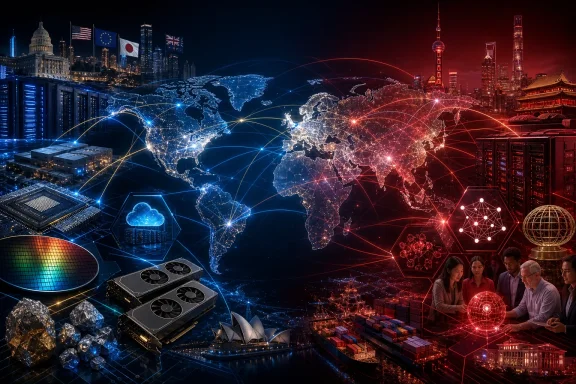 Pax Silica Has Moved Beyond a Small Technology Club
Pax Silica began as a U.S.-led effort to secure the inputs needed for AI: advanced semiconductors, critical minerals, manufacturing capacity, data centers and associated infrastructure. The initiative is not principally an alliance for choosing a chatbot. It is a strategic supply-chain project aimed at making partner countries less dependent on technology and materials that Washington considers exposed to Chinese leverage.
The latest State Department summary of the 2026 Pax Silica summit lists 24 formal signatories, including the United States, Japan, South Korea, the United Kingdom, Australia, India, Israel, Singapore, the United Arab Emirates, the Netherlands, Germany and Kazakhstan. Separately, an AI Opportunity Statement associated with the summit has attracted 35 countries and the European Union.
That is a more consequential footprint than the roughly two dozen participants described in Kurdistan24’s account. It also explains why the initiative matters to enterprise technology readers. Countries joining Pax Silica are not merely issuing political statements; many have assets central to the AI buildout. Japan and South Korea are critical electronics and memory producers. The Netherlands is home to ASML, whose lithography systems sit at the center of advanced chip manufacturing. Australia, Chile and other partners bring mineral resources into the calculation. The United States brings leading cloud providers, chip designers, AI software vendors and capital.
For Windows and enterprise administrators, Pax Silica is not a product release or a policy switch in the Microsoft 365 admin center. Its effect is more structural. It could shape the conditions under which future capacity is built: where GPU clusters are financed, which suppliers qualify for public projects, how equipment export controls are enforced, and whether a government customer asks vendors to demonstrate the origin and security of their AI infrastructure.
The U.S. government has already put operational weight behind that direction. A Pax Silica AI Assistance Project posted through the federal grants system describes plans for a trusted supply-chain credentialing and provenance platform for partner economies. In plain terms, Washington is exploring ways to document where AI-related components and services came from and whether they fit a preferred network of suppliers. That could become relevant to procurement requirements long before it becomes visible to ordinary commercial buyers.
China’s WAICO Offers a Different Kind of Membership
China’s World Artificial Intelligence Cooperation Organization, commonly called WAICO, was formally established in Shanghai on July 16. Chinese government statements say 29 countries signed the founding agreement, making it an intergovernmental body headquartered in Shanghai. Kazakhstan, Pakistan, Russia, Indonesia and Laos were among the founding participants.
WAICO does not mirror Pax Silica line for line. Pax Silica is built around supply-chain security, investment and access to what the United States calls trusted AI technology. China’s organization is presented as a forum for international AI cooperation and global governance, with messaging centered on broader access, capacity building and equitable participation.
Those are competing political offers, but their memberships and purposes show why calling them mutually exclusive is premature. A country can support standards discussions, training programs or AI governance principles under a Chinese-led organization while also pursuing secure hardware supply chains, Western investment and cloud partnerships through Pax Silica. Kazakhstan is the most visible example: it joined the U.S.-led initiative and then became a WAICO founding member.
That overlap is the most important fact missing from the simple “choose a side” narrative. Kazakhstan may be an exception rather than a durable model, especially if U.S. pressure hardens. But its participation in both groups demonstrates that the frameworks have not yet become a binary technical blockade. The contest is real; full exclusivity is not established.
China is also pitching its approach at a moment when lower-cost Chinese models, open-weight releases and domestic hardware alternatives appeal to countries that cannot easily afford frontier U.S. cloud services or the newest American-designed accelerators. Washington’s pitch, by contrast, rests heavily on trusted supply chains, leading-edge compute and private-sector investment. For many governments, the short-term attraction lies in keeping access to both rather than making a permanent geopolitical choice.
The Pressure Point Is the AI Stack, Not One Application
The meaningful risk is that governments could increasingly treat the AI stack as a national-security procurement category. That stack includes chips, server systems, cloud platforms, energy supply, data-center construction, networking, models, developer tools, datasets and security controls. Once those components are evaluated as a package, an organization’s supplier decisions become harder to isolate.
A public-sector buyer may soon ask whether an AI system uses restricted accelerators, whether its inference service runs in an approved jurisdiction, whether its training data can be governed locally, and whether the supplier can prove the provenance of critical hardware. Organizations bidding for government work in Pax Silica partner countries should expect those questions earlier than purely commercial customers.
The immediate implication is not that a Windows fleet, an Azure tenant or a line-of-business application suddenly becomes noncompliant because it contains a Chinese-made component. No new cross-border compliance regime was announced with Kurdistan24’s report, and neither Pax Silica nor WAICO has published a universal technical rule that forces member states’ private companies to abandon the other group’s technologies.
But the direction of travel is visible. Export controls already determine which advanced computing products can reach particular markets. National-security reviews can affect cloud deals, undersea cables, telecommunications equipment and critical-infrastructure bids. Procurement standards can turn an informal preference into an effective market barrier. AI is joining that list because high-end model development and deployment are dependent on concentrated supplies of compute, power and specialized equipment.
For enterprise IT leaders, the policy risk is therefore less about today’s model selection than tomorrow’s procurement lock-in. A provider that appears globally available now may face regional service limits, restricted hardware capacity or compliance costs later if its supply chain falls outside a customer’s approved technology sphere.
Administrators Should Start Mapping Dependencies Before Contracts Force the Issue
The sensible response is inventory, not panic. Organizations operating AI workloads should know which parts of their environment are dependent on particular cloud regions, chip vendors, model providers, data-processing locations and managed-service subcontractors. Most companies have not mapped those dependencies to the degree that a national-security-sensitive contract could require.
A practical review should establish whether the organization can answer several basic questions:
- The organization should identify where its production and development AI workloads run, including cloud regions, colocation facilities and managed inference endpoints.
- It should document the providers behind its models, vector databases, orchestration layers and GPU capacity rather than treating “the cloud” as a single vendor relationship.
- It should review public-sector, regulated-industry and critical-infrastructure contracts for language on trusted suppliers, export controls, locality requirements and component provenance.
- It should assess whether critical AI workflows can move between regions or providers if capacity, licensing or regulatory conditions change.
- It should distinguish genuinely sensitive workloads from experimentation, because the first category is more likely to face procurement and security scrutiny.
This work is especially relevant to organizations that are adopting AI through multiple paths at once: a hosted assistant for productivity, a cloud AI platform for application development, third-party SaaS tools with embedded models, and locally run open-weight models for specialized data. A mixed approach can reduce dependence on one vendor, but it also makes provenance and policy review more difficult.
The strongest mitigation is not an ideological commitment to one country’s technology. It is contractual and technical portability: clear data-export terms, documented interfaces, tested backup providers, auditable logging and a realistic understanding of where the organization’s compute actually comes from.
Governments Are Competing to Set the Default Rules
The deeper issue is that Pax Silica and WAICO are trying to influence what “responsible” international AI deployment will mean. Washington’s model emphasizes secure and trusted supply chains, allied investment and access to advanced infrastructure. Beijing’s model emphasizes global governance, access and cooperation under a body it hosts and influences.
Neither framework, as currently documented, resolves the operational questions that matter most to IT teams: which models can be used with regulated data, how audits will be conducted, whether national laws will apply to cloud inference across borders, and how equipment restrictions will affect availability or cost. Those questions will be answered through domestic laws, procurement conditions, export rules and commercial contracts—not summit declarations alone.
Kurdistan24 is right that AI competition now reaches far beyond model benchmarks. The missing qualification is that countries are still attempting to preserve room to maneuver, and the organizations they are joining do not yet impose a universal technological divorce. The pressure will first show up in strategic hardware, publicly financed data centers and government procurement. Enterprises that map their AI dependencies now will have more options when that diplomatic competition reaches their next infrastructure contract.
