

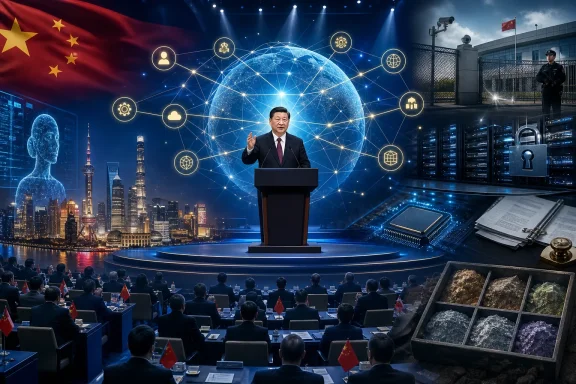
At the World Artificial Intelligence Conference in Shanghai on July 17, Xi Jinping called for countries to encourage open source, openness, collaboration and sharing. He also framed unequal access to AI as a risk of “new historical injustices,” pledged capacity-building support for developing countries, and promoted the China-backed World Artificial Intelligence Cooperation Organization, or WAICO. Reuters reported the speech as Beijing’s most explicit attempt yet to cast itself as an alternative center of AI governance to the United States.
The practical message is more limited than the slogan. China is advocating wider access to AI systems and a larger international role in writing AI rules; it is not offering an unconditional technological commons. Its own WAIC documents preserve intellectual-property protections, enterprise choice, national sovereignty and security controls. Those qualifications do not invalidate the initiative, but they do show that “open” is being used as a policy direction rather than a binding promise to release frontier technology.
For Windows administrators and enterprise AI teams, the result is straightforward: treat China’s open-model push as a potentially valuable supply of lower-cost models and tooling, not as a guarantee of durable access, transparent provenance, or freedom from geopolitical restrictions.
What Xi Jinping Actually Proposed at WAIC 2026
Xi’s speech did not announce that Chinese frontier models would be released under open-source licenses. The official text calls for countries to “encourage open source, openness, collaboration and sharing,” language that supports an open-source ecosystem without specifying which models, weights, datasets, training code, evaluation results, or inference services would be made public.
That ambiguity matters. In AI, “open source” can mean source code is published under a license that permits inspection and modification. It can also be used more loosely to describe open-weight models, where downloadable model parameters are available but the training dataset, complete codebase, model architecture details, and commercial-use rights remain limited or unavailable. A government call to “encourage” openness is a third and still broader category: it creates no obligation for any particular company to publish any particular asset.
The Chair’s Statement from the July 17–20 WAIC conference makes the boundaries clearer. It supports joint development of open-source ecosystems and international communities, but says research results and technical experience should be shared “on the basis of sound intellectual property protection” and with respect for companies’ independent choices. That is conventional language for a managed technology-sharing framework, not a commitment to compel or even guarantee disclosure.
China’s 2025 Global AI Governance Action Plan is more specific in its aspirations. It calls for cross-border open-source communities, secure and reliable platforms, shared basic resources, compliance systems, and security guidelines. Yet its focus is access, interoperability, standards, and application capacity. The plan does not say China will stop treating leading models, high-end accelerators, sensitive data, AI agents, cloud infrastructure, or technical personnel as assets subject to state policy.
The important reporting point is that there is no contradiction hidden in the fine print: Beijing’s stated policy is open cooperation under sovereign and security constraints. The Vision Times commentary is right to challenge any reading of the initiative as pure technological altruism. It overstates the case, however, if it suggests China formally promised unrestricted access and then immediately broke that promise. China did not make the unrestricted promise in the first place.
The Manus Case Shows Where Beijing Draws the Line
The Meta-Manus transaction offers a far more concrete measure of Beijing’s priorities than summit language. China’s National Development and Reform Commission said on April 27 that it had prohibited the foreign acquisition of the Manus project and required the parties to cancel the deal under its foreign-investment security review process.
Manus, an AI-agent company founded by Chinese engineers and later based in Singapore, had been acquired by Meta for roughly $2 billion late in 2025. Bloomberg, Reuters, the Associated Press, The Washington Post, and TechCrunch all reported the later Chinese intervention, while Meta said the original transaction complied with applicable law. The NDRC’s public decision did not publish a detailed account of the security concerns that caused the deal to be blocked.
That omission is significant. Chinese authorities did not publicly identify the exact code, datasets, models, customer information, personnel arrangements, or intellectual property that would have created a national-security problem. The public record establishes the action — a foreign acquisition of a strategically sensitive AI company was ordered unwound — but does not establish a detailed technical rationale.
The transaction therefore delivers a blunt operational signal. China can support international AI collaboration and still intervene when it believes a foreign acquisition would transfer AI capability, intellectual property, or high-value talent outside its effective control. Those positions are compatible under China’s policy framework, even if they will look selective to companies expecting “open” to mean free movement of capital and technology.
This is also why WAICO should not be mistaken for a technology-transfer treaty. It is an institution-building project aimed at governance influence, capacity building, standards, and relationships with countries seeking accessible AI systems. It is not a mechanism that neutralizes China’s foreign-investment screening, data rules, export controls, or domestic security requirements.
Export Controls Make the Broader Argument Harder to Dismiss
The Vision Times article points to rare-earth and critical-mineral controls as evidence of a double standard. The central factual claim holds up, though the details need more care than the commentary gives them.
China has imposed controls on strategically important materials in several stages. Gallium and germanium faced export licensing rules in 2023. China later restricted certain graphite exports, acted against antimony-related exports, and in April 2025 placed seven categories of medium and heavy rare-earth-related items under export controls. China’s Ministry of Commerce justified the rare-earth measures on national-security, national-interest and nonproliferation grounds. The U.S. Geological Survey’s 2026 mineral report continues to list China’s export controls across several important technology inputs.
The broad point is not that China alone uses export restrictions. The United States has applied wide-ranging controls to advanced semiconductors, chipmaking equipment, and services linked to Chinese advanced-computing and AI development. Both governments now treat technology supply chains as national-security instruments. The U.S. restricts access upstream, especially at the advanced-compute layer; China has demonstrated leverage downstream in selected minerals, processing technologies, and domestic AI assets.
That makes Beijing’s WAIC argument politically potent in the Global South, where costly closed AI services and restricted access to high-end U.S. hardware are immediate constraints. It also makes the rhetoric incomplete. A country cannot credibly describe the global AI future as frictionless when its own policy reserves the right to restrict the ingredients, intellectual property and businesses it considers strategic.
The better conclusion is not that China’s position is uniquely hypocritical. It is that the world is entering an era of conditional openness. Every major AI power is championing openness where it has an interest in wider adoption, market access, standards influence, or reduced dependence on a rival. Every major AI power also maintains a security exception broad enough to protect technology it considers consequential.
“Open” Models Still Carry Enterprise Risk
For IT professionals, the geopolitical dispute becomes concrete at procurement and deployment time. Chinese model families may offer compelling capabilities, lower inference costs, on-premises deployment, and freedom from the recurring costs of proprietary U.S. model APIs. Those are genuine advantages, particularly for organizations that need local inference, controlled latency, specialized language coverage, or the ability to tune a model inside their own environment.
But a downloadable model does not remove supply-chain questions. Teams evaluating any open-weight or purportedly open-source model should establish whether they can verify the license, model origin, training-data disclosures, dependency chain, update path, security reporting channel, and legal terms for commercial use. They should also ask what happens if an upstream repository disappears, a model provider changes terms, sanctions or export restrictions affect support, or a future version is withheld.
The WAIC language offers no answer to those operational questions. It does not promise that a Chinese vendor’s model weights will remain available in every jurisdiction, that cloud endpoints will remain accessible, or that corporate acquisitions and cross-border transfers will be treated as ordinary commercial matters. The Manus order suggests the opposite: AI capability may be governed as a strategic asset even when the company involved has restructured overseas.
Windows-focused organizations should apply the same discipline they would use for any new AI dependency. Keep reproducible local copies of approved artifacts where licensing allows, scan models and related packages before deployment, isolate inference workloads, document model versions and hashes, and avoid designing critical workflows around a single vendor’s public endpoint. An open model reduces some forms of vendor lock-in; it does not eliminate jurisdictional, licensing, security, or maintenance risk.
China’s AI initiative is therefore best read as an offer of a different route into the global AI market: more affordable systems, open-source-oriented development, capacity-building help, and a governance forum less centered on U.S. technology firms. It is not an offer to dissolve the strategic controls Beijing uses when AI, data, talent, minerals, or intellectual property are at stake.
The immediate consequence is that enterprises will have more Chinese AI options to evaluate, while the policy environment around those options remains decidedly non-open.