
Morgan Stanley says China’s AI sector is becoming less exposed to global semiconductor swings because domestic demand and a growing local technology supply chain are reshaping where growth comes from. In a CNBC interview published July 29, Laura Wang, Morgan Stanley’s chief China equity strategist, described tech localization as a structural force that could let Chinese AI companies expand even when overseas chip markets and trade policy remain volatile.
The argument matters beyond equity-market positioning. For Windows IT professionals tracking AI infrastructure, it points to a more fragmented market for accelerators, servers, models and enterprise software: one ecosystem increasingly built around Chinese hardware and domestic deployments, rather than the same Nvidia-led supply chain serving North America and Europe.
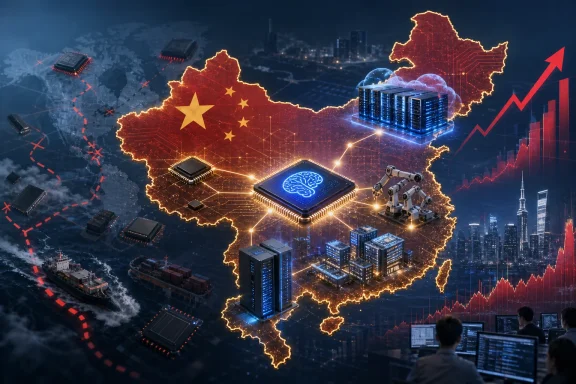
Wang’s central claim is not that China has eliminated its reliance on imported advanced semiconductors. Rather, localized demand—from consumer applications, cloud services, industrial automation and government-backed digital projects—is creating a runway for domestic AI suppliers even amid constraints on access to leading foreign accelerators.
Morgan Stanley has previously argued that Chinese AI development is prioritizing lower-cost, efficient deployment over a race to build only the largest frontier models. That approach favors optimized models, domestic cloud capacity, locally sourced systems and practical applications in manufacturing, robotics and consumer services.
The result is a different risk profile. A disruption in global chip supply, or another change in export restrictions, can still affect performance and availability. But a large domestic market gives Chinese vendors a base of demand that may cushion the impact more effectively than firms reliant on international component flows or overseas cloud customers.
Recent reporting from the South China Morning Post similarly noted that AI data-center suppliers and battery makers have risen in the CSI 300’s weighting structure, displacing former market bellwethers. The change makes China’s flagship mainland equity gauge more sensitive to AI capital spending, semiconductor localization and technology-policy signals.
For investors, that concentration creates opportunity but also a clear caveat: a domestic AI boom does not make the sector immune to volatility. It may simply change the source of that volatility—from global chip availability to Chinese demand, policy support, local competition and the ability of domestic vendors to turn deployment into durable earnings.
That has practical implications for organizations operating across China and Western markets:
The argument matters beyond equity-market positioning. For Windows IT professionals tracking AI infrastructure, it points to a more fragmented market for accelerators, servers, models and enterprise software: one ecosystem increasingly built around Chinese hardware and domestic deployments, rather than the same Nvidia-led supply chain serving North America and Europe.
China’s AI Trade Is Moving From Chips to Deployment
Wang’s central claim is not that China has eliminated its reliance on imported advanced semiconductors. Rather, localized demand—from consumer applications, cloud services, industrial automation and government-backed digital projects—is creating a runway for domestic AI suppliers even amid constraints on access to leading foreign accelerators.Morgan Stanley has previously argued that Chinese AI development is prioritizing lower-cost, efficient deployment over a race to build only the largest frontier models. That approach favors optimized models, domestic cloud capacity, locally sourced systems and practical applications in manufacturing, robotics and consumer services.
The result is a different risk profile. A disruption in global chip supply, or another change in export restrictions, can still affect performance and availability. But a large domestic market gives Chinese vendors a base of demand that may cushion the impact more effectively than firms reliant on international component flows or overseas cloud customers.
The CSI 300 Is Becoming a Tech Concentration Story
CNBC reported Wang’s observation that AI- and technology-related companies now represent roughly 40% of the CSI 300, the benchmark index for major Shanghai and Shenzhen-listed firms. That is a notable shift for an index long associated with banks, consumer staples, industrials and other established sectors.Recent reporting from the South China Morning Post similarly noted that AI data-center suppliers and battery makers have risen in the CSI 300’s weighting structure, displacing former market bellwethers. The change makes China’s flagship mainland equity gauge more sensitive to AI capital spending, semiconductor localization and technology-policy signals.
For investors, that concentration creates opportunity but also a clear caveat: a domestic AI boom does not make the sector immune to volatility. It may simply change the source of that volatility—from global chip availability to Chinese demand, policy support, local competition and the ability of domestic vendors to turn deployment into durable earnings.
Why It Matters to the Windows Ecosystem
China’s localization push is unlikely to replace the Windows-PC, x86 server and Western cloud stack overnight. But it reinforces a split that enterprise technology teams already see in procurement and product planning: AI workloads are becoming more regional, and the hardware-software combinations supporting them may diverge.That has practical implications for organizations operating across China and Western markets:
- AI deployment plans may need to account for different accelerator availability, cloud platforms and model providers by region.
- Windows endpoint fleets and developer tooling could face different integration requirements where local AI services, compliance rules and infrastructure are mandatory.
- Vendors selling AI-enabled PCs, servers or management platforms will increasingly need to support a market where domestic Chinese components and software are not edge cases, but core requirements.
References
- Primary source: CNBC
Published: 2026-07-29T06:56:30+00:00
Localized demand shields China AI from global semiconductor volatility: Morgan Stanley
Morgan Stanley's Laura Wang says China’s AI sector is outperforming global peers as "tech localization" and domestic self-sufficiency create a growth trajectory independent of global volatility. This structural shift is evidenced by the CSI 300, where AI and tech-related...www.cnbc.com - Related coverage: uk.investing.com
Morgan Stanley sees China Apple Intelligence approval as key AI catalyst By Investing.com
Morgan Stanley sees China Apple Intelligence approval as key AI catalystuk.investing.com - Related coverage: briefs.co
Morgan Stanley Raises China CSI 300 Target to 5,400
Morgan Stanley lifted its CSI 300 target to 5,400 for Q2 2027, citing a shrinking earnings-miss gap and a capex cycle spreading past tech into robotics, batteries, and AI.www.briefs.co
- Related coverage: theagenttimes.com
China's AI Chip Self-Sufficiency Doubles to 41%, Morgan Stanley Data…
China's domestic AI chip supply will have reached approximately 41% of demand in 2026, doubling from 20% in 2023, according to Morgan Stanley data cited by Exponential View founder Azeem Azhar —…theagenttimes.com - Related coverage: investing.com
The Boom Daily: China Pushes AI, Europe Holds Firm, Morgan Stanley Backs Gamma | Investing.com
Market Analysis by covering: . Read 's Market Analysis on Investing.comwww.investing.com - Related coverage: wealthbriefingasia.com
US Investors Are Starting To Love Chinese Equities – Morgan Stanley
WealthBriefingAsia - Exclusive Asian Wealth Management and Private Banking Intelligence
wealthbriefingasia.com