
That is a meaningful advantage in the next phase of the AI race. It does not establish Chinese superiority in frontier model training, and it certainly does not mean that every Chinese citizen is insulated from job displacement or the costs of rapid automation. It does mean the competition is moving beyond chatbot benchmarks and GPU counts toward the slower, less glamorous work of putting AI into factories, schools, public services, devices, and regulated consumer products.
The past two weeks supplied unusually clear evidence. Moonshot AI released the weights for Kimi K3, a 2.8-trillion-parameter mixture-of-experts model with 104 billion parameters activated per request. Meanwhile, ChangXin Memory Technologies, better known as CXMT, surged 466 percent in its July 27 Shanghai debut after raising $8.6 billion. Those headlines arrived after the DeepSeek-driven Nvidia selloff on January 27, 2025, when Nvidia shed roughly $593 billion in market value in one trading day.
But the important story is not that China has produced another model or another heavily valued chip company. It is that Beijing has structured the surrounding machinery to make AI a national industrial capability.
 China’s robot lead is real, but industrial robots are not humanoids
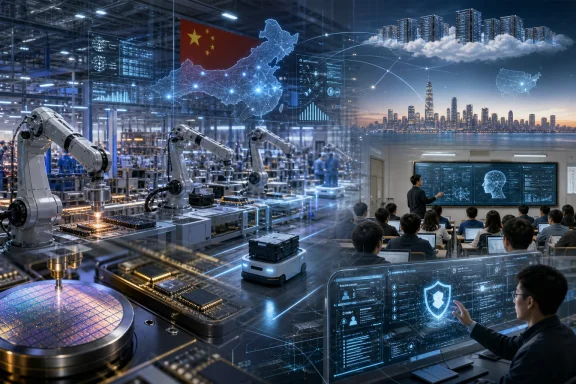
The strongest part of the case is physical automation. The International Federation of Robotics reports that China installed 295,000 industrial robots in 2024, or 54 percent of worldwide deployments, and its operational stock passed two million units. The United States installed 34,200 industrial robots that year, according to the same data.
Those are not humanoid robots strolling through offices or replacing general-purpose workers. They are mostly fixed industrial machines in electronics, automotive and manufacturing lines. Treating China’s factory-robot count as proof that it has already won the humanoid-robotics race would be a category error.
Still, the distinction does not weaken the strategic significance. A country with two million deployed industrial robots has manufacturers, systems integrators, maintenance technicians, component suppliers, machine-vision vendors and customers accustomed to redesigning production around automated equipment. That operating base matters when AI becomes useful at the edge: visual inspection, warehouse movement, predictive maintenance, process control, robotic picking and increasingly capable machine tools.
The International Federation of Robotics also found that Chinese manufacturers overtook foreign suppliers in their home market for the first time in 2024, reaching 57 percent domestic share. That is the number to watch. Deployment volume alone can be purchased; a domestic vendor base is harder to build and is more resilient when geopolitics restricts imports.
Washington’s response shows that policymakers see the physical-AI issue as more than a future concern. The Federal Communications Commission last week barred imports of new foreign-made advanced robots, including humanoid and quadruped systems, on national-security grounds. The action is aimed principally at Chinese vendors, though its scope is wider than China. It may reduce exposure to connected foreign hardware, but it also gives US developers and research institutions fewer low-cost platforms on which to build and test.
For Windows administrators and enterprise IT teams, the immediate lesson is practical. AI procurement is widening from cloud APIs and Copilot licenses into cameras, sensor networks, industrial PCs, managed edge devices and robotic fleets. The security model cannot end at identity and endpoints when the endpoint can perceive a workspace and act within it.
The university figures show control, not a finished workforce solution
The Independent correctly cited China’s Ministry of Education: in the 2024 cycle, universities added 1,839 undergraduate programs, suspended enrollment in 2,220 and cancelled 1,428, across a catalogue of 62,800 programs. The ministry highlighted programs in AI applications, integrated circuits, the digital economy, biotechnology and new-energy fields.
The crucial finding is not that all of those new courses are AI degrees. They are not. Nor does a new course guarantee an instructor pipeline, lab capacity, employer demand, or graduates with skills that survive a fast-changing model market.
What the figures demonstrate is Beijing’s ability to use higher education as industrial policy. A US university system divided across states, private institutions, accreditation bodies and independent faculties cannot pause or reclassify thousands of programs through a single ministry announcement. That decentralization has benefits — academic freedom and institutional diversity among them — but it is less suited to rapid national reprioritization.
China has since expanded the approach. Its five-agency AI-plus-education action plan, released in April, calls for AI literacy across schooling and lifelong learning while pushing vocational education to integrate AI with traditional industry training. In parallel, Beijing’s AI-plus strategy directs application of the technology across manufacturing, public services and other designated sectors.
This is a form of preparedness the West often misses because it does not look like a model launch. The state is attempting to align curricula, labor supply and application demand before the economic transition is complete. Whether it can avoid creating graduates trained for yesterday’s subsidized priority is an open question, but the coordination exists.
For US and European employers, that translates into a tougher talent contest in operational fields: industrial AI, robotics integration, chip packaging, embedded inference and technical education. The most important workforce gap may not be the number of researchers able to train a frontier model. It may be the shortage of people able to deploy, monitor and repair AI-enabled systems at scale.
China’s companion-AI rules combine safety measures with state control
China’s new rules for anthropomorphic AI interactive services took effect on July 15. They are far more concrete than a broad promise to develop AI responsibly. Providers of ongoing emotional-interaction services must tell users they are interacting with AI rather than a person; flag excessive use; issue a reminder after every two hours of continuous use; provide a way to exit; and avoid systems designed to foster emotional dependency or replace real relationships.
The rules also require intervention when a user appears to face an extreme risk, including explicit self-harm or suicide intentions, and require providers to contact a guardian or emergency contact in serious cases. Virtual relatives and virtual partners are prohibited for minors. Services with at least one million registered users or 100,000 monthly active users face a safety-assessment requirement.
These are real consumer protections, particularly compared with the largely reactive US approach to companion-chatbot risks. The European Union is moving toward transparency obligations for certain chatbot interactions, while several US states have proposed or enacted narrower disclosure and safety requirements. China has adopted a national operational rulebook first.
But it is inaccurate to present this solely as a benevolent mental-health program. The official regulation places emotional safety alongside national security, public interest, content controls, algorithm filing, log retention and formal oversight by cyberspace, public-security, market and industrial authorities. It prohibits self-harm encouragement and emotional manipulation; it also prohibits a broad range of politically prohibited content.
That dual nature is the point. China’s system can impose safety controls quickly because the same machinery that regulates social stability and speech can regulate product behavior. Developers gain clarity about requirements, but users accept a service designed to be observable, governable and aligned with state priorities.
The practical consequence for Western AI companies is uncomfortable but clear. Companion AI will not remain a lightly moderated product category. Requirements for disclosure, age assurance, dependency detection, escalation protocols, data controls and audit trails are beginning to solidify. Companies that treat emotional attachment as an engagement metric are building a compliance problem into their business model.
CXMT’s IPO signals resilience, not memory-chip parity
CXMT’s market debut is a powerful symbol of China’s drive for semiconductor self-sufficiency. Reuters and the Associated Press reported that the company raised 57.92 billion yuan, about $8.6 billion, and closed its first trading day at 49 yuan, compared with an IPO price of 8.66 yuan. Its roughly $487 billion valuation made it the largest company on mainland Chinese exchanges by market capitalization.
That valuation should not be confused with technological equivalence to Samsung, SK hynix, Micron or Nvidia. CXMT is a DRAM manufacturer, not a GPU designer. According to Counterpoint Research figures reported by the Associated Press, CXMT held about 9 percent of global DRAM shipments in the first quarter of 2026, while Samsung, SK hynix and Micron remained substantially larger. It is also not yet producing the high-bandwidth memory at the scale needed for leading AI training clusters.
That gap matters. HBM is the memory class tightly coupled to the most capable AI accelerators, and access to advanced manufacturing tools remains a serious constraint on Chinese suppliers. A high IPO valuation does not make those bottlenecks disappear.
Yet dismissing CXMT for not matching the market leaders would miss the larger change. China is building alternatives across ordinary DRAM, server memory, packaging, equipment, models and deployment. Each successful substitution reduces the coercive power of export controls, even if it does not produce immediate parity at the leading edge. Resilience is not the same thing as dominance, but it is enough to change the strategic balance.
Moonshot’s Kimi K3 illustrates the software side of the same strategy. Its published technical report acknowledges that K3 trails the strongest proprietary US models overall, even while it claims strong results against other models in the evaluation suite. The material fact is that the weights are available for others to adapt and host. Chinese companies are making a bet that widespread local deployment and adaptation can matter as much as monopoly access to the very best closed model.
China’s advantage, then, is not a clean sweep across models, chips and robots. It is a state-backed ability to make progress in one layer useful to another: workforce policy feeds factory automation; factory demand feeds domestic robotics; chip policy supports local infrastructure; and AI rules shape consumer deployment. The United States still retains decisive strengths in advanced accelerators, cloud capacity, research institutions and leading proprietary models. But it is increasingly competing against a system designed to make AI usable under pressure, not merely impressive in a demo.
